Project Management

Your team is spread across time zones, switching between laptops and phones throughout the day. Someone approves a task on their iPhone during a commute. Another teammate leaves a comment from their Android tablet between meetings. By the time everyone syncs up, half the updates are buried in email threads or personal WhatsApp groups — and nobody has a clear picture of where things stand.
This is the quiet friction that slows teams down. It is not a dramatic breakdown. It is the steady accumulation of missed notifications, inconsistent experiences across devices, and apps that work beautifully on desktop but feel clunky the moment you open them on a phone. For teams managing work across Android and iOS, the mobile app experience is not a secondary concern — it is central to how work actually gets done.
As mobile-first work becomes the norm rather than the exception, the tools your team relies on need to hold up on every screen. And if they do not, the cost shows up in delayed decisions, lost context, and teams reverting back to the very habits — scattered messages, long email chains — that productivity tools were supposed to replace.
Mobile Work Is No Longer Optional
The shift to mobile work has been accelerating for years, but 2026 has made it undeniable. According to Statista, mobile devices now account for more than 60% of global web traffic, and enterprise app usage on smartphones has followed a similar trajectory. Teams are not just checking messages on their phones — they are reviewing project updates, assigning tasks, approving deliverables, and making real decisions from their mobile screens.
For managers leading hybrid or remote teams, this creates a genuine challenge. If your work management tool delivers a degraded experience on mobile, you are effectively cutting off a large portion of your team's working hours. A field operations lead, a sales manager traveling between client sites, or a team member working across different time zones — these people are not always at a desk, and their ability to stay connected should not depend on whether they happen to have a laptop open.
The Android vs. iOS Gap Teams Often Ignore
Here is something most teams do not think about until it causes a problem: Android and iOS are genuinely different environments, and not every work tool handles that gap well. Apps that are built primarily for one platform — or that treat mobile as an afterthought — tend to behave inconsistently across operating systems. Notifications arrive late on one device. Attachments do not preview correctly on another. A task status someone updated on iOS does not reflect immediately for the Android user waiting on it.
These are not just technical inconveniences. They erode trust in the tool. When your team cannot rely on the app to behave predictably, they stop using it for anything important — and fall back on WhatsApp or email, which creates exactly the scattered, hard-to-track communication that team communication tools are designed to fix.
What a Consistent Cross-Platform Experience Actually Looks Like
A truly consistent cross-platform experience means more than the app being available on both stores. It means the core workflows — creating tasks, responding to updates, sharing files, checking in on team progress — feel natural and fast on any device. Here is what to look for when evaluating whether your current tool meets that standard:
Real-time sync across devices: An update made on Android should appear instantly on iOS and desktop, without requiring a manual refresh.
Reliable push notifications: Alerts for task assignments, mentions, and deadlines should arrive consistently, regardless of the operating system.
Touch-optimized navigation: Menus, buttons, and task flows designed for touch input — not just a shrunk-down version of the desktop interface.
Offline functionality: The ability to view tasks, leave comments, or review files even when connectivity is unreliable.
File handling that works: Uploading photos, documents, or voice notes from a mobile device should be seamless, not a frustrating workaround.
If your current tool struggles on any of these points, your team is quietly absorbing that friction every single day.
Why the Interface Familiarity Factor Matters
There is a reason WhatsApp has over two billion users. The interface is instantly familiar. Opening it requires no onboarding, no learning curve, no hesitation. This is the same reason teams default to personal messenger apps for work communication — even when they know it is not the right tool for the job. Familiarity wins over functionality, especially under pressure.
Gallup research consistently shows that friction in daily workflows is one of the leading contributors to disengagement at work. When tools feel complicated or unreliable, people disengage from them — and disengage from the work coordination they were supposed to support.
This is where the design philosophy behind a tool starts to matter as much as the feature list. A work management platform that looks and feels like something your team already uses on their phones will see much higher adoption — especially in non-technical teams where forcing a complex tool creates resistance from day one.
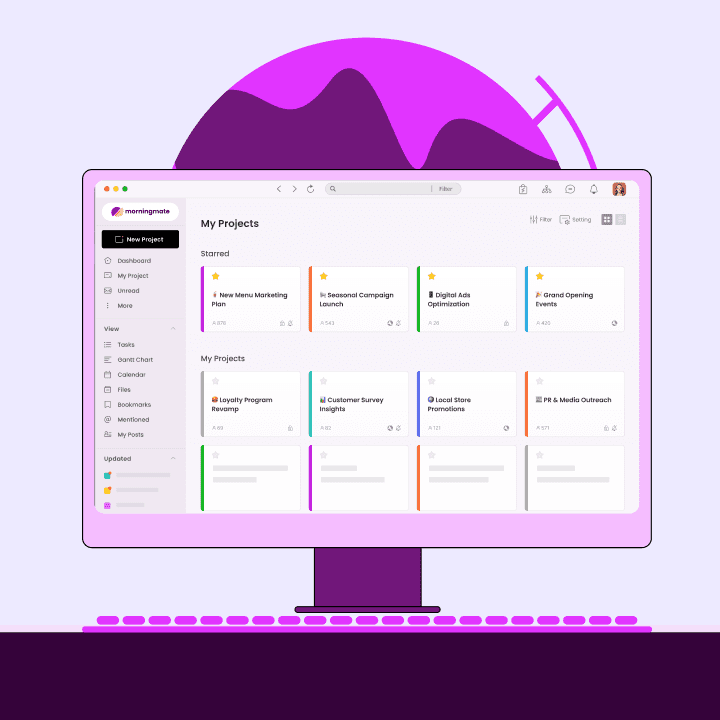
Morningmate, a lightweight work management tool used by over 550,000 teams, was built with this principle at its core. Its built-in chat interface mirrors the familiar look and feel of messaging apps your team already uses, while the Feed view organizes team updates in a format that feels as natural as scrolling a social feed. The result is a tool that non-technical team members actually open on their phones — because it does not feel like work to figure out how to use it.
Real Scenarios Where the Mobile Experience Makes or Breaks Team Coordination
It helps to think through concrete situations where mobile app quality directly affects team outcomes. These are not edge cases — they are the everyday moments where work either flows or stalls.
The Manager Traveling Between Sites
An operations lead at a logistics company spends most of their day moving between warehouse locations. They are rarely at a desk for more than an hour at a stretch. If their work management app is slow to load, drops them out of sessions, or makes it difficult to assign tasks on a phone screen, they lose the ability to keep their team unblocked in real time. A strong mobile experience means they can check task status, leave a voice note, and reassign a deadline in under two minutes — from a parking lot.
The Remote Team Spread Across Time Zones
For a remote team where members work across different continents, asynchronous communication is everything. When the team lead in London wraps up their day, they need to know the update they left will reach the team in Manila clearly — with the right context, attached to the right task, not buried in a chat thread. If the mobile app handles file attachments poorly or notification timing is unreliable, that handoff breaks down. Async communication only works when the tools support it properly on every device.
The Business Owner Who Needs a Quick Pulse Check
A founder or executive at a growing company does not want to log into a complex dashboard every time they want to know how a project is progressing. They want to open an app on their phone while waiting for a meeting to start and get an instant read on what is moving and what is stuck. If the mobile interface requires three taps to find that information — or worse, is missing key views available on desktop — they will stop checking. And then they stop having visibility.
What to Look For When Evaluating a Work App for Mobile Teams
If you are in the process of choosing or re-evaluating a work management tool for your team, mobile performance deserves a dedicated line on your checklist. Here is a practical framework for assessing whether a tool will actually hold up in daily mobile use:
Test it on both platforms before committing. Download the app on an Android device and an iPhone. Try creating a task, uploading a file, and leaving a comment. If anything feels awkward or broken, that friction will only grow at scale.
Check the notification reliability. Send yourself a test mention or task assignment and see how quickly it arrives on mobile. Delayed notifications are a silent killer for async teams.
Evaluate the onboarding experience on mobile. Can a new team member sign up and get started from their phone without needing a desktop walkthrough? If the answer is no, adoption will always lag.
Look at the interface design, not just the feature list. Features mean nothing if the interface is confusing on a small screen. Prioritize tools that feel intuitive at first touch.
Ask your least tech-savvy team member to try it. Their experience will tell you more about real-world adoption than any sales demo.
The Hidden Cost of a Poor Mobile Experience
Research from Harvard Business Review highlights that one of the biggest barriers to effective hybrid team management is inconsistent access to information across different working contexts. When some team members have full access to work tools and others are working with a degraded mobile experience, you create an uneven playing field — and coordination gaps that compound over time.
The hidden cost is not just the time lost in any single interaction. It is the pattern that forms when mobile users are consistently working with less visibility, slower responses, and fewer features than their desktop counterparts. Over weeks and months, that gap widens into a real organizational problem.
Morningmate addresses this directly by offering the same core experience — task creation, team chat, file sharing, and project feeds — across its mobile apps and desktop platform. Teams using it find that the feed-style interface translates naturally to mobile, so members who are primarily phone-based are not second-class users. For remote and hybrid teams managing work across devices, that parity matters.
Building a Mobile-Ready Work Culture
The right tool helps, but it only works if the team uses it consistently. Choosing a great cross-platform app is step one — but you also need to set some shared expectations around how work gets communicated and tracked on mobile.
A few habits that make mobile-first team collaboration more effective:
Set a team norm that all task updates happen inside the work tool — not in personal chat apps — so everyone has visibility regardless of device.
Use task comments for decisions and context, not just chat messages that disappear into a thread. This keeps information attached to the work itself.
Encourage brief async video or voice updates for complex topics, which are easy to record and share on mobile and reduce the need for scheduled meetings.
Make sure new team members set up mobile notifications during onboarding, not as an afterthought two weeks later.
None of these habits require a complex system. They just require a tool that makes them easy to follow through on — on any device, any operating system, any time zone.
The teams that manage work most effectively across Android and iOS are not the ones with the most sophisticated tools. They are the ones with tools that are actually used — consistently, by everyone, from whatever device they happen to be holding. That is a higher bar than it sounds, and it starts with taking the mobile app experience seriously.