Project Management

You started with a simple spreadsheet. A few columns, some color coding, maybe a shared Google Sheet the whole team could access. It worked fine — until it didn't. Now you've got seventeen tabs, conflicting versions, and a team that's stopped trusting the data because no one knows which row is actually current.
Spreadsheet-based task tracking is one of those habits that feels harmless until the cost quietly compounds. It's not a dramatic failure — it's a slow drain on your team's time, focus, and accountability. And for most teams, that drain is bigger than they realize.
This article breaks down the real cost of managing work through spreadsheets, the warning signs that you've outgrown them, and what a more practical setup actually looks like — without requiring you to overhaul everything overnight.
Why Spreadsheets Become a Problem as Teams Grow
Spreadsheets were built for data analysis, not team coordination. They're static by nature — they capture information at a point in time, but they don't reflect how work actually moves. Tasks don't live in rows. They have owners, deadlines, dependencies, comments, and status changes that happen in real time.
According to Harvard Business Review, knowledge workers spend a significant portion of their day just searching for information and coordinating with colleagues — time that should be going toward actual work. Spreadsheets make this worse by scattering context across files, inboxes, and chat threads.
When your team is small — say, two or three people — a shared sheet can genuinely work. But once you cross into double-digit headcount, or you're managing work across departments, the limitations hit fast and hit hard.
The Hidden Costs You're Probably Not Counting
The cost of spreadsheet-based task tracking isn't just the time spent updating rows. It shows up in ways that are harder to measure but very real in terms of business impact.
Version Confusion and Data Errors
Even with cloud-based tools like Google Sheets, teams run into version issues. Someone downloads a copy, edits it offline, and re-uploads it. Someone else updates a cell without notifying anyone. A study cited in Forbes found that roughly 88% of spreadsheets contain errors — a staggering figure when you consider that many teams are making decisions based on that data.
When your task tracker is unreliable, your team stops relying on it. People start keeping their own lists. Status updates live in someone's head or in a WhatsApp message that no one else can find later.
No Accountability Without Notifications
A spreadsheet doesn't know when a deadline has passed. It doesn't ping someone when a task is overdue. It doesn't remind a manager that a deliverable was supposed to be handed off yesterday. That responsibility falls entirely on humans — which means it often falls through the cracks.
This creates a specific kind of management overhead: the follow-up loop. You send a message asking for an update. You wait. You send another message. Meanwhile, the actual work sits stalled. This is one of the most common complaints from operations leads and team managers who rely on spreadsheets as their primary coordination tool.
Context Gets Lost Immediately
Every task has a story behind it — what triggered it, what decisions were made, what changed midway through. In a spreadsheet, there's nowhere to put that context. Notes columns get messy fast. Comments in Google Sheets are buried and easy to miss. So the institutional knowledge around a piece of work disappears the moment the task is marked done.
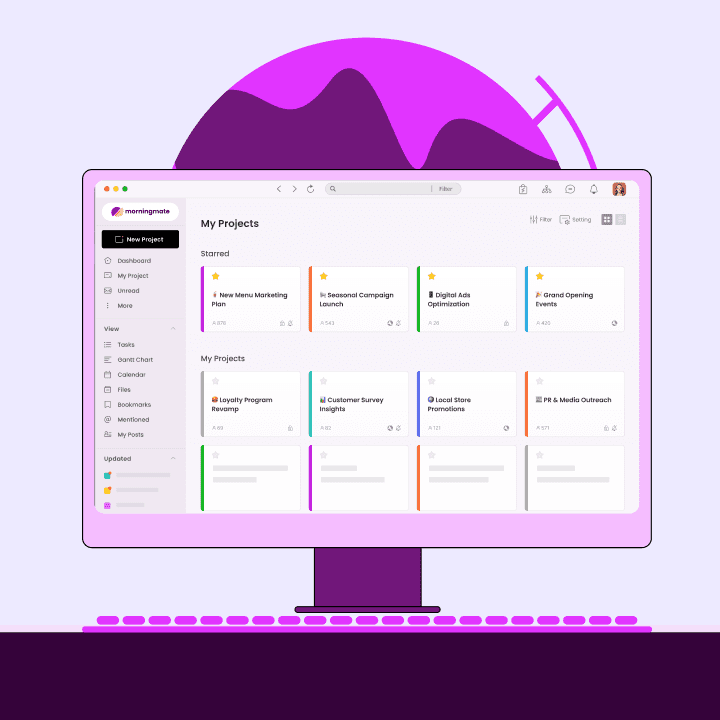
Compare that to a tool like Morningmate, where each task lives in a feed-style workspace alongside the conversations, files, and updates that belong to it. Your team isn't digging through a chat app and a spreadsheet and an email thread to piece together what happened — everything is in one place, in context.
The Warning Signs You've Outgrown Your Spreadsheet
Not sure whether you've hit the wall yet? Here are the clearest signals that your spreadsheet-based task tracking is costing you more than it's saving you.
You spend more time maintaining the tracker than doing the work it's supposed to track
Team members regularly ask "where's the latest version?" or "which sheet should I be looking at?"
Tasks fall through the cracks because there's no notification system and no one checked the sheet
Managers have to manually chase updates through email or messaging apps
Onboarding a new team member means explaining a convoluted spreadsheet logic that only one person fully understands
You've lost track of who owns what, and accountability has become fuzzy
Deadlines are being missed more often than before, even though everyone seems busy
If more than two or three of these hit home, you're not just outgrowing a tool — you're actively absorbing the cost of it every single day.
When It Actually Makes Sense to Switch
The decision to switch isn't just about frustration — it's about whether the pain of the current setup outweighs the friction of changing. And that calculation usually tips when one of the following happens.
Your Team Crosses 10 People
Below ten people, informal systems can hold together with enough discipline. Above ten — especially across departments or time zones — you need structure that doesn't rely on everyone remembering to check the same document. McKinsey research has shown that improving communication and collaboration tools can boost productivity significantly for knowledge workers — but only when the tools actually match how teams work.
You're Managing Remote or Hybrid Work
Async work requires a higher standard of documentation and visibility. When your team isn't in the same room, the burden on your tracking system goes up considerably. A spreadsheet that "works" in an office where you can tap someone on the shoulder falls apart completely when everyone's in different time zones and no one can easily see what's blocked, what's done, and what's waiting.
This is exactly where tools like Morningmate earn their place. Its built-in chat works like a familiar messaging app — similar to what your team already uses — while keeping work conversations attached to actual tasks rather than floating in a separate inbox. Managing remote teams effectively requires that kind of integration, not two separate tools stitched together manually.
Leadership Needs Real Visibility
If you're a business owner or ops lead trying to get a clear picture of where projects stand across multiple teams, a spreadsheet will always give you a partial view. You're seeing a snapshot, not a live status. And the time it takes to compile that snapshot — usually through manual updates from multiple people — means the data is already outdated by the time you look at it.
Good work visibility tools give leadership a real-time view of progress without requiring everyone to stop and report in. That's a structural shift, not just a feature upgrade.
What to Look for in a Replacement (Without Overcomplicating It)
The most common mistake teams make when switching away from spreadsheets is swinging too far in the other direction — adopting a complex project management platform that requires training, admin overhead, and constant maintenance just to keep running. That's trading one problem for a different one.
What most teams actually need is something in between: a tool that's structured enough to provide accountability and visibility, but simple enough that everyone actually uses it — including the people on your team who aren't particularly tech-savvy.
Here's a practical checklist for evaluating a switch:
Can non-technical team members use it without training? If the onboarding process requires a manual, it'll create resistance.
Does it show who owns what, and when things are due? Basic accountability features are non-negotiable.
Does it support async communication? Chat or commenting built into tasks prevents the context-switching between tools.
Can you see progress at a glance? A clear overview — not a wall of rows — matters for managers and execs.
Does it replace tools your team already uses, rather than adding to the stack? The goal is fewer apps, not more.
Morningmate was built around this balance. Its feed-style interface feels familiar — like a social media feed — which means teams pick it up quickly without a steep learning curve. Task management, file sharing, and team chat are all in one place, so you're not bouncing between five tabs to get a picture of what's happening. For teams that have been running on spreadsheets and WhatsApp groups, it's a meaningful upgrade without the complexity of enterprise tools like Jira or Asana.
How to Make the Switch Without Disrupting Your Team
Switching tools mid-stream is always a little uncomfortable. Here's how to do it without losing momentum or buy-in.
Start With One Team or One Project
Don't try to migrate everything at once. Pick one active project or one team and run it through the new system for two to four weeks. This gives you a real test without the risk of breaking everything.
Document Your Current Structure First
Before you migrate tasks, write down how your current spreadsheet is organized — what columns mean, what the statuses represent, what the naming conventions are. This forces clarity and makes the transition into a new tool much smoother.
Get One Champion on Your Team
Find the person on your team who's most frustrated with the current setup — they'll be your natural advocate. Have them lead the pilot, share their experience with the rest of the team, and help troubleshoot early friction. Peer endorsement does more than any top-down mandate.
Set a Sunset Date for the Old System
If you keep the spreadsheet running alongside the new tool, people will default back to it. Set a clear date — ideally within the first month — when the spreadsheet is no longer the official source of truth. That deadline creates the motivation to actually make the switch.
The Real Cost Is Time — And Trust
The hidden toll of spreadsheet-based task tracking isn't just hours lost to manual updates. It's the erosion of trust in your team's systems. When people don't trust the tracker, they stop using it. When they stop using it, accountability becomes a conversation instead of a process. And when accountability is conversational, it's uneven — some people stay on top of things, others quietly fall behind, and managers spend half their week just trying to figure out where things stand.
Switching to a purpose-built work management tool is not about chasing the latest software trend. It's about giving your team a system they can actually rely on — one that reflects how work moves, not just how it looked at the moment someone last updated a cell. That shift, done well, is one of the most practical things a team manager or business owner can do to improve team productivity without adding more meetings or more overhead.
The spreadsheet served its purpose. But if you're reading this, it's probably already outlived it.