Project Management
![Why Most Teams Need a Work OS to Stay Organized [2026]](https://framerusercontent.com/images/LgkUz06x86SS0P1uWM2OfLCmhqY.png?width=1000&height=1000)
If you've ever felt like your team's work is scattered across too many apps — emails here, task lists there, chat messages somewhere else — you're not alone. Most teams don't have a work problem. They have a system problem. That's exactly where the concept of a Work OS comes in.
A Work OS, or Work Operating System, is a centralized digital platform that brings together the core elements of how a team operates: tasks, communication, files, and workflows — all in one place. Think of it like the operating system on your computer, but instead of managing apps and files, it manages how your team plans, collaborates, and gets things done.
It sounds like a big idea, but the practical reality is simple. If your team still relies on email chains and WhatsApp groups to coordinate work, you're missing a layer of structure that could save you hours every week — and prevent a lot of headaches.
What Makes Something a Work OS?
Not every project management tool qualifies as a Work OS. A to-do list app is not a Work OS. A standalone chat tool is not a Work OS. What separates a true Work OS is that it covers the full operational layer of a team — not just one slice of it.
A proper Work OS typically includes these capabilities:
Task and project management — assign, track, and prioritize work across individuals and teams
Team communication — built-in messaging so context stays next to the work, not buried in a separate app
File and knowledge management — documents, attachments, and references stored where the work actually happens
Workflow visibility — a clear picture of who is doing what, and what's actually moving forward
When these elements live in the same system, the friction of switching between apps drops dramatically. More importantly, information stops getting lost.
Why Teams Are Moving Toward a Work OS
The shift toward centralized work systems isn't just a trend — it reflects a real structural problem that teams are hitting. McKinsey research has consistently shown that knowledge workers spend a significant portion of their time searching for information and coordinating with colleagues rather than doing the actual work they were hired to do. A fragmented toolset is a major culprit.
There's also a visibility gap that many managers feel acutely. When your team communicates through personal messaging apps and sends updates via email, you end up managing people rather than work. You're constantly asking for status updates instead of seeing them.
One of the biggest drivers of workplace burnout is the cognitive load of managing too many tools and too many communication channels simultaneously. A Work OS reduces that load by consolidating where things happen.
The Remote and Hybrid Work Factor
Hybrid and remote work has made the Work OS even more critical. When your team isn't in the same room, informal coordination disappears. The question "hey, what's the status on that?" no longer gets answered in the hallway — it becomes another message that may or may not get a timely response.
A Work OS creates a shared source of truth that doesn't depend on everyone being online at the same time. Tasks are visible. Updates are logged. Files are findable. That's what makes async work actually work.
Work OS vs. Traditional Project Management Tools
It's worth drawing a clear line here, because there's real confusion in this space. Tools like Jira or Asana are powerful — but they're built for technical teams with complex workflow needs. For most teams, especially those outside of software development, they're genuinely overkill. The setup time alone can be a barrier to adoption.
A Work OS, by contrast, is designed to be usable by everyone on the team — not just the project manager or the person who set it up. The goal is adoption across the whole organization, not just a corner of it.
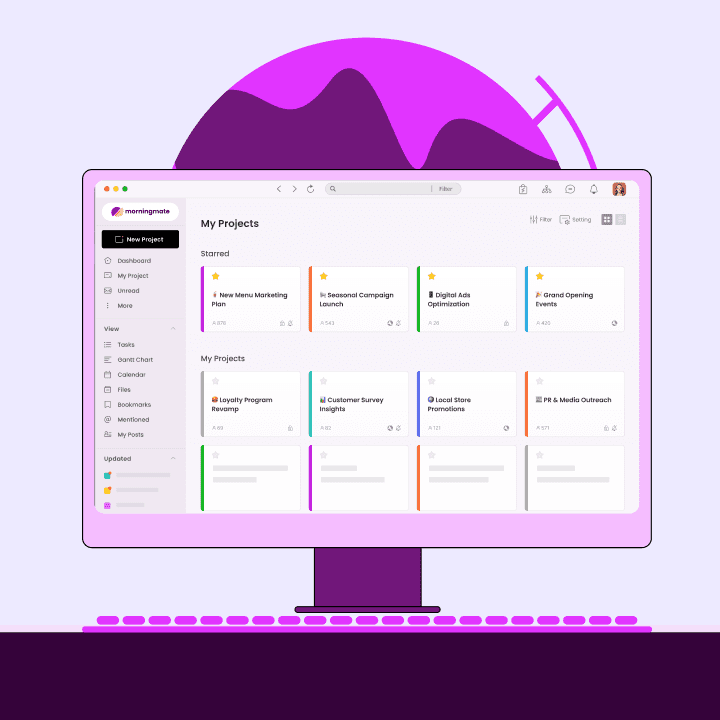
This is where tools like Morningmate fit in. Morningmate is a lightweight work management tool that combines task management, built-in team chat, and file sharing in a single interface. The feed-style layout feels familiar — similar to social media — which means teams without a technical background can start using it with almost no learning curve. It's designed to replace email threads and WhatsApp groups, not to replicate the complexity of enterprise tools.
When Does a Team Actually Need a Work OS?
Here's a practical checklist. If two or more of these describe your team, you're probably ready for a Work OS:
You regularly ask for status updates that should already be visible somewhere
Important decisions or files get buried in email or chat threads
New team members struggle to understand what's been decided and why
You're managing work across more than one location or time zone
Tasks fall through the cracks because there's no clear ownership
Your team uses three or more different apps just to coordinate basic work
If you're nodding at this list, the problem isn't your team — it's the absence of a system designed for how teams actually operate.
What a Work OS Does for Different Roles
A Work OS doesn't look the same to everyone on the team. Here's how it tends to change work at different levels:
For Team Managers
You get visibility without micromanaging. Instead of pulling status updates from people, you see work progress as it happens. You can spot blockers early, redistribute tasks when someone is overloaded, and make better decisions because you're working from real data — not from what you remember hearing in a meeting.
For Operations and Business Leaders
A Work OS gives you a cross-team view of how work is moving. You stop relying on department heads to manually compile updates. Patterns become visible — which teams are consistently blocked, which projects are on track, where resources are being stretched. Gallup's State of the Global Workplace report points to manager effectiveness as one of the top drivers of team engagement — and a big part of manager effectiveness is simply having the right information at the right time.
For Individual Contributors
Work becomes clearer. Priorities are explicit. You know exactly what you're responsible for, what's waiting on someone else, and where to find the files you need. You spend less time in your inbox and more time doing actual work.
How to Evaluate a Work OS for Your Team
Not all Work OS platforms are created equal, and the right choice depends heavily on your team's size, technical comfort level, and workflow complexity. Here's a simple framework for evaluating your options:
Ease of adoption — Will your whole team actually use it, or just the people who set it up? Look for tools with familiar interfaces and a short onboarding curve.
Core feature fit — Does it cover tasks, communication, and file management — or do you still need to plug in three other tools?
Scalability — Can it grow with your team without becoming unmanageable?
Visibility features — Does it give managers and leaders the oversight they need without being invasive?
Price and value — Enterprise pricing models can be prohibitive for smaller teams. Make sure the tier you can afford includes the features you actually need.
Morningmate, for example, is built specifically for teams that want a capable Work OS without enterprise-level complexity. Its built-in chat mirrors the interface of familiar messaging apps, so there's no resistance from team members who aren't used to formal project management tools.
The Real Cost of Not Having a Work OS
Teams often resist adopting a new system because switching feels like effort. That's fair — any change requires short-term friction. But the cost of staying fragmented is ongoing, not one-time.
Every hour your team spends searching for files, re-explaining context, or chasing status updates is an hour not spent on actual work. Every decision made without full visibility carries extra risk. Every new hire who has to piece together "how things work here" from scattered messages is a delayed contributor.
A Work OS doesn't just make work more organized — it makes your team more capable. That's the real return on the investment of switching. If you're exploring what that transition looks like in practice, centralizing your team communication is often the best first step before tackling full workflow management.
The teams that get the most out of a Work OS are the ones that treat it as infrastructure — not just another app. When your team's work lives in one place, something simple but powerful happens: everyone finally knows what's going on.