Project Management
Work stress is not a personality flaw or a sign that someone needs to toughen up. It is a direct response to how work is structured, communicated, and managed — and that means it is something leaders can actually fix. When your team is overwhelmed, productivity drops, mistakes increase, and eventually people leave. The cost is real, and it compounds quietly over time.
Gallup's State of the Global Workplace report found that 44% of employees worldwide experience a lot of stress on a daily basis — a figure that has remained stubbornly high in recent years. What's more troubling is that most of that stress does not come from the work itself. It comes from unclear expectations, poor communication, and the feeling of being out of the loop.
The good news is that reducing employee stress at work does not require a wellness retreat budget or a new HR policy binder. It starts with removing the friction that makes ordinary work feel exhausting. This guide breaks down the practical steps you can take — as a manager, an operations lead, or a business owner — to genuinely lower stress levels across your team.
Why Employee Stress Keeps Climbing (And Where It Actually Comes From)
Most workplace stress conversations jump straight to solutions like mental health days or yoga apps. But before you can reduce stress, you need to understand what is generating it in your specific team. The root causes are usually more operational than emotional.
The Hidden Stressors Most Managers Miss
Stress often builds not from one big problem but from dozens of small frictions that stack up across a workday. Think about how your team currently receives updates — are critical messages buried in email threads? Is someone waiting for a file that was "sent" three days ago but landed in the wrong chat app? These daily inefficiencies are not minor annoyances. They erode focus, drain energy, and leave people feeling like they can never fully catch up.
Common hidden stressors include:
Unclear task ownership — when no one is sure who is responsible for what
Communication scattered across email, WhatsApp, Slack, and verbal conversations
Last-minute requests caused by a lack of shared visibility on timelines
Repetitive status-update meetings that could have been a shared board
No clear place to find the latest version of a document or decision
Research published in Harvard Business Review consistently shows that ambiguity — not workload alone — is one of the strongest predictors of burnout. When people do not know what is expected of them or where to find what they need, their nervous systems stay on high alert all day long.
How to Reduce Employee Stress at Work: Practical Steps That Actually Work
Here are concrete, actionable approaches that address stress at the structural level — where the real leverage is.
1. Give Everyone a Clear, Shared View of Work
One of the fastest ways to reduce anxiety on a team is to make work visible. When your team can see what is assigned to whom, what the deadline is, and what stage a task is in — without having to ask — a huge amount of ambient stress disappears. People feel oriented rather than reactive.
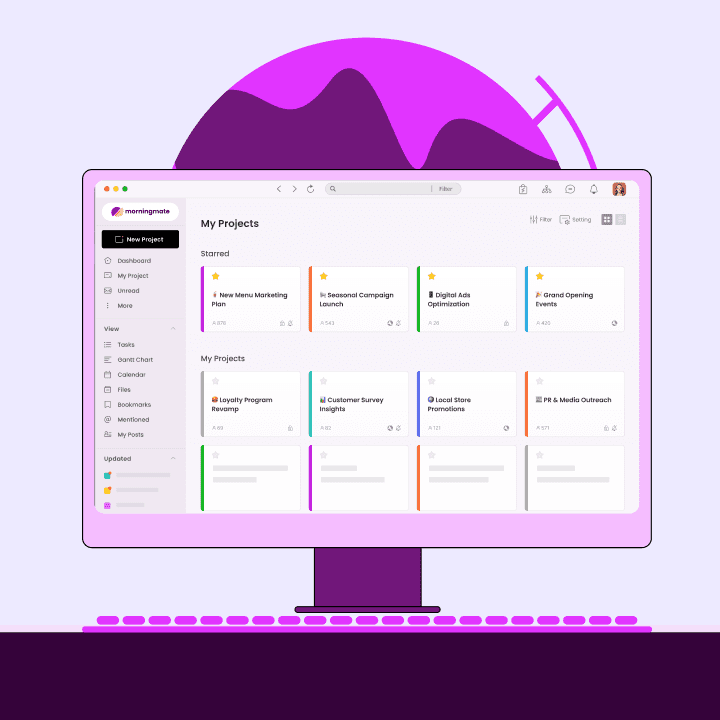
This is where a structured work management tool earns its keep. Morningmate, for example, gives teams a shared workspace where tasks, updates, and files all live in one place. Instead of chasing updates across WhatsApp groups and email chains, everyone can check a single feed and know exactly what is happening. For managers and business owners who need visibility across multiple teams, this kind of clarity is not a luxury — it is a stress-reduction tool in itself.
2. Reduce Communication Overload
Getting 47 messages before 10am is not communication. It is noise. And chronic notification overload is one of the most underrated sources of employee stress at work. When people cannot distinguish urgent from routine, everything feels urgent — and that is exhausting.
Practical steps to cut communication clutter:
Establish clear norms around which channel is for what — urgent issues go here, project updates go there
Move recurring status updates out of chat and into a shared task board or feed
Reduce the number of platforms your team communicates on — consolidation alone lowers cognitive load
Set expectations around response times so people are not glued to their phones after hours
Teams using Morningmate often find that its built-in chat — designed with a familiar interface similar to WhatsApp — makes it easy for even non-technical staff to consolidate work conversations in one place. Instead of work bleeding into personal messaging apps, your team keeps professional and personal communication clearly separated. That boundary alone reduces after-hours stress significantly.
3. Make Async Communication Work for Your Team
Not every conversation needs to happen in real time. In fact, forcing synchronous communication on a team that is partly remote or across time zones is one of the biggest stress multipliers there is. Someone is always being interrupted at the wrong moment or expected to respond immediately when they are deep in focused work.
Building a culture of thoughtful async communication means writing updates clearly enough that they do not generate follow-up questions, using task comments instead of fragmented chat threads, and trusting your team to check in on their own schedule. If you want a deeper look at making this work, our guide on async communication for remote teams walks through the practical setup.
4. Clarify Roles and Task Ownership
Ambiguity about who owns what is a silent, daily stressor. When two people think the other one is handling something, one of three things happens: the work gets duplicated, it falls through the cracks, or someone spends mental energy worrying whether it is being handled at all. None of those outcomes are good for your team's stress levels.
Make task assignment a non-negotiable habit. Every task should have one clear owner, a due date, and enough context to act on it without a follow-up conversation. This sounds simple, but most teams skip it — and then wonder why everyone feels overwhelmed. Strong task management practices are one of the highest-leverage investments a manager can make.
5. Protect Focus Time
Fragmented attention is physically tiring. McKinsey research on knowledge worker productivity has found that workers spend a significant portion of their day just searching for information and switching between communication tools — time that adds no value and drains energy. When people cannot get into a sustained flow of work, everything takes longer and feels harder than it should.
Encourage your team to block focused work time on their calendars and treat it as a real commitment. Set norms that not every message needs an instant reply. When your communication infrastructure is organized — through structured channels and visible task boards — people can step away from their notifications without fearing they will miss something critical.
6. Create Psychological Safety Around Workload
Many employees say nothing when they are at capacity. They quietly absorb more work, miss deadlines, and eventually burn out — all while appearing fine in meetings. Creating an environment where people can flag workload issues early is one of the most important things a manager can do to reduce employee stress at work.
This is partly a culture shift, but it is also structural. When workloads are visible on a shared board, managers can spot overload before the employee even has to say it. You can see when one person has 14 active tasks and another has three. That visibility enables proactive rebalancing rather than crisis management.
Building a Stress-Aware Team Culture
Process changes matter, but so does the environment you create day to day. A stress-aware culture is one where people feel safe to raise problems, where managers model sustainable work habits, and where good work is recognized — not just deadlines met.
Small Habits That Signal You Take This Seriously
You do not need a formal wellness programme to show your team that their wellbeing matters. Small, consistent signals go a long way:
Start team check-ins with a genuine "how is everyone doing" rather than jumping straight to status updates
When someone raises a workload concern, respond with problem-solving — not reassurance
Avoid sending non-urgent messages outside of work hours, even if you do not expect an immediate reply — the message still lands
Acknowledge effort publicly, not just outcomes
Model taking breaks and logging off on time yourself
Morningmate's feed-style workspace makes it easy to give quick, visible recognition on a project update or a completed task — similar to how you might react to a post on social media. That kind of low-friction acknowledgement, done consistently, builds a team culture where people feel seen rather than just monitored.
When to Escalate Beyond Process
Sometimes structural fixes are not enough, and an employee is dealing with stress that goes beyond what better task management can solve. If someone on your team shows signs of serious burnout — withdrawal, persistent errors, emotional exhaustion — that is a conversation for one-on-one time, not a process checklist. Know when to involve HR or direct people to professional support.
Your role as a manager is not to be a therapist. It is to notice, to create the conditions for honest conversation, and to connect people with the right resources. That is already more than most managers do — and it matters enormously.
A Quick Checklist: Is Your Team Set Up to Succeed Without Burning Out?
Run through this honestly. If you check fewer than five of these, your team's stress levels are likely higher than they need to be.
Every task has a named owner and a clear due date
Team members know which channel to use for which type of communication
Work conversations are not happening primarily in personal messaging apps
People can find the latest project updates without having to ask someone
Managers have visibility into individual workloads across the team
There is an established norm around response times and after-hours messaging
Team members feel comfortable saying when they are at capacity
Focus time is protected and respected during the workday
If your team is still coordinating primarily through email and group chats, tools like Morningmate are worth exploring — not because software solves everything, but because having one organized place for tasks, updates, and team communication removes a layer of daily friction that adds up to real stress over time. Over 550,000 teams use it specifically because it is lightweight and easy to adopt, even for non-technical teams who have never used a project management tool before.
Reducing employee stress at work is not a one-time project. It is an ongoing practice of paying attention to how your team works — and removing the obstacles that make good work harder than it should be. Start with one thing on the checklist above, build the habit, then move to the next. That kind of steady, practical progress creates the conditions where your team can actually do their best work — without paying for it with their health.