Project Management

Your team is already using Loom for walkthroughs, Miro for brainstorming, and maybe Whimsical for mapping out flows. The async stack looks solid on paper. People record videos, drop sticky notes, and leave comments — and for a while, it feels like collaboration is actually happening. But then something slips. A decision buried in a Loom comment never becomes an action item. A Miro board full of brilliant ideas just... sits there.
This is the quiet failure mode of visual and async tools. They are excellent at capturing thinking, communicating context, and working across time zones — but they were never designed to close the loop. Without a task layer sitting underneath all of that creative output, your team ends up with a lot of documented ideas and very little accountability for what happens next.
If you manage a remote or hybrid team, you have probably felt this friction without being able to name it. The good news is it is not a people problem. It is a tooling gap — and once you see it clearly, it is straightforward to fix.
Why Async and Visual Tools Are So Popular Right Now
The shift toward asynchronous work has accelerated significantly. McKinsey research on the future of work has consistently shown that flexible, async-friendly environments improve both employee satisfaction and productivity — particularly for knowledge workers spread across time zones. Tools like Loom, Miro, and Whimsical have grown because they meet people where they are: thinking visually, communicating on their own schedule.
Loom lets you record your screen and voice so you can explain a complex topic without scheduling a meeting. Miro gives distributed teams a shared canvas to think together, run workshops, and map out systems. Whimsical helps teams sketch flowcharts and wireframes quickly. Each of these tools solves a very specific problem extremely well.
But here is the tension: the more tools you add to capture and communicate work, the more you need something to actually organize and track it. Asana's Anatomy of Work report found that workers switch between an average of nine apps per day just to do their jobs. The result is not efficiency — it is fragmentation.
What These Tools Cannot Do On Their Own
Let's be honest about the limitations. None of this is a criticism of these products — they do exactly what they promise. The issue is what happens at the edges of their functionality.
Loom: Great for Context, Not for Accountability
A Loom video is a fantastic replacement for a meeting where you are explaining a process or giving feedback. But once someone watches the video, where does the follow-up live? Comments get buried. Action items mentioned at the 3:47 mark of a video are not trackable. There is no built-in way to assign a task, set a deadline, or know whether anything actually got done.
Miro: Brilliant for Ideation, Problematic for Execution
Miro boards are incredible for workshops, planning sessions, and collaborative brainstorming. Teams come together on a canvas and generate real, meaningful output. But once the session ends, what happens to the sticky notes? Who owns the items that came out of that retro or planning session? Miro has made strides toward project management features, but its core identity is still the whiteboard — not the work tracker.
Whimsical: Strong for Mapping, Weak for Managing
Whimsical shines when your team needs to map out a user flow, sketch a product concept, or wireframe a new feature. It is fast and beautiful. But like the others, it is a thinking tool — not a doing tool. After the diagram is drawn, someone still needs to break that flow into tasks, assign ownership, and track progress.
The Missing Layer: Task Management
Every workflow has a lifecycle. It starts with thinking, moves through communication, and ends with execution. Visual and async tools cover the first two stages exceptionally well. The task layer is what handles the third — and without it, work stalls between inspiration and completion.
A task layer does a few things that no video or whiteboard can replace:
It converts ideas and decisions into concrete, assignable actions
It gives every piece of work a clear owner and a deadline
It creates a single place where progress is visible to the whole team
It closes the loop — so things that were decided actually get done
Think of it this way: Loom, Miro, and Whimsical are tools for generating and sharing information. Task management is the system for acting on it. You need both — and the two need to be connected in your team's daily workflow.
What a Complete Async Workflow Actually Looks Like
Here is a practical example. Say your product team uses Miro to run a sprint planning workshop. Ideas flow, priorities get mapped, and the team leaves the session energized. Here is what should happen next — and where most teams fall short:
Capture decisions as tasks immediately. Every action item from the Miro board should be moved into a task management tool within 24 hours, with an owner and a due date assigned.
Use Loom for async handoffs. If a task needs context — how to do something, what the background is — record a short Loom to accompany it. Link the video directly in the task description.
Track progress in one place. Your task tool becomes the single source of truth for what is in progress, what is blocked, and what is done. No one needs to go back to the Miro board to figure out the status of work.
Keep communication tied to tasks. When questions come up about a specific piece of work, that conversation should live next to the task — not in a separate chat thread or email chain.
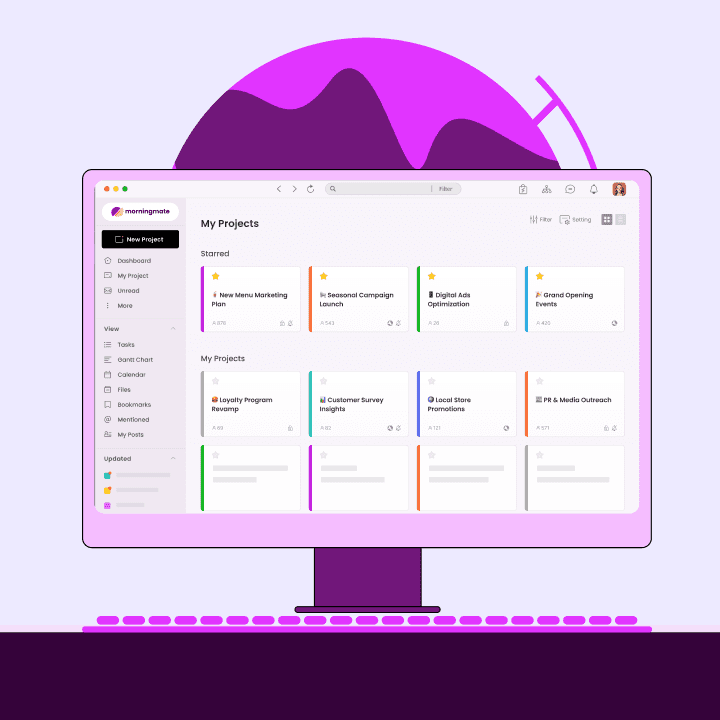
This is where a tool like Morningmate fits naturally into the picture. Morningmate is a lightweight work management tool that combines task management with built-in team chat — all in a single, clean workspace. It is designed for teams who need real structure without the complexity of enterprise tools like Jira or Asana. When your team finishes a Miro session or watches a Loom, Morningmate is where the output lives and gets acted on.
Why Most Teams Resist Adding a Task Layer
It is worth addressing the pushback directly, because it is real. Many teams resist task management tools because previous experiences have been painful. Heavy tools with steep learning curves, endless configuration, and features nobody uses — it is enough to make anyone want to just stick with a WhatsApp group and a shared Google Doc.
Harvard Business Review has noted that tool overload is one of the biggest barriers to effective async work. When adding a new system feels like adding more complexity, people avoid it — even when the system would genuinely help them.
The solution is not to abandon task management. It is to choose a task layer that is light enough to actually use. The best task tools for most teams are the ones that feel familiar — more like the apps people already use in their personal lives than like software built for enterprise IT departments.
This is exactly the philosophy behind Morningmate. Its Feed view is structured like a social media timeline — something every person on your team already knows how to navigate. The built-in chat mirrors the experience of WhatsApp, so onboarding is fast even for non-technical team members. You get the structure you need without forcing your team through a learning curve that kills adoption.
How to Bridge Visual Tools and Task Management
You do not have to overhaul your entire workflow. The goal is to build a simple bridge between the tools where thinking happens and the tool where work gets tracked. Here is a framework to start with:
The Three-Step Bridge Framework
Use this whenever your team wraps up a session in Loom, Miro, or Whimsical:
Extract. After any visual or async session, spend ten minutes pulling out every decision, open question, and next step. Do not leave them living inside the tool where they were created.
Assign. Every extracted item needs a name attached to it. If no one owns it, it does not exist. Set a realistic deadline at the same time.
Track. Drop all of it into your task layer. This is now the system of record. Anyone on the team should be able to see exactly what is happening without hunting through Miro boards or rewatching a 12-minute Loom.
This does not require expensive integrations or complex automation. It just requires a consistent habit — and a task tool simple enough that the habit actually sticks.
Signs Your Team Needs a Task Layer Now
If you are not sure whether this gap exists in your team, here are some honest signals to look for:
Decisions get made in meetings or async sessions, but there is no clear record of who agreed to do what
People frequently ask "what's the status on X?" because there is no central place to check
Things fall through the cracks between tools — someone assumed someone else was handling it
Your team relies on WhatsApp, Slack, or email to follow up on action items that should already be tracked
New team members struggle to understand what is actually in progress because the information is spread across too many places
Any one of these is a sign. All of them together means your async stack has a structural problem that no amount of better Loom videos or prettier Miro boards will fix.
Building a Stack That Actually Closes the Loop
The best async stacks are not the ones with the most tools. They are the ones where every tool has a clear job, and the handoffs between tools are intentional. Visual tools like Loom, Miro, and Whimsical earn their place in your stack — keep using them. But pair them with something that turns their output into trackable, owned, deadline-driven work.
Morningmate was built for exactly this role. Used by over 550,000 teams worldwide, it gives growing teams the task structure they need without the complexity that drives people back to email and personal messaging apps. Tasks, file sharing, team chat, and project updates all live in one place — so nothing gets lost between tools, and your team always knows what needs to happen next.
Async work is not the problem. The gap between async communication and actual execution is. Fill that gap, and the tools you already love become significantly more powerful.