Project Management

Something quiet has been happening inside teams over the past year. Managers who once juggled seven or eight different apps — one for chat, one for tasks, one for file storage, one for video calls, one for docs, one for timesheets — are now making a deliberate cut. Not because they ran out of budget, but because the sprawl finally cost them more than it saved.
The shift is real and it is picking up speed. Teams are consolidating their tool stacks, often down to just two or three core platforms, and they are seeing immediate gains in focus, accountability, and communication clarity. If your team is still hopping between five tabs before lunch, this trend is worth paying close attention to.
This article breaks down why tool consolidation is one of the defining workplace moves of 2026, what is actually driving it, and how to think about simplifying your own stack without losing the capabilities your team depends on.
The Tool Sprawl Problem Nobody Talks About Loudly Enough
Most teams did not choose to end up with seven tools. It happened gradually — a free trial here, a team request there, an integration that made sense at the time. Before long, your project updates live in Asana, your client conversations are in WhatsApp, your files are split between Google Drive and Dropbox, and nobody is quite sure where the final version of anything actually is.
Research from Harvard Business Review has long flagged that collaboration tools, when poorly implemented, can actually reduce productivity rather than improve it. The overhead of managing the tools themselves — switching contexts, re-explaining information, searching across platforms — quietly eats into the time that work is supposed to protect.
And the switching cost is not just minutes. It is cognitive energy. Every time someone has to remember which platform holds which conversation, they burn mental bandwidth that could have gone toward actual work.
Why 2026 Is the Year Teams Are Finally Cutting Back
A few converging forces have made tool consolidation feel urgent rather than optional right now.
Budget Scrutiny Is at an All-Time High
SaaS subscriptions that felt trivial at $15 per seat per month stop feeling trivial when you multiply them across a team of 40 and then across six different tools. Finance teams and business owners are auditing software spend more aggressively than ever, and many are shocked by what they find.
Cutting from seven tools to two does not just mean a cleaner workflow. For a 50-person team, it can mean saving tens of thousands of dollars a year — money that goes back into hiring, product, or operations.
Employees Are Burned Out on Context Switching
Asana's Anatomy of Work report found that workers switch between apps dozens of times per day and consider a significant portion of their work time to be wasted on coordination rather than actual output. When employees have to re-explain the same update in three different places, frustration builds fast — and so does attrition risk.
Simplified tool stacks reduce that friction directly. When everything lives in fewer places, people spend less time managing information and more time doing their jobs.
Remote and Hybrid Work Exposed the Cracks
Distributed teams revealed just how fragile multi-tool setups can be. When you cannot walk over to someone's desk, scattered information becomes a genuine operational risk. Updates go unseen. Decisions get made without full context. Accountability blurs.
Teams that consolidated their stack into fewer, more intentional platforms found it significantly easier to maintain visibility and keep async communication from becoming chaos. This is exactly the gap that tools like Morningmate were built to close — replacing the combination of email threads and WhatsApp group chats with one organized workspace that keeps tasks, conversations, and files connected in the same place.
What "Fewer Tools" Actually Looks Like in Practice
Cutting your stack does not mean stripping your team of capability. It means being deliberate about which categories of work get their own dedicated platform and which ones can be handled inside something you already use.
Most teams who consolidate successfully end up with a structure that looks something like this:
One work management platform — handles tasks, projects, deadlines, and progress tracking
One communication layer — handles team chat, file sharing, and day-to-day updates
One or two specialist tools — for things that genuinely require dedicated software, like video conferencing or design
The key insight here is that the first two categories are often better served by a single tool than by two separate ones. When your task management and your team chat live in the same platform, the context travels with the conversation. You do not have to explain in Slack what you already documented in Asana.
The Hidden Cost of Keeping Too Many Tools
Beyond the obvious subscription fees, running too many tools creates costs that never show up on an invoice.
Onboarding Gets Expensive
Every time you hire someone new, they have to learn your tool stack. If that stack has seven platforms — each with its own logic, permissions, and file structure — onboarding takes longer, costs more in manager time, and increases the chance that new hires give up and default to emailing everything anyway.
A streamlined stack shortens that ramp dramatically. When a new team member only needs to learn one or two tools, they become productive faster and feel less overwhelmed in their first weeks.
Information Gets Siloed
When conversations happen in WhatsApp, decisions get made in email, tasks live in a project tool, and files sit in a storage platform, no single person has full visibility — including the manager who needs it most. McKinsey research on workplace communication has shown that workers spend a significant portion of their week just searching for information that already exists somewhere in their organization.
Consolidating tools forces information into fewer channels, which paradoxically makes it easier to find. A decision made in a task comment is visible to everyone with access to that task. It does not disappear into a chat thread three weeks later.
Accountability Becomes Hard to Maintain
When work is spread across platforms, it is genuinely difficult to know who owns what. If a task was assigned in a chat message and the update came in an email, the paper trail is fragmented. Things fall through the gaps — not because your team is irresponsible, but because the system makes it too easy for them to.
This is one of the most consistent frustrations we hear from operations leads and remote team managers. The answer is not more process — it is fewer places where work can hide.
How to Audit and Consolidate Your Tool Stack
If you are ready to cut back, here is a practical framework to do it without disrupting your team mid-project.
List every tool your team uses — include anything that touches work, even if it feels minor. Personal messenger apps count.
Categorize by function — group tools by what they actually do: communication, task tracking, file storage, scheduling, etc.
Identify overlap — where are two tools doing the same job? This is your first target for elimination.
Ask where information gets lost — which platforms create dead ends? Where do updates go to die?
Choose anchor platforms — pick one tool per core function and evaluate whether any of them can cover two functions well.
Run a 30-day consolidation pilot — move one team or one project to the simplified stack and measure what changes.
The goal is not minimalism for its own sake. It is intentionality. You want every tool in your stack to earn its place by solving a real problem that nothing else already handles.
What to Look For in a Consolidation-Ready Platform
Not every tool can absorb two or three functions gracefully. Some platforms try to do everything and end up doing nothing well. The right consolidation anchor is one that covers adjacent needs without becoming complicated to use.
For most teams, the sweet spot is a platform that combines task management with built-in communication — so that conversations about work happen next to the work itself, rather than in a separate channel that requires context every time.
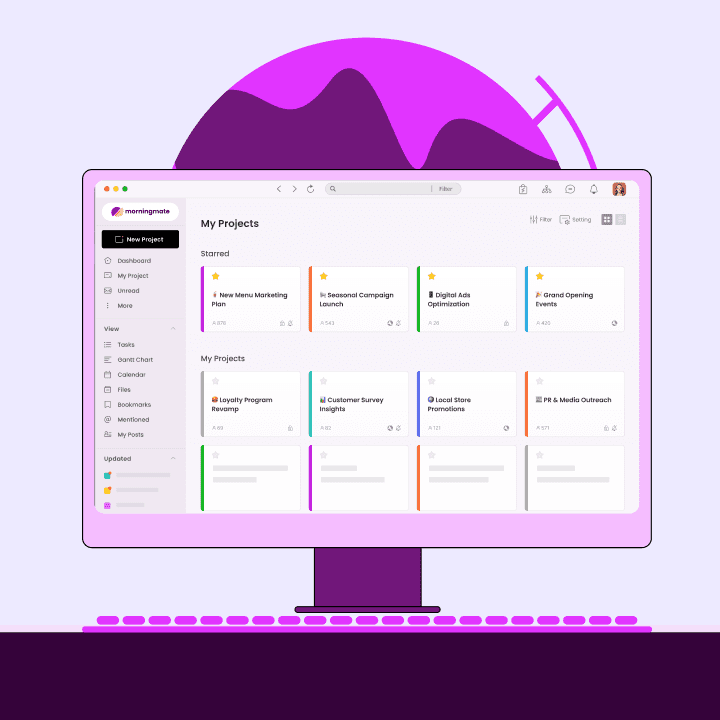
Morningmate is built around exactly this idea. It combines a task management system with a built-in chat interface that feels familiar — similar to what most people already use in their personal lives. The Feed view organizes team updates in a format that looks like a social media timeline, which means even non-technical teams can adopt it without a steep learning curve. For teams replacing a combination of WhatsApp, email, and a project tool, it is designed to be the one place where work actually lives.
When evaluating any consolidation platform, look for these qualities:
Task creation and assignment built into the same interface as communication
File attachment and storage that does not require a separate platform
A view that gives managers visibility across all ongoing work, not just individual projects
Low adoption friction — if your team needs training to use it, it probably will not stick
The Teams Getting This Right
The teams making the most dramatic cuts tend to share a few characteristics. They have a manager or operations lead who is willing to own the transition. They pick a start date and actually migrate, rather than running old and new tools in parallel indefinitely. And they communicate the "why" to the team clearly — because people are more willing to change their habits when they understand the problem being solved.
Interestingly, the teams that struggle with consolidation are usually not the ones with too few tools. They are the ones with too many informal habits — the manager who insists on WhatsApp because it is faster, the client who only responds to email. Changing the tool is the easy part. Building new communication habits around it is where the real work happens.
But those habits compound over time. A team that consolidates from seven tools to two in Q1 will feel the clarity difference by Q2 — in fewer missed updates, faster onboarding, and more productive meetings because everyone comes in with the same shared context.
Start Small, But Start Now
You do not have to overhaul everything at once. Pick the two tools that create the most friction in your team right now — probably your current project tool and whatever personal messenger has crept into your workflows — and find one platform that handles both well.
Run it for 30 days with one team. Measure what changes. Then decide how much further to go. The teams cutting from seven tools down to two are not doing it because they love change. They are doing it because the cost of staying fragmented finally outweighed the discomfort of switching. For most teams, that tipping point is already here.
If you want to see how a consolidated workspace actually looks in practice, take a look at how Morningmate brings tasks, chat, and file management into one place that your whole team can actually use from day one.