Project Management

Task management inside a WhatsApp group starts out feeling clever. You post an update, someone replies, work moves forward. But as your team grows from five people to fifteen, then thirty, the same behavior that once felt efficient quietly becomes one of your biggest operational liabilities. Messages bury decisions. Context disappears overnight. And you — the person responsible for keeping everything on track — end up spending more time reconstructing what happened than actually moving things forward.
This is not a communication problem. It is a task management problem. WhatsApp was built for personal messaging, not for coordinating work across departments, tracking deliverables, or maintaining accountability. When teams try to stretch it into a work coordination tool, they are essentially trying to manage a warehouse using sticky notes. It works until it doesn't — and when it breaks, it breaks expensively.
The goal of this article is to show you exactly where and why WhatsApp-based task tracking fails as teams scale, quantify the cost of staying with it, and give you a practical framework for making the shift to something that actually holds up under operational pressure.
The Compounding Cost of WhatsApp as a Task Management System
Let's put a number on this. McKinsey research found that employees spend an average of 28% of their workweek managing email and messaging — and that figure rises when work communication is fragmented across personal apps. In a 10-person team, that is nearly three full-time employees' worth of hours lost every week just to the overhead of chasing, finding, and re-communicating information.
WhatsApp compounds this in a specific way: it has no task tracking, no assignee field, no due date, and no status. Every "action item" posted in a chat is already decaying the moment it is sent, pushed down by the next message. By the time follow-up is needed, that task coordination is buried under dozens of replies, voice notes, and off-topic threads. The manager ends up being the task management system — which is neither scalable nor sustainable.
According to Asana's Anatomy of Work report, 58% of workers say they miss important information because it gets lost in messaging apps. For an operations manager trying to standardize process and reduce rework, that number should be alarming.
Operational Area | WhatsApp-Based Task Management | Structured Task Management Tool |
|---|---|---|
Task visibility | Buried in chat scroll, no central view | Visible dashboard, status at a glance |
Accountability | Informal, easy to miss or ignore | Named assignees with due dates |
Process consistency | Varies by person and group | Standardized templates and flows |
Onboarding new staff | No written history, knowledge silos | Searchable records, linked files |
Cross-team coordination | Separate groups, no shared view | Shared workspaces across departments |
Introducing the DRIFT Framework: Why Task Management Breaks Down in Chat Apps
To understand the failure modes clearly, it helps to have a named model. Call it the DRIFT framework — five structural reasons why chat-based task coordination collapses as organizations grow. DRIFT stands for: Decay, Responsibility gaps, Inaccessibility, Fragmentation, and Traceability loss. Each one is a distinct operational failure, and each gets worse with every person you add to the team.
D — Decay: Task Management Information Disappears Automatically
In WhatsApp, every message has a half-life. A task assigned on Monday morning is effectively invisible by Wednesday afternoon once the group has generated another hundred messages. There is no pinning system robust enough to compensate, and no way to separate "active tasks" from conversational noise.
Operationally, this means task tracking only works if people manually remember what they were asked to do. That reliance on memory is the first thing to break when workloads increase. Deadlines slip not because people are negligent, but because the system offers no persistent reminder. Task management in a chat thread is inherently decaying — the moment you post it, the clock starts on its visibility.
Where Task Information Gets Lost in WhatsApp-Based Teams
58%
Miss info in chat apps
43%
Duplicate work from unclear tasks
71%
Time lost chasing status updates
Fig 1: Common operational costs of chat-based task coordination (illustrative, based on industry research)
R — Responsibility Gaps: No Clear Assignee in Chat-Based Task Coordination
When someone posts "Can someone handle the supplier follow-up?" in a WhatsApp group, that is not a task assignment. It is a request floating in a shared space, hoping someone claims it. In a small team, social pressure fills that gap. In a 25-person team, it falls through entirely.
Effective task management requires explicit ownership: one named person, one clear deliverable, one due date. Chat apps cannot enforce this structure. The result is that responsibility gaps multiply as your headcount grows — and each gap becomes a potential missed deadline or dropped deliverable.
I — Inaccessibility: Task Tracking That New Team Members Cannot Access
When a new operations coordinator joins your team, they need to get up to speed quickly. In a WhatsApp-based environment, the institutional knowledge they need is locked inside chats they were never added to, or has already scrolled out of view in groups they joined late. There is no structured way to onboard someone into a WhatsApp-based task workflow.
This is one of the most underestimated scaling costs. Every new hire represents a knowledge gap that your existing team has to fill manually — through calls, informal briefings, and repeated explanations. That is time your team is not spending on actual work. Research consistently shows that knowledge transfer friction is one of the highest hidden costs in growing organizations.
F — Fragmentation: Cross-Team Task Management Breaks Into Silos
As your SMB grows, you add more WhatsApp groups: one for ops, one for sales, one for the warehouse team, one for the leadership layer. Each group becomes its own information silo. A task that spans two departments — say, a supplier delivery that ops needs to coordinate with sales — now requires someone to manually bridge two separate chat streams.
Cross-team task coordination in this environment means you, the ops manager, become the human middleware. You relay updates, re-confirm status, and reconcile what each group thinks is happening. That is not a leadership function — it is an administrative tax that grows linearly with every new group you create.
T — Traceability Loss: No Audit Trail for Task Management Decisions
When something goes wrong — a delivery missed, a client complaint unaddressed, a deadline blown — you need to understand why. In a structured task management system, you can trace back through task history, see who was assigned what, when status changed, and what comments were added. In WhatsApp, that audit trail either does not exist or requires someone to manually scroll through months of messages to reconstruct it.
For operations managers focused on process improvement, the absence of traceability is not just inconvenient — it makes root cause analysis nearly impossible. You cannot fix a process you cannot see.
Applying the DRIFT Framework: A Standardized Task Management Flow in Morningmate
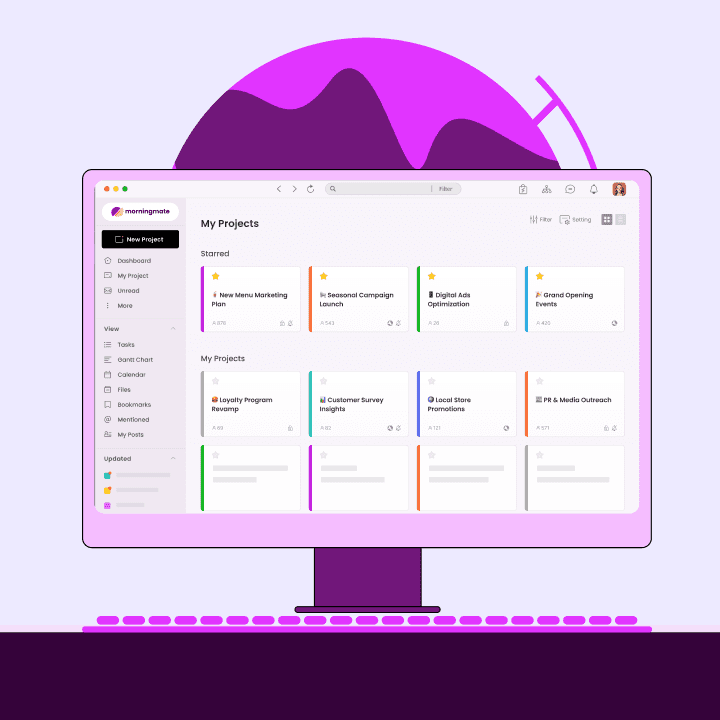
Let's walk through a concrete example. Imagine your ops team manages a weekly vendor reconciliation process involving three people: a procurement coordinator, a finance reviewer, and yourself as approver. Here is how that process typically runs in WhatsApp — and how it runs in Morningmate, a lightweight work management tool built for teams that need real task tracking without the complexity of enterprise software.
In WhatsApp: You post a reminder in the ops group on Monday. The coordinator replies that they have started. The finance reviewer either misses the message or responds two days later in a thread that has already moved on. By Friday, you are manually chasing both parties for confirmation, and there is no record of what was agreed or when.
In Morningmate: You create a recurring task called "Weekly Vendor Reconciliation" with the coordinator as assignee, a Wednesday due date, and the finance reviewer tagged as a collaborator. Each step of the process is a subtask with its own owner. The task sits in a shared workspace that everyone on the team can see — not buried in a chat scroll. When the coordinator marks their portion complete, the finance reviewer gets an automatic notification. You see status in real time on your dashboard. No chasing required.
Morningmate's feed-style interface makes this feel familiar — it looks more like a structured social feed than a traditional project management tool, which means non-technical team members adopt it without resistance. The built-in chat is still there for quick communication, but it is separated from the task tracking layer, so work coordination and conversation no longer compete for the same space.
Process Step | WhatsApp Approach | Morningmate Task Flow |
|---|---|---|
Task assignment | Posted in group, unclear owner | Named assignee, due date, subtasks |
Progress tracking | Manually chase via messages | Live status visible on shared board |
Handoff between team members | Relies on memory or re-messaging | Automatic notification on completion |
Manager approval | Informal message, easy to miss | Structured approval step with record |
Post-process review | No history, no audit trail | Full task history, searchable record |
Reduction in Status-Chasing Time After Switching to Structured Task Management
12%
Still using WhatsApp
41%
Email + spreadsheet combo
68%
Dedicated task management tool
Fig 2: Average reduction in manager time spent chasing task updates, by toolset (illustrative)
Your Task Management Migration Checklist
Making the move from WhatsApp to structured task management does not have to be a disruptive overhaul. The key is sequencing it so your team adopts the new system without reverting to old habits. Use this checklist to get started.
Audit your current task flows. List every recurring process your team manages via WhatsApp. These are your highest-priority candidates for migration.
Pick one process to standardize first. Do not migrate everything at once. Start with the workflow that causes the most status-chasing or rework.
Define task structure before you build it. For each process, identify: task name, assignee, due date, dependencies, and what "done" looks like.
Choose a tool that matches your team's comfort level. If your team is not technical, you need a task management platform with an interface they recognize — not one that requires a week of training. Morningmate's feed-based layout is specifically designed for this, and is used by over 550,000 teams globally for exactly this reason.
Set a "no WhatsApp for work tasks" norm. Communication still happens in chat — but task assignments and status updates move to the dedicated tool. This boundary is critical.
Build onboarding into the system. When a new team member joins, their first view of active work should come from the task management platform, not from someone briefing them over a call.
Review and iterate monthly. Task management standardization is not a one-time project. Schedule a monthly ops review to catch process drift before it becomes a habit.
The DRIFT framework gives you a clear lens for diagnosing where your current setup is failing. Decay, Responsibility gaps, Inaccessibility, Fragmentation, and Traceability loss — each one is fixable, but only with a tool that was actually built for task management. WhatsApp was not. The sooner your team operates from a system that holds task tracking, accountability, and communication in one organized place, the sooner you stop being the human glue holding it all together — and start leading instead of chasing.