Project Management

Good task management is supposed to keep your team moving forward — but there is a quiet saboteur sitting right inside most small businesses, and it looks completely innocent. It is the "quick update" culture: the habit of pinging someone for a status check, dropping a voice note in the group chat, or calling a five-minute huddle to find out where things stand. Individually, none of these feel like a problem. Collectively, they are eating your team's most productive hours alive.
If you run a team of 5 to 50 people, you are probably nodding right now. Your day is a relay race of short interruptions dressed up as collaboration. Someone needs a quick word. Someone else wants to loop you in. By 3pm, you have been "in the loop" twelve times and finished almost nothing of real substance. That is not a people problem. That is a task coordination problem — and it has a fix.
This article breaks down exactly why constant-update culture destroys deep work, what it is actually costing your business, and the practical steps you can take this week to reclaim focused time without losing visibility on what your team is doing.
The Real Cost of "Just a Quick Update" on Task Management
Every time someone interrupts a focused work session for a status update, the damage is bigger than the two-minute conversation suggests. Research published in Harvard Business Review has consistently shown that it takes an average of 23 minutes to regain full concentration after an interruption. Multiply that by six interruptions a day per employee and you have lost nearly two and a half hours of deep work — per person, per day.
For a small business, that math is brutal. You do not have slack in the system the way a 200-person company does. Every hour lost to unnecessary task tracking conversations is an hour not spent on work that actually moves the needle.
Hidden cost | What it looks like day-to-day | Estimated weekly impact (10-person team) |
|---|---|---|
Interruption recovery time | 6 status pings per person per day × 23 min refocus | ~115 hours lost |
Duplicate task coordination | Two people working on the same thing without knowing | 8–15 hours wasted |
Decision amnesia | Verbal updates disappear, tasks get re-discussed | 4–10 hours re-spent |
Owner bottleneck | Team waits on you for approvals or direction | Delays compound daily |
Why This Happens: The Root Cause Is Not Laziness
Most small business owners assume the problem is attitude — people not taking initiative, or the team being too dependent. But that is almost never it. The actual root cause is a structural one: your team has no reliable, shared place to see task status without asking someone.
When task management lives across a mix of WhatsApp threads, email chains, spreadsheets, and someone's personal to-do list, the only way to know where something stands is to ask. So people ask. Constantly. It is not a culture problem — it is an information architecture problem.
McKinsey's 2026 workplace productivity research found that employees spend a significant portion of their workweek searching for information or waiting on responses — time that could be entirely eliminated with a properly structured task workflow. For a lean team, that is the difference between shipping work and talking about shipping work.
The second cause is that "update culture" gets mistaken for engagement. As a founder, you probably value responsiveness and communication — and your team picked up on that. So they communicate constantly, even when the communication adds no new information. It feels productive. It is not.
How Bad Is It? The Numbers Behind Interrupted Task Workflows
The scale of this problem is larger than most owners realize until they see the data laid out. Asana's Anatomy of Work report found that workers spend more than 60% of their time on work about work — status updates, searching for files, following up on tasks — rather than the skilled work they were actually hired to do. For a small team where every person carries significant output responsibility, that is unsustainable.
Hours Per Week Spent on "Work About Work" vs. Skilled Output
24 hrs
Status updates & chasing
10 hrs
Searching for files/info
16 hrs
Meetings & check-ins
30 hrs
Actual skilled work
Fig 1: Estimated weekly hours breakdown for a 10-person SMB team (illustrative, based on industry research)
When nearly half the working week is consumed by coordination overhead instead of task execution, your team's real output capacity is half what you are paying for. And unlike a large company, you probably cannot just hire your way out of this problem.
A Practical Fix: Build a Task Management System That Answers Questions Before They Get Asked
The goal is simple: make task status visible to everyone without anyone having to ask. Here is a step-by-step approach that works for lean teams and does not require a big process overhaul.
Step 1 — Move every task out of chat and into a shared task management space
Stop assigning work in WhatsApp or email. Any task that lives only in a chat thread is invisible the moment it scrolls out of view. Pick one place where all tasks live — with an owner, a due date, and a status — and make it non-negotiable. This alone removes 60% of the "just checking in" messages.
Step 2 — Create a simple status vocabulary your team actually uses
You do not need complex workflows. Three or four statuses are enough: Not started, In progress, Blocked, Done. When task tracking shows a real-time status, people stop pinging each other to find out where things are. They look it up in under ten seconds.
Step 3 — Replace your daily stand-up ping with an async task update
Instead of a morning check-in where everyone says what they are working on out loud, have each person post a brief written update to the shared workspace. This takes two minutes per person, happens at their own pace, and creates a written record. No calendar block required. No interruption to deep work.
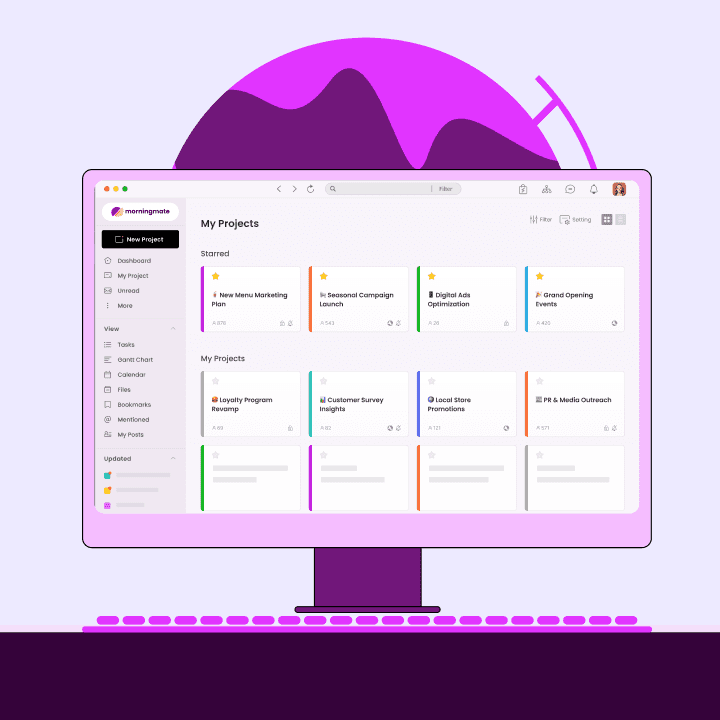
This is exactly where a tool like Morningmate earns its keep. It combines a social-media-style Feed view — where team members post brief work updates — with a built-in task management board, so async check-ins and task tracking happen in the same place. There is no switching between a chat app and a separate project tool. Used by over 550,000 teams worldwide, it is designed specifically to be lightweight enough for non-technical teams to actually adopt.
Step 4 — Set a "no update requests before checking the board" rule
Make it a team norm: before messaging someone for a status update, check the task management board first. If the answer is there, no message needed. This is a cultural shift, but it is fast to embed when the board is genuinely kept up to date. Within two weeks, most teams report a 50–70% drop in internal status messages.
Step 5 — Give yourself a daily five-minute review instead of an all-day feedback loop
As the owner, your job shifts from fielding updates to reviewing the task workflow once or twice a day on your own schedule. If something is blocked, it is flagged visibly. You act on it when you choose to, not when someone interrupts you. That is what real task visibility looks like for a founder who needs to think, not just react.
Comparing Task Management Approaches for Small Teams
Not all task coordination methods are equal. Here is an honest comparison of the most common approaches small businesses use — and what each one actually costs you in practice.
Approach | Visibility | Interruption level | Setup effort | Best for |
|---|---|---|---|---|
WhatsApp / group chat | Near zero | Very high | None | Teams under 3 people |
Email task tracking | Low | High | None | Nobody, really |
Shared spreadsheet | Medium (if maintained) | Medium | Medium | Static project tracking only |
Heavy PM tools (Jira/Asana) | High | Low | Very high | Tech teams with dedicated ops |
Morningmate | High | Low | Low (familiar interface) | SMBs who want results, not complexity |
The comparison above makes one thing clear: the tools most small businesses default to are the worst possible choice for task coordination at scale. And the tools that do the job well are often dismissed as too complex — when in reality, a lightweight option exists that hits the sweet spot.
Morningmate is built specifically to avoid the trap of tool sprawl. It keeps task management, built-in chat, and file sharing all in one place, with a familiar interface that your team can learn in an afternoon — not weeks of onboarding. Choosing the right collaboration tool for your team size matters more than most owners realize until they have already wasted time and money on the wrong one.
What Happens After You Fix Task Management: The Productivity Lift
Teams that move from reactive update culture to structured task tracking see measurable shifts within the first month. The changes are not subtle — they show up in output, morale, and your own day as the owner.
Reduction in Internal Status Messages After Adopting Structured Task Tracking
5%
Chat-only teams
30%
Spreadsheet tracking
55%
Dedicated PM tools
72%
Integrated hub (e.g. Morningmate)
Fig 2: Average reduction in internal status-check messages by task coordination method (illustrative)
The biggest gains come when chat and task management live in the same tool. When your team does not have to switch context — from a chat app to a project board to an email — they stay in flow longer and interrupt each other less. Morningmate's built-in chat mirrors the WhatsApp interface your team already knows, sitting right alongside the task board, so adoption is fast and the friction to stay organized is nearly zero.
You can also learn how to build an async-first communication habit that compounds these gains over time, without requiring your team to be online all at the same time.
Your Next Step: One Change That Pays Back Immediately
Good task management is not about adding complexity. It is about replacing the question "where does this stand?" with a place your whole team can look — without asking anyone. That single change eliminates the interruption loop that is quietly burning your team's most productive hours every day.
The ROI is straightforward: if structured task tracking recovers even three hours of deep work per person per week across a ten-person team, that is thirty hours of real output gained — every single week — without adding headcount or budget. For most small businesses, that is the equivalent of a part-time hire, except it compounds over time instead of adding to your payroll.
Start this week. Pick one active project. Move every task for that project out of chat and into a shared task management board with an owner, a due date, and a visible status. Run it for two weeks and count how many "just checking in" messages disappear. That number will tell you everything you need to know about whether to scale the habit across your whole team.
If you want to skip the setup friction, Morningmate gives you task management, async updates, and team chat in one lightweight workspace — no IT team required, no months-long rollout. Your team will be using it the same day you sign up. The time to fix your task workflow is not next quarter. It is now.