Project Management

Good task management is supposed to tell you, at a glance, whether your team is actually moving forward — but most small marketing teams can't answer that question with confidence. You look around and everyone is busy: messages pinging, calendars packed, docs multiplying. And yet the campaign launch slips. The blog post misses the window. The founder's feedback arrives two days late and blows up the whole timeline. Being busy and being productive are two completely different states, and confusing them is one of the most expensive mistakes a small marketing team can make.
The gap between the two shows up fastest during crunch time. Task tracking falls apart not because people aren't working hard, but because the system — or lack of one — hides the real status of work. Requests get buried in Slack threads, approvals float in email, and your freelancer is still waiting on copy that someone forgot to send. Meanwhile, the founder thinks everything is on track because the last message they saw said "almost done."
This article is a practical guide to diagnosing which mode your team is actually in, and giving you a repeatable task workflow to shift from performative busyness to measurable output. Let's get into it.
The Campaign Day That Fell Apart (Sound Familiar?)
It's 9 AM on launch day for your product promotion campaign. The email is scheduled, the social graphics are "done," and the landing page went live yesterday. Then it starts. Your designer sends a revised banner — the fourth version — over WhatsApp because she couldn't find the feedback thread. Your freelance copywriter emails to ask which headline you decided on. The founder pings you asking to see the final ad set before it goes live... which it already did, an hour ago.
Nobody missed a deadline technically. Everyone was busy right up until launch. But the campaign goes out with the wrong headline variant, the landing page CTA doesn't match the email, and you spend the afternoon in damage control instead of monitoring performance. This is what busy-without-productive looks like in marketing — and it's more common than any team wants to admit.
Where Task Management Actually Breaks Down
The breakdown rarely happens because of laziness or incompetence. It happens because task coordination across a tiny team — with a founder, freelancers, and a marketing manager all working from different tools — creates invisible bottlenecks. Asana's Anatomy of Work report found that workers spend 58% of their time on work about work — status updates, chasing approvals, searching for information — rather than on skilled, strategic tasks. That number is even higher in small teams where no one has designated operational support.
The Three Bottlenecks Killing Your Task Workflow
The first bottleneck is scattered context. Feedback lives in five places: a WhatsApp message, an email reply, a comment on a Google Doc, a verbal note from a standup, and a Slack DM. Nobody has the full picture, so tasks get restarted, redone, or launched wrong.
The second bottleneck is approval limbo. The founder is the final approver on most things, but they're also running sales calls and investor meetings. Without a clear system, "send for approval" means "hope they see it before the deadline." Task tracking only works if the approval step is a real, visible, assignable action — not a prayer sent via email.
The third bottleneck is invisible task status. When someone says "I'm working on it," there's no way to know if they're 10% done or 90% done. Without structured task management, managers default to chasing updates instead of leading strategy. According to Harvard Business Review, unclear accountability loops are one of the most consistent predictors of team underperformance — and marketing teams are especially vulnerable given how collaborative and revision-heavy the work is.
Here's a quick diagnostic to see which mode your team is in right now:
Signal | Busy Team | Productive Team |
|---|---|---|
Campaign status | Ask someone to find out | Visible in your task board in seconds |
Approvals | Sent by email, lost, resent | Assigned task with due date and owner |
Freelancer handoffs | Email attachments + follow-up DMs | Centralized brief + file + feedback thread |
Founder involvement | Surprise reviews at the last minute | Scheduled review steps built into the workflow |
Post-campaign learning | Informal debrief, quickly forgotten | Notes captured in the same workspace as the tasks |
How Much Time Gets Lost to "Busy Work" vs. Real Output
Before moving to the fix, it helps to see the scale of the problem. McKinsey research found that employees spend nearly 20% of their working week searching for internal information or tracking down colleagues. For a marketing manager running campaigns, content, and social simultaneously, that's a full day every week burned on task coordination overhead rather than actual marketing.
Where Small Marketing Team Hours Actually Go (Weekly)
20%
Chasing updates
38%
Coordination overhead
42%
Actual skilled work
Fig 1: Estimated weekly hour distribution for small marketing teams (illustrative, based on McKinsey and Asana research)
The Repeatable Task Management Play for Small Marketing Teams
You don't need a complex project management system to run tight campaigns. You need a lightweight, repeatable task workflow that everyone actually follows. Here's the five-step play that works even with a team of three people plus a founder and two freelancers.
Step 1: Break every campaign into named tasks before work starts. Not a checklist in your head — actual task cards with titles, owners, and due dates. "Launch email campaign" is not a task. "Write subject line variants (3 options) — due Tuesday, owned by copywriter" is a task.
Step 2: Assign every approval as its own task. Founder review is not a soft handoff. Create a task: "Founder approves final ad creative — due Thursday noon." This makes approval a trackable action, not a hope.
Step 3: Keep all feedback attached to the task, not scattered in chat. When the designer uploads a revision, the feedback lives on the same card. No hunting through WhatsApp. No "which version did we approve?" on launch day.
Step 4: Use a visible status system (not just "done" and "not done"). At minimum: To Do → In Review → Approved → Live. These four stages alone eliminate 80% of the "where are we on this?" questions.
Step 5: Run a 15-minute weekly task review every Monday. Not a full standup. Just: what shipped last week, what's blocked this week, what needs a decision from the founder. This single habit compresses a week's worth of status-chasing into one focused session.
Common Task Management Failure Points (and How to Dodge Them)
Even good systems collapse under predictable pressure. Here's what breaks task tracking in small marketing teams — and the fix for each.
Failure Point 1: The Founder Bypasses the System
The founder sends feedback by text at 11 PM. Your designer sees it first, makes the change, and now the task board doesn't reflect reality. Fix: agree upfront that all feedback — including the founder's — goes on the task card, even if it's just a quick comment. Make it the path of least resistance by keeping the system simple enough for a non-technical person to use in 30 seconds.
Failure Point 2: Freelancers Work Outside the System
Your freelancer delivers work by email because that's how they always do it. Brief them on your task workflow at the start of every engagement. Most freelancers adapt quickly when the system is simple and doesn't require them to learn a complex new tool.
Failure Point 3: Tasks Without Due Dates
A task without a due date is a wish. Every single task — including internal reviews and feedback rounds — needs a specific date attached. Ambiguity is where timelines go to die.
Failure Point 4: The System Is Too Heavy to Maintain
Teams abandon task coordination tools when updating them takes longer than just messaging someone. This is why the tool itself matters. You need something that requires minimal overhead to keep current — otherwise, the system becomes another form of busy work.
How Morningmate Solves the Task Management Problem for Marketing Teams
This is where the right tool makes a measurable difference. Morningmate is a lightweight work management platform used by over 550,000 teams worldwide, built specifically to replace the chaos of email threads and personal chat apps — without the complexity of tools like Jira or Asana that take weeks to set up and require dedicated admins to maintain.
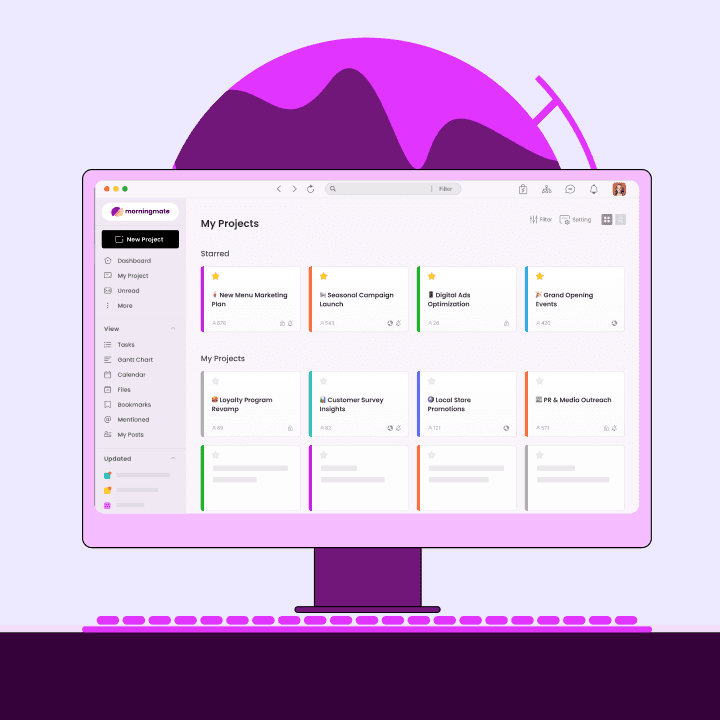
The key for a small marketing team is that Morningmate combines task management, built-in chat, and file sharing in one place. Its Feed view works like a social media timeline — your team actually uses it because it feels familiar, not like enterprise software. Approvals become assigned tasks with due dates. Feedback on creative assets lives on the task card, not scattered across three messaging apps. The founder can check in and leave comments without needing a tutorial.
Worked Example: Product Promotion Campaign
Here's how this plays out in practice. You're managing a two-week promotional campaign across email, paid social, and organic content. In Morningmate, you create a project for the campaign and break it into tasks: copy brief, design brief, email build, ad creative, landing page copy, founder review, and go-live sign-off. Each task has an owner and a due date. The freelance designer is added as a guest — she uploads assets directly to the task card and tags you when it's ready for review.
The founder gets a task assigned: "Review and approve final ad creative — due Thursday 2 PM." He sees it in his Morningmate feed, clicks through, leaves one comment ("change the CTA to 'Get Started'"), and marks the task approved. Your designer sees the comment in the same task thread, makes the update, and the campaign launches with everyone aligned. No 11 PM text message. No "which version did we decide on?" Total time for the founder: six minutes.
That's the difference between task tracking as a habit and task tracking as a system. Morningmate makes it easy enough that the habit actually sticks.
Task Management Workflow: Busy vs. Productive Compared
Here's a side-by-side look at how task coordination actually changes when you move from reactive to structured:
Workflow Step | Busy Team Approach | Productive Team Approach |
|---|---|---|
Campaign kickoff | Kickoff meeting, notes in email | Tasks created with owners + due dates before the meeting ends |
Creative brief | PDF emailed to freelancer | Brief attached to task, freelancer comments and delivers in same thread |
Revision round | Feedback in WhatsApp, v2 emailed separately | Feedback on task card, version history visible to all |
Founder approval | Email with "Please review ASAP" | Task assigned to founder with due date and single-click approve |
Post-campaign review | Verbal debrief, nothing documented | Notes logged in the project workspace for the next campaign |
What Happens When Task Coordination Actually Works
Teams that shift from scattered to structured task management don't just launch campaigns more smoothly. They reclaim significant time that gets reinvested into strategy, creative quality, and iteration. The improvement in output per hour — not hours worked — is the real measure of productive versus busy.
Reduction in Campaign Coordination Overhead After Adopting Structured Task Tracking
5%
No system
35%
Basic task lists
68%
Structured task workflow
Fig 2: Estimated reduction in coordination overhead by task management maturity level (illustrative)
Your Task Management Checklist to Apply This Week
You don't need to overhaul everything at once. Start with your next campaign and apply this checklist. Each item directly shifts your team from busy to productive.
Break your next campaign into individual named tasks — one owner, one due date per task, no shared "we'll all handle it" assignments
Create a dedicated approval task for the founder — written, dated, tracked — not a message asking them to "take a look"
Stop using email or WhatsApp for creative feedback — pick one place where feedback lives and enforce it for one full campaign cycle
Add four status labels to your task tracking: To Do, In Progress, In Review, Done — and keep them updated daily
Block 15 minutes every Monday to review task status as a team — this replaces ad hoc check-ins throughout the week
Brief every freelancer on your task workflow at the start of each engagement — two minutes of onboarding saves hours of chasing later
After your next campaign, log three lessons learned in the same workspace where the tasks lived — so the next campaign starts smarter
The goal isn't to add process for the sake of process. It's to make the actual state of your marketing work visible — to you, to your team, and to your founder — so that decisions get made faster, approvals don't slip, and launch day is boring in the best possible way. That's what real task management delivers. And that's exactly the difference between a team that looks busy and a team that's actually productive.