Project Management

Good task management is supposed to keep your campaigns moving — but when a team member walks out the door, even the most organized marketing operation can unravel overnight. You thought the brief was in the shared drive. Turns out it was in Priya's inbox. The approval chain? Buried in a Slack thread that no one can find. The freelancer's login details? Gone with the contractor who left last month. Sound familiar? Losing work context when a team member leaves is one of the most underrated productivity killers for small marketing teams, and it happens far more often than anyone tracks.
Task tracking in small teams is rarely as clean as the org chart suggests. When you are running campaigns, managing freelancers, and chasing founder sign-offs all at once, critical context tends to live in people's heads — not in systems. The moment someone transitions out, that institutional knowledge evaporates. What was the rationale behind that email subject line test? Why did we pull the LinkedIn ad in week two? Who approved the final copy? Nobody knows, and you are left reconstructing decisions from memory and half-read message threads.
This article is a practical playbook for fixing that. You will find a concrete task workflow for capturing context as you go, the most common failure points to avoid, and a worked example of how one marketing team stopped losing work knowledge every time someone moved on.
Where Task Management Actually Breaks Down When People Leave
The problem is not that people leave. Turnover, contractor rotations, and freelance churn are just facts of life for a lean marketing team. The real problem is that your task coordination was never designed to survive without the specific person who set it up.
Context Lives in the Wrong Places
Most small teams run task workflows that are person-dependent by design: a Trello board that only one person updates, a Google Sheet with colour-coded columns only the creator understands, a WhatsApp thread where the founder gave approval six weeks ago. Harvard Business Review has flagged for years that knowledge hoarding — even unintentional — is one of the biggest barriers to team performance. When that knowledge is tied to a person rather than a process, every exit is a mini-crisis.
Approvals and Decisions Are Never Documented
Think about the last campaign sign-off your founder gave. Was it in a task thread with the rationale attached? Or was it a voice note, a quick "looks good!" reply in email, or a verbal "yeah, go for it" in a hallway? Approval decisions made outside your task management system leave zero trace. The next person to pick up that campaign has no idea what was approved, why, or whether the parameters have since changed.
According to McKinsey's research on knowledge worker productivity, employees spend an average of 1.8 hours every day searching for information and tracking down colleagues. For a two- or three-person marketing team, that is nearly a full day lost every week — just trying to reconstruct context that should have been captured the first time.
Here is a quick breakdown of where context typically lives versus where it should live:
Type of Context | Where it usually lives | Where it should live |
|---|---|---|
Campaign rationale | Creator's memory or inbox | Pinned task description or brief file |
Approval decisions | Chat thread or verbal | Logged comment on the task |
Freelancer briefs | Emailed PDF, lost on exit | Attached to the relevant task |
Revision history | Version 4_FINAL_v2.docx | Task comments with change notes |
Strategic decisions | Founder's head | Decision log linked to project task |
How Bad Is the Context-Loss Problem? The Numbers
It is easy to dismiss context loss as a soft problem — annoying but manageable. The data says otherwise. Gallup's research on workplace engagement consistently shows that unclear roles and lost institutional knowledge are top drivers of disengagement and rework. For a small marketing team, rework is not just frustrating — it directly eats into campaign velocity and output quality.
Where Marketing Work Context Gets Lost (% of teams affected)
71%
Chat apps & email
58%
Verbal approvals
44%
Scattered file storage
29%
Structured task tools
Fig 1: Common sources of work context loss in small marketing teams (illustrative, based on industry patterns)
A Repeatable Task Management Play to Capture Context as You Go
The fix is not a massive knowledge-management overhaul. It is a lightweight task workflow habit you build into every campaign from day one. Here is a six-step play your team can start using this week.
Create one task per campaign deliverable, not per campaign. Instead of a single "Q3 Email Campaign" task, create separate tasks for brief, copy, design, approval, and send. Each task becomes its own context container.
Write the "why" into the task description. Before assigning a task, add two to three sentences explaining the goal, the audience, and any constraints. This takes 90 seconds and saves hours of reconstruction later.
Log every approval as a task comment. When the founder approves a subject line in chat, copy that message into the relevant task as a comment. Date it. Tag the approver. Done.
Attach files directly to tasks, not to emails. Every brief, asset, or reference doc lives on the task itself. No more hunting through shared drives or old inboxes.
Add a "handover note" when closing a task. Before marking something complete, the assignee writes one paragraph: what was decided, what was left open, and what the next person needs to know. Takes three minutes. Saves hours.
Run a monthly "context audit." Once a month, review active tasks and flag any that exist only in someone's head. If a task cannot be understood by a new team member without asking the assignee, it needs more documentation.
This task coordination system is intentionally lightweight. It does not require new software or long onboarding sessions. It just requires the discipline to treat tasks as living documents rather than to-do list checkboxes.
Common Failure Points in Task Tracking — and How to Avoid Them
Even teams that commit to better task workflow habits tend to fall into the same traps. Here are the biggest failure points and the quick fixes for each.
Failure Point 1: "We'll document it later"
Later never comes. When a campaign is live and moving fast, documentation feels like overhead. Build it into the task creation step, not the closeout step. If context is not captured when the decision is made, it will not be captured at all.
Failure Point 2: One person owns the entire task system
If your task management setup only works because one person maintains it, you have a single point of failure. Distribute ownership. Every team member — including freelancers — should be able to add a comment or upload a file without needing to ask someone else for access.
Failure Point 3: Approvals happen outside the task workflow
This is the biggest one. The founder approves copy via text. The designer gets feedback in a personal DM. The campaign launches without a single approval logged anywhere in your task coordination system. When something goes wrong — or when someone new needs to understand what happened — there is no record. The fix: make it a team norm that all approvals must be confirmed inside the task, even if the initial discussion happened elsewhere.
Failure Point 4: Freelancers are excluded from the task system
Contractors and freelancers often communicate via email, delivering work outside your core task tracking environment. That means their output — and any feedback or revision history — lives in a silo. Bring freelancers into your task workflow directly. Assign them tasks, share briefs there, and collect deliverables there. Their work becomes part of the institutional record, not an orphaned email attachment.
How Morningmate Keeps Task Context Intact — A Worked Example
Here is what this looks like in practice. Imagine a three-person marketing team running a product launch campaign: a marketing manager, a part-time content writer, and a freelance designer. The founder is the final approver on all copy and creative.
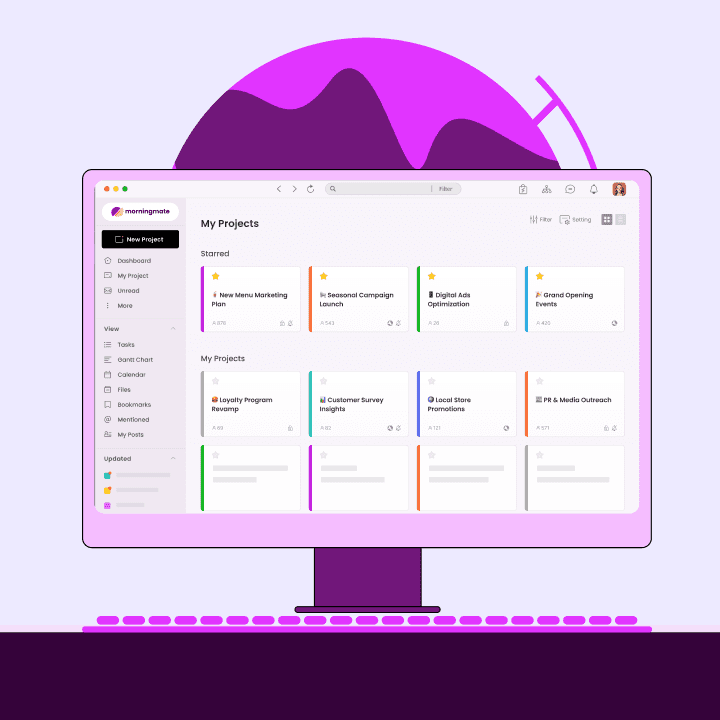
Using Morningmate — a lightweight work management tool that combines task management, file storage, and built-in chat in one place — the team sets up the campaign as a project with individual tasks for each deliverable. The marketing manager writes the campaign brief directly into the task description. The content writer drafts copy, attaches it to the task, and tags the founder for approval. The founder reviews and leaves a comment on the task: "Approved — keep the urgency framing, avoid the discount language." That comment is now permanently attached to the task. Anyone who joins the project later — including a new freelancer onboarding in three months — can read the entire decision history without asking anyone.
When the designer finishes the creative, they upload the final files directly to the design task and add a handover note: "Used the purple variant per founder feedback on 14 March. The orange version is in the attachments as a backup if needed." The task is marked complete, but the context lives on.
Morningmate's built-in chat mirrors a WhatsApp-style interface, so non-technical team members and freelancers adopt it instantly — no training required. But unlike WhatsApp, every conversation thread is linked to a project or task, meaning nothing gets buried in a personal inbox when someone leaves. The interface feels familiar, but the structure keeps task coordination intact across team changes.
Compare that to the traditional approach most small teams rely on:
Scenario | Scattered tools (chat + email + sheets) | Morningmate task workflow |
|---|---|---|
Team member leaves | Context disappears with them | All task history stays in the project |
Founder gives approval | Text message, no record | Logged as task comment, timestamped |
Freelancer submits work | Emailed attachment, siloed | Uploaded to task, visible to all |
New team member onboards | Days of catch-up questions | Reviews task history independently |
Campaign retrospective | Incomplete, based on memory | Full decision trail available |
Time Saved Per Week After Adopting Structured Task Management
0.5 hrs
Email + chat only
2.1 hrs
Spreadsheet tracking
4.8 hrs
Structured task tool
Fig 2: Estimated weekly hours saved on information retrieval by task management approach (illustrative)
Your Task Management Checklist for This Week
Stop waiting for the next team member departure to expose how fragile your task coordination is. Apply this checklist to your current active campaigns before the week is out.
✅ Audit your active tasks. Can a new person understand each one without asking anyone? If not, add a description today.
✅ Find your last five approval decisions. Are they logged inside a task? If they are in chat or email, copy them over now.
✅ Check your freelancer workflow. Are briefs and deliverables living inside your task system, or in email attachments? Move them.
✅ Add a "why" field to your next three task descriptions. Two sentences explaining the goal and constraints. Build the habit now.
✅ Assign a backup owner to every active campaign task. No task should have a single point of failure.
✅ Schedule a 15-minute monthly context audit. Review active tasks and flag any that only exist in someone's head.
✅ Introduce a handover note habit. Before any task is closed, the assignee writes one paragraph of context for whoever comes next.
Strong task management is not about having the most sophisticated system. It is about making sure the work your team does today is still understandable six months from now, by someone who was not in the room. Every decision logged, every approval recorded, every brief attached to its task — that is the real competitive advantage for a small marketing team running fast. Start building that muscle now, and the next time someone leaves, you will barely notice the gap.