Project Management

Every time your team kicks off a new project, someone faces a blank page — and that blank page is costing you more than you think. Effective task management should begin the moment a project is scoped, not after hours of reinventing structure, ownership, and timelines that already existed in a previous initiative. Yet in most growing SMBs, that reinvention is exactly what happens, repeatedly, across every team and every quarter.
The problem is not a lack of effort. Your people are capable. The problem is that task coordination starts from scratch every single time because there is no reusable system — no standardized structure for how work gets defined, assigned, tracked, and handed off. The result: inconsistent execution, duplicated effort, and the constant low-grade chaos that makes scaling feel harder than it should be.
According to Project Management Institute research, organizations waste an average of 11.4% of investment due to poor project performance — much of it tied to inadequate process standardization. For an ops manager trying to hold a growing organization together, that number translates directly into missed deadlines, re-done work, and frustrated teams. This article gives you a concrete framework to fix it.
The Compounding Cost of Starting From Zero
Starting every project from a blank page feels like a small inefficiency in isolation. But the costs stack. When your task management has no repeatable structure, onboarding new team members takes longer because there is nothing to point them to. Cross-team handoffs break down because each team has built its own version of a workflow. Status updates get chased manually because no one agreed on how progress would be reported in the first place.
Asana's Anatomy of Work report found that workers spend 58% of their time on work about work — status checks, searching for information, duplicating effort — rather than on the skilled tasks they were hired to do. That figure does not shrink on its own. It shrinks when task workflow becomes systematic.
Here is what the blank-page problem looks like in real numbers for a 20-person operations team:
Inefficiency | Hours Lost Per Project | Annualized Cost (10 projects/year) |
|---|---|---|
Re-building task structure | 4–6 hrs per project lead | 40–60 hrs per lead |
Chasing status updates manually | 2–3 hrs/week during execution | 80–120 hrs per manager |
Onboarding without documented flow | 8–12 hrs per new hire | Multiplied by every hire |
Duplicated cross-team effort | 3–5 hrs per cross-functional project | 30–50 hrs across teams |
These are not edge cases. They are the default state for any growing team that has never formalized its task tracking approach. And the fix is not just "better tools" — it is a deliberate framework applied consistently.
Introducing the SCOPE Framework for Standardized Task Management
To move your team off the blank page permanently, you need a model that is simple enough to remember and rigorous enough to actually standardize task coordination across teams. Call it the SCOPE Framework: Structure, Context, Ownership, Progress, and Exit. Each component addresses a specific point where ad-hoc task management tends to break down in growing SMBs.
SCOPE is not a project methodology in the traditional sense. It is an operational checklist that gets embedded into every project kickoff — regardless of team, department, or project size. Once it is running, starting a new project no longer means starting from nothing. It means filling in a known structure with new specifics.
S — Structure: Pre-Built Task Management Templates
Structure is the first thing that disappears when task management is ad hoc. Every project lead has their own approach: some use spreadsheets, some use a doc, some work entirely from memory. The result is a fragmented task workflow that cannot be audited, replicated, or handed off.
The fix is templating. Before any new project begins, your team should have access to a pre-built task structure — a standardized set of task categories, phases, and fields that apply to that project type. For example, a vendor onboarding project always has the same five phases: qualification, contract review, system setup, team briefing, and go-live. Those phases should already exist as a template. Your task tracking starts with populating them, not inventing them.
Practically, this means identifying your three to five most common project types, mapping out their repeating task structures, and saving those as reusable templates inside your work management system. Time invested once; saved every subsequent project.
C — Context: Attach Knowledge to Tasks, Not to People
Knowledge silos are the silent killer of cross-team task coordination. When critical context lives in someone's inbox, their memory, or a chat thread from three months ago, your task management has a single point of failure: that person.
McKinsey research has consistently shown that employees spend nearly 20% of their working week searching for internal information. In a task workflow context, this means your team members are spending a full day each week just trying to find what they need to execute their work — not actually executing it.
Context standardization means every task carries the information needed to complete it: a brief description, relevant files, links to prior decisions, and a clear definition of done. This is especially critical for onboarding. When a new hire joins, they should be able to open any active task and understand the what, why, and how without needing to interrupt a senior colleague.
O — Ownership: Single Accountable Owner per Task
One of the most common failure patterns in task tracking is the shared ownership problem. When a task is assigned to a team or a group, it is effectively assigned to no one. Accountability diffuses, deadlines slip, and the ops manager ends up manually chasing status — which is precisely the pattern you are trying to escape.
The SCOPE Framework mandates one accountable owner per task — not a team, not a department, one person. That person is responsible for completion, for raising blockers, and for updating status. Others can be tagged as contributors or reviewers, but the single owner role cannot be shared.
For cross-team task coordination, this rule becomes even more important. When Finance hands a task to Operations, and Operations hands a subtask to IT, each hand-off must include a named owner at the receiving end. Without that, the task disappears into the gap between teams.
Time Spent Chasing Status Updates (Hours/Week per Manager)
6.2 hrs
No Formal System
4.1 hrs
Spreadsheet Tracking
1.4 hrs
Standardized Task Mgmt
Fig 1: Average manager hours per week chasing status, by system maturity (illustrative, based on PMI and Asana benchmarks)
P — Progress: Standardized Task Tracking Cadences
Progress visibility should be automatic, not manually solicited. In a standardized task management system, status is always current — not because managers chase it, but because the workflow itself requires updates at defined intervals.
This means standardizing three things: how status is reported (a fixed set of values — Not Started, In Progress, Blocked, Complete), when it is updated (at task completion, at milestone transitions, or on a weekly cadence), and where it lives (in the task record itself, not in a separate email or chat message).
When progress reporting is embedded in the task workflow rather than bolted on as a separate ritual, you eliminate the status-chasing loop entirely. Your visibility into project health becomes a byproduct of the work itself.
E — Exit: Close-Out Standards That Feed the Next Project
The exit phase is where most teams drop the ball — and where the blank-page problem perpetuates itself. Projects close without a debrief, without capturing what worked, and without updating the template for next time. The next project lead starts fresh, repeating the same mistakes and reinventing the same structures.
A standardized close-out process for task management includes: marking all tasks to a final status, documenting what changed from the original plan and why, flagging any reusable assets or decisions for the template library, and sending a brief close-out summary to stakeholders. This takes under an hour and compresses onboarding time for every similar project that follows.
Manual vs. Standardized: The Before-and-After of Task Coordination
It helps to see the SCOPE Framework's impact laid out directly against how most growing SMBs currently operate. The differences are not cosmetic — they represent a fundamental shift in how task tracking absorbs or amplifies organizational chaos.
Dimension | Ad-Hoc Task Management | SCOPE-Standardized Task Management |
|---|---|---|
Project kickoff time | 4–8 hrs building structure | 30–60 min populating a template |
Ownership clarity | Assumed or shared, often unclear | Single named owner per task |
Status visibility | Manager must ask; inconsistent | Embedded in task record; always current |
Cross-team handoffs | Email threads, gaps in accountability | Structured task transfer with named owner |
Onboarding speed | Relies on tribal knowledge | Templates and context built into every task |
Post-project learning | Lost; next project starts from scratch | Captured; template library grows over time |
Applying the SCOPE Framework with Morningmate: A Worked Example
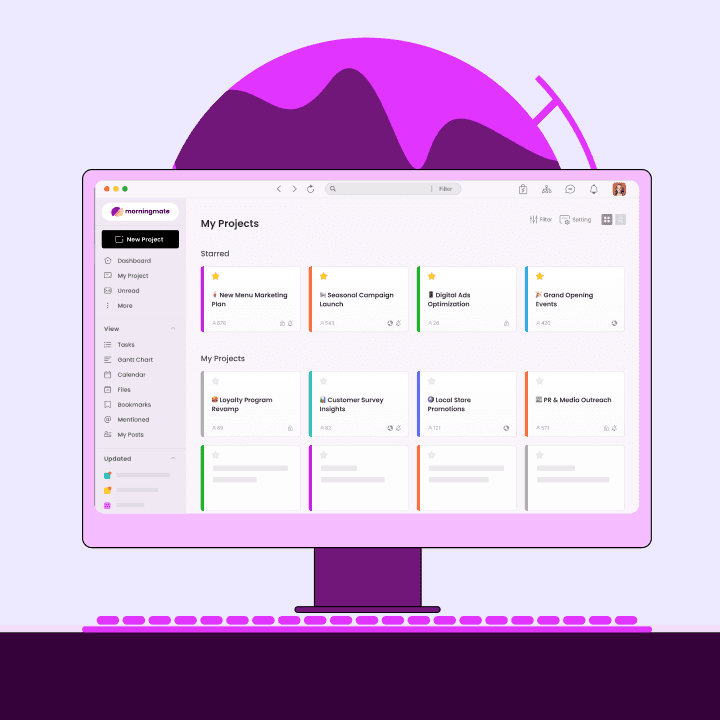
Here is what the SCOPE Framework looks like when implemented inside Morningmate, a lightweight work management tool used by over 550,000 teams worldwide. Morningmate combines task management with built-in chat and file management in a single workspace — the kind of setup that makes standardization practical rather than aspirational.
The scenario: Onboarding a new operations hire
Without a system, this process relies entirely on the hiring manager's memory and a series of ad-hoc Slack messages or emails. With SCOPE embedded in Morningmate, here is how each component plays out:
Structure: A saved Morningmate project template called "New Hire Onboarding — Operations" is duplicated at the start of every hire. It already contains tasks for IT setup, policy review, system access, team introductions, 30-day check-in scheduling, and role-specific training. The task workflow exists before anyone opens a blank page.
Context: Each task in the template includes a description, relevant file attachments (policy documents, access request forms, training materials), and links to prior decisions stored in the same workspace. The new hire's task tracking record becomes their orientation guide.
Ownership: Each task is assigned to a single named owner at duplication — IT setup goes to the IT lead, policy review is self-assigned to the new hire, system access requests go to the ops coordinator. Morningmate's task assignment feature makes this unambiguous and visible to everyone involved.
Progress: Status fields on each task are updated by the owner as work is completed. The hiring manager can view project progress across all onboarding tasks in Morningmate's board view without sending a single follow-up message.
Exit: At the 30-day mark, the template includes a close-out task: capture what changed, flag any process gaps, and update the master template. The next onboarding cycle starts sharper than the last.
Morningmate's Feed view — which mirrors the familiar format of a social media timeline — means team members can see task updates, file shares, and comments in one stream without learning a complex new interface. For non-technical operations teams, this dramatically reduces the adoption friction that kills standardization efforts before they start. You can explore how Morningmate handles task management for operations teams in more detail.
Project Kickoff Time Reduction After SCOPE Framework Adoption (% improvement)
12%
Partial Templating
41%
Full Template Library
68%
SCOPE + Integrated Tool
Fig 2: Estimated kickoff time reduction by standardization maturity level (illustrative)
Your Task Management Standardization Checklist
Implementing the SCOPE Framework does not require a six-month rollout. You can begin standardizing your task management this week with a focused sequence of actions. Use this checklist to drive the first 30 days:
Audit your three to five most common project types. Map the recurring phases and task categories for each. This becomes your template library foundation.
Build one template first. Start with the highest-volume project type. Define phases, standard tasks, required fields (owner, due date, status, context), and attach relevant documents.
Mandate single ownership. Update your task tracking standards so every task carries one named accountable owner — not a team name, not a shared role.
Standardize your status values. Choose four to five fixed status labels and enforce them across all active projects. Consistency is the point.
Schedule a close-out ritual. Add a close-out task to every template. Make it the final task in every project: update the template, document what changed, file the record.
Choose a tool that supports your system — not replaces it. Tools like Morningmate, which combines task workflow with built-in communication in a familiar interface, reduce the friction between planning and execution without requiring your team to learn complex software.
Run a 30-day review. Measure kickoff time, manual status requests, and onboarding speed before and after. The data will make the case for expanding standardization across teams.
The blank page is not inevitable. It is a symptom of a task management approach that has not yet been formalized. The SCOPE Framework gives you a named, repeatable structure to end the cycle — so your team stops reinventing the wheel on every project and starts building on what already works. Effective task coordination is not about working harder; it is about designing a system where good work compounds over time.