Project Management

Good task management should not depend on a single fifteen-minute window each morning. Yet for thousands of small business owners, the daily stand-up has quietly become the only moment when real project status gets shared — and that single point of failure is costing far more than most realize. When task coordination lives exclusively in a verbal meeting, anything that happens before, after, or between those meetings exists in a kind of blind spot: decisions get forgotten, blockers go unresolved for hours, and the owner ends up fielding "quick questions" all day because there is no other place to get a straight answer.
If your team runs on stand-ups alone, you already know the feeling. Someone was out sick and missed the update. A client deadline moved overnight, but nobody knew until the next morning's call. A task sat blocked for a full day because the person who could unblock it didn't realize there was a problem. These are not edge cases — they are the predictable result of treating task management as a once-a-day event rather than a continuous, visible system.
This article is about what actually gets lost when project updates only happen in stand-up meetings — and what a lean team of five to fifty people can do to fix it without adding complexity or cost.
The Stand-Up Was Never Meant to Carry This Much Weight
Stand-up meetings were designed as a quick sync, not a system of record. Research from Harvard Business Review consistently shows that over-reliance on meetings for information transfer creates organizational drag — people spend time preparing for and attending meetings instead of doing the work those meetings are supposed to coordinate. For a small business with a lean team, that drag compounds fast.
The deeper problem is that verbal updates are ephemeral. Someone says "the proposal is with the client," and twelve hours later nobody can remember exactly what was said, who owns the follow-up, or what the agreed deadline was. Task tracking without a written record is not really task tracking at all — it is a shared memory exercise, and shared memory degrades quickly.
What Actually Disappears Between Stand-Ups
Here is a concrete list of what your team loses every day when task management only happens in a morning meeting:
Blockers that sit unresolved. If someone hits a wall at 10 a.m., they either interrupt you, wait until tomorrow's stand-up, or quietly switch to lower-priority work. None of those outcomes is good.
Decisions that never get documented. A verbal "yes, go ahead" in a meeting disappears the moment people leave the room. Later, nobody agrees on what was decided.
Context for new or returning team members. Someone joining mid-project or returning from leave has no way to catch up. They either ask multiple people or stay confused.
Accountability for task completion. Without a visible task workflow, it is genuinely hard to know who owns what — and harder still to notice when something has stalled.
Your own time. When the stand-up is the only place to get updates, people bring every question to you. You become the human task management system.
The Real Cost of Stand-Up-Only Task Management
Let's put a number on it. Asana's Anatomy of Work report found that knowledge workers spend 60% of their time on "work about work" — status updates, searching for information, chasing approvals, and attending unnecessary meetings. In a ten-person team, that is six full-time equivalents doing coordination instead of output. For a small business owner paying salaries, that is a significant hidden payroll cost.
Beyond dollars, there is a team morale cost. People who cannot get clarity on their task coordination without waiting for a meeting feel less autonomous and more anxious. They either over-communicate (interrupting you constantly) or under-communicate (hiding blockers until they become crises).
What Gets Lost | Stand-Up Only | Real Business Impact |
|---|---|---|
Blocker resolution time | Up to 24 hours | Deadlines slip, clients notice |
Decision documentation | None (verbal only) | Rework, disputes, confusion |
Task ownership clarity | Relies on memory | Dropped balls, missed deliverables |
Onboarding / catch-up | No written trail | Owner becomes the source of truth |
Owner interruptions | High (no other channel) | Owner can't focus or step away |
Why This Happens: The Root Cause Is Not the Meeting
Most small business owners know intuitively that relying solely on a stand-up is fragile. So why does it persist? The honest answer is that the alternatives have felt worse. Project management tools like Jira or Monday.com require setup time, onboarding effort, and ongoing admin that a lean team simply cannot absorb. So the stand-up becomes the path of least resistance — it requires no software, no learning curve, and no discipline beyond showing up.
The problem compounds because most teams also use a mix of chat apps and email for day-to-day task coordination. That means project status is scattered across three or four places — the morning call, a WhatsApp thread, a Gmail inbox, and someone's notebook. There is no single, reliable task workflow that anyone can check at any time. According to McKinsey Global Institute, employees spend an average of 1.8 hours per day searching for information. In a small team, that search time is pure waste.
The root cause, then, is not the stand-up itself. It is the absence of a lightweight, always-visible task management layer that the whole team can actually use without training.
Time Lost Per Day Searching for Task Status or Project Information
108 min
Stand-up only
82 min
Chat + email mix
18 min
Centralized task tool
Fig 1: Estimated daily time lost chasing project status (illustrative, based on industry research)
A Practical Fix: Five Steps to Make Task Management Continuous
You do not need to overhaul how your team works. You need to add one lightweight layer that makes task tracking visible between meetings — not instead of them. Here is how to do it in sequence.
Step 1: Move Every Task Out of Verbal Space and Into a Written System
Every commitment made in a stand-up gets logged immediately — owner, due date, status. This does not have to be complicated. Even a shared document is better than nothing. The goal is that any team member can check task status without asking a person.
Step 2: Assign One Owner Per Task, Always
Shared ownership is no ownership. Every task in your task workflow must have exactly one named person responsible for it. If two people are involved, one is the owner and one is the helper. This single rule eliminates more dropped balls than any software feature.
Step 3: Make Blockers Reportable Without a Meeting
Create a simple habit: anyone who is blocked updates their task status to "blocked" and posts a one-line note explaining why. That signal should be visible to the whole team — including you — without requiring a meeting or a direct message. This is where a dedicated task coordination tool earns its keep. Tools like morningmate let team members update task status and leave contextual comments directly on a task, so blockers surface in real time rather than the next morning.
Step 4: Use the Stand-Up to Review What the System Already Shows
This is the reframe that changes everything. Instead of using the stand-up to collect updates, use it to discuss what the task management system already displays. The meeting becomes a conversation about decisions and priorities — not a data-gathering exercise. It gets shorter, more useful, and less stressful for everyone.
Step 5: Do a Weekly Five-Minute Task Audit, Not a Long Review
Once a week, spend five minutes scanning your task workflow for anything overdue, unassigned, or blocked for more than 48 hours. Address those specifically. This keeps the system honest without adding meeting overhead.
How One Tool Replaces the Patchwork
The five steps above work with any decent task management system. The challenge for small business owners is finding one that the whole team will actually use — including the non-technical people. Most tools are either too simple (a shared spreadsheet breaks the moment you scale) or too complex (Jira or Asana requires onboarding, admin, and ongoing maintenance that a five-to-fifty person team cannot afford).
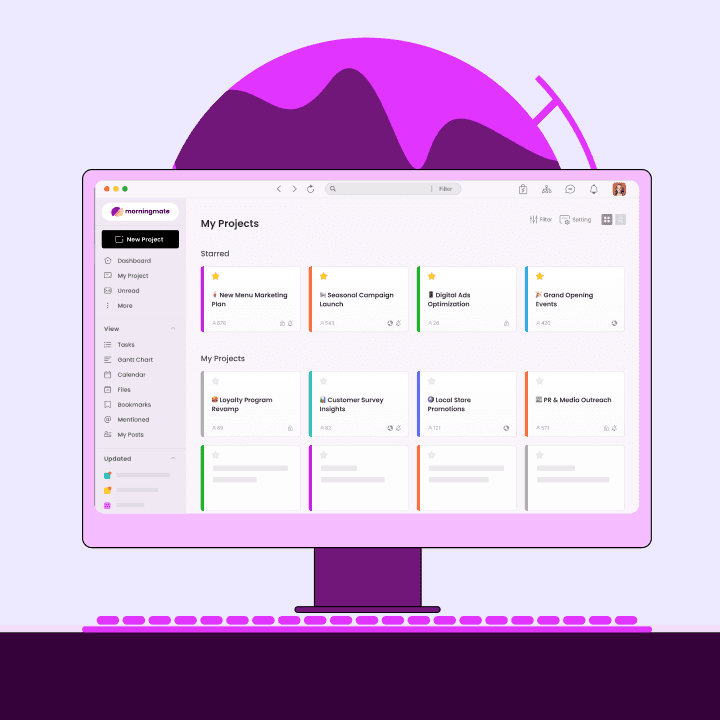
This is the gap that Morningmate is built for. It is a lightweight work management tool that combines task tracking with a built-in team chat — so your team does not need separate apps for communication and task coordination. The interface looks and feels like the social and messaging apps people already use every day, which means adoption is fast even for non-technical team members. There is no week-long onboarding. People can start using it the same day.
Critically for owners worried about tool sprawl: Morningmate replaces the patchwork of WhatsApp threads, email chains, and sticky notes rather than adding to it. Task management, file sharing, and team chat live in one place. When someone needs to know where a project stands, they check one screen — not three apps and a morning meeting.
Capability | Stand-Up + Chat/Email | Morningmate (Centralized) |
|---|---|---|
Task status visibility | Once a day, in a meeting | Always visible, real-time |
Blocker surfacing | Delayed up to 24 hours | Immediate, on the task card |
Decision record | Verbal, lost after meeting | Written, searchable, permanent |
Tool count | 3–5 apps (chat, email, docs…) | One hub |
Onboarding effort | None (but no system either) | Same-day, familiar interface |
What Teams Actually Gain When Task Management Becomes Continuous
When task coordination moves from a once-a-day verbal ritual to an always-on written system, the change is felt immediately — and the ROI is tangible. Stand-up meetings get shorter because they are no longer carrying the weight of status collection. Blockers get resolved the same day instead of the next morning. The owner stops being the human switchboard for project questions.
Teams using Morningmate's task management features report that their stand-ups shrink from fifteen to twenty minutes down to five to eight minutes — because the system already shows what everyone needs to know. That reclaimed time across a team of ten is worth hours of productive output every week.
Stand-Up Duration Before vs. After Implementing Continuous Task Tracking
22 min
Before (verbal only)
14 min
Chat + basic tasks
7 min
Centralized task mgmt
Fig 2: Average stand-up duration by task management approach (illustrative)
Your Next Action: One Week, One Change in Task Management
The stand-up is not the enemy. Used well, it is a genuinely useful team ritual. But when it doubles as your only task management system, it is quietly draining time, money, and momentum every single day. The fix is not a complex project — it is one structural change: give your team a place where task tracking is visible, continuous, and written down.
Start this week. Pick one active project. Log every task from your next stand-up into a shared system with an owner and a due date. Make blockers reportable in that system. Run your stand-up the following day using only what the system shows you. Notice how the conversation changes — and how many fewer "quick questions" land in your inbox afterward.
If you want a tool that makes this easy without adding complexity, Morningmate is worth a look. It combines task management, built-in chat, and file sharing in one workspace that is familiar enough for any team member to use on day one — and affordable enough for a business that is not ready to invest in enterprise software. Trusted by 550,000 teams worldwide, it is built precisely for teams that want results without the overhead. The ROI of better task management is not abstract: it is fewer dropped deadlines, shorter meetings, and more hours back in your week.