Project Management

Effective task management is not just about knowing what needs to be done — it is about actually doing it, finishing it, and moving on. Yet in most growing SMBs, the ops team spends a disproportionate amount of its day responding: to messages, to status questions, to requests for updates, to clarifications that should never have been necessary. The result is a team that looks busy but consistently falls behind on output that matters.
This is not a motivation problem. It is a structural one. When task management is fragmented across chat apps, email inboxes, and verbal agreements, responsiveness fills the vacuum left by absent process. People answer messages because that is the only way to know what is happening. Every answered ping feels productive. Almost none of it is.
According to Harvard Business Review, knowledge workers switch tasks an average of every three minutes when interrupted, and it takes more than twenty minutes to fully recover focus. Multiply that across a ten-person ops team and you have a structural productivity crisis baked directly into your daily workflow. The fix is not telling people to check messages less. The fix is building a system where task tracking replaces the need for constant check-ins in the first place.
The Compounding Cost of Reactive Work: Put a Number on It
Reactive work compounds quietly. A five-minute status check here, a ten-minute clarification thread there — individually they seem harmless. But McKinsey research found that employees spend an average of 28% of their working week on email alone, and another 20% tracking down information they need to do their jobs. That is nearly half a workweek lost to coordination overhead rather than actual task execution.
For an operations manager running a team of fifteen people, that translates to roughly 37 person-hours lost every single week — before a single deliverable is produced. At an average fully loaded cost of $40 per hour, that is $1,480 in wasted labor, every week, from coordination inefficiency alone. Across a year, that is over $77,000 in absorbed cost that never appears on a budget line but bleeds your team dry nonetheless.
The problem is not that your team is unproductive. It is that your task management system — or lack of one — is converting productive capacity into reactive noise. Standardizing that system is not an administrative nicety. It is a financial imperative.
Cost Category | Reactive / No Standard Process | Standardized Task Management |
|---|---|---|
Status update time per manager per day | 90+ minutes | Under 15 minutes |
Onboarding time to full productivity | 4–6 weeks | 1–2 weeks |
Cross-team handoff errors per month | 8–12 incidents | 1–2 incidents |
Knowledge retention when staff turn over | Lost with the person | Documented and searchable |
Missed deadlines per quarter | High (reactive firefighting) | Low (visible pipeline) |
Introducing the SPORT Framework for Task Management Standardization
To move from reactive operations to reliable task execution, you need more than a new tool. You need a repeatable operating model. The SPORT Framework is a five-component model for standardizing task management across a growing SMB: Structure, Process, Ownership, Record, and Triggers. Each component addresses a specific failure mode that turns responsiveness into a substitute for real task coordination.
S — Structure: Build a Task Management Architecture That Everyone Uses
The first reason task tracking breaks down in SMBs is structural inconsistency. Operations uses a spreadsheet. Marketing uses a shared inbox. Sales tracks deals verbally. When a cross-team handoff is required, nothing connects. Structure means deciding — and enforcing — where work lives.
In practical terms, this means defining your project and task hierarchy before onboarding anyone to a new system. For an ops team, that might look like: a top-level workspace per department, sub-projects per initiative, and individual tasks with a consistent set of required fields: assignee, due date, priority, and status. No task exists outside this structure. No work is assigned via chat message alone.
Structure is the scaffold everything else hangs on. Without it, your task workflow degrades into personal preference — and personal preference does not scale.
P — Process: Standardize How Task Coordination Flows Between Teams
Structure defines where work lives. Process defines how it moves. A standardized process means every recurring workflow — vendor onboarding, internal approvals, new hire setup — follows the same documented sequence of tasks every time, not whatever someone remembers from last time.
Consider a common ops scenario: onboarding a new contractor. Without a standard process, the ops manager fields five separate questions from HR, IT, and Finance — often across three different channels — before the contractor can start. With a standardized task management process, a checklist template is triggered the moment a new contractor is confirmed. Each department sees only their tasks, in sequence, with clear deadlines. The ops manager is not a human relay station. They are a process architect.
O — Ownership: Every Task in Your Task Tracking System Has One Name on It
Shared ownership is the polite fiction that lets accountability dissolve. When a task is assigned to a team rather than a person, it belongs to no one. When a deadline is missed, the conversation becomes archaeological — who was supposed to do what, when, and who told whom.
The ownership rule is simple: every task in your task tracking system must have exactly one assignee. That person is responsible for completion, escalation, or reassignment. They are not responsible for doing everything alone — they are responsible for the task not falling through the cracks. This single rule eliminates the majority of follow-up conversations most ops managers have in a given week.
Where Ops Time Goes Without Standardized Task Management
28%
Email management
20%
Chasing information
14%
Status check-ins
38%
Actual task execution
Fig 1: Average time allocation for ops teams without standardized task tracking (McKinsey / illustrative breakdown)
R — Record: Task Workflow Must Leave a Paper Trail Automatically
Knowledge silos are not created by secretive employees. They are created by systems that store information in people's heads, inboxes, and chat histories. When a decision is made in a WhatsApp thread, it vanishes when the thread scrolls. When a task is completed but never documented, the next person who runs that process starts from scratch.
The Record component of the SPORT framework means your task management system is also your institutional memory. Every task carries its full context: what was decided, who approved it, what files were attached, and what the outcome was. This is the component that makes onboarding dramatically faster — a new hire does not need three weeks of handholding if every prior task for their role is documented and searchable.
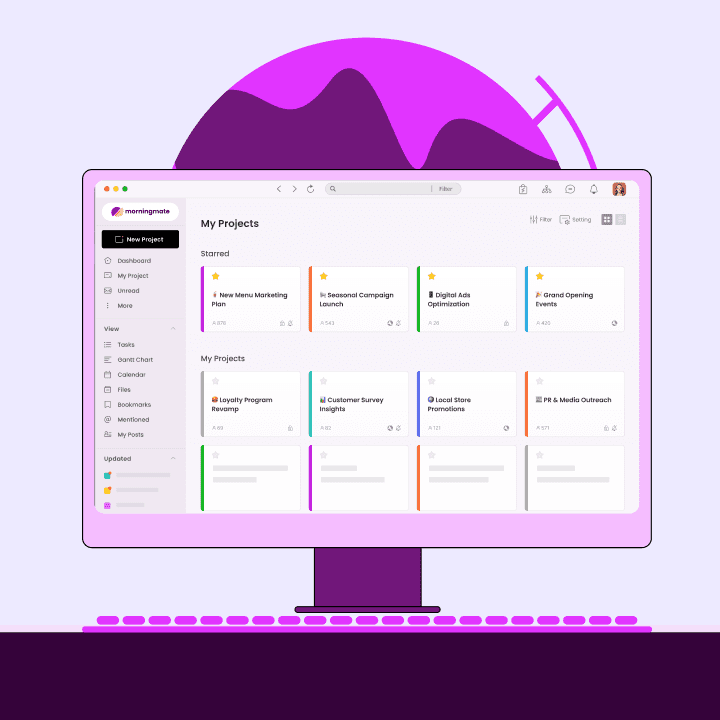
This is where a tool like Morningmate earns its place in an ops stack. Morningmate is a lightweight work management platform used by over 550,000 teams that keeps tasks, files, comments, and team communication in one structured workspace. Unlike chat-first tools, context in Morningmate lives on the task itself — not buried in a message thread that scrolls away. When someone new takes over a project, the record is already there.
T — Triggers: Automate the Start of Every Standard Task Coordination Sequence
The final component is the one that makes the whole system self-sustaining. Triggers are the defined events that automatically initiate a standard task workflow. A new vendor contract is signed — trigger the vendor setup checklist. A team member submits a leave request — trigger the coverage planning task sequence. A product launch is confirmed — trigger the cross-team coordination board.
Triggers remove the ops manager as the manual initiator of every process. Instead of you remembering to create the tasks, the event creates them. This is where task templates and recurring workflows pay off in compounding returns — once built, they run without prompting.
Applying SPORT with Morningmate: A Worked Example of Standardized Task Management
Scenario: Your company hires two new operations coordinators simultaneously. In the old model, onboarding is a chaos of Slack messages, forwarded emails, and verbal walkthroughs. In the SPORT model running on Morningmate, here is exactly what happens.
Structure: A dedicated onboarding workspace exists in Morningmate with sub-projects for IT setup, HR compliance, tool access, and first-week training. Every new hire gets their own task board cloned from a master template.
Process: The onboarding checklist has 22 tasks in a fixed sequence. IT cannot mark "access provisioned" complete until HR has marked "contracts signed" done. Dependencies are built in. No one moves out of order.
Ownership: Each of the 22 tasks has a single named assignee. The ops manager is assigned only four of them. The rest are distributed to IT, HR, and the new hire directly. Morningmate's task view shows every assignee their personal queue — no cross-checking required.
Record: Every completed task logs who did it and when. Decisions — like which software licenses were approved — are noted in the task comment field. The new hire can reference this history independently. The ops manager is not the memory of the organization.
Triggers: The moment HR marks a new hire as confirmed in the system, the entire 22-task onboarding board is created, assigned, and notified. The ops manager's only job is to confirm the start date. Morningmate's built-in workspace structure means the team communicates around those tasks using contextual chat rather than separate messaging apps — keeping all discussion attached to the work it belongs to.
Onboarding Step | Manual / Ad-Hoc Approach | Standardized via Morningmate |
|---|---|---|
Task creation | Ops manager builds manually each time | Template triggered automatically on hire confirmation |
Cross-team coordination | Email + Slack + verbal reminders | Assigned tasks with due dates visible to all parties |
Status visibility | Manager must ask each team individually | Real-time task status visible on shared board |
Process documentation | Exists in someone's memory or old email | Logged in task history, searchable by anyone |
Time to full productivity | 4–6 weeks | 1–2 weeks |
Reduction in Coordination Overhead After Standardizing Task Workflows
5%
Missed task handoffs
20%
Time on status updates
30%
Onboarding duration
15%
Cross-team errors
Fig 2: Residual overhead as a % of pre-standardization baseline after implementing the SPORT framework (illustrative)
Your Task Management Implementation Checklist
The SPORT framework does not require a six-month rollout. For most SMB ops teams, a structured two-week sprint is sufficient to get the core system in place. Use this checklist to move from intent to execution on your task management standardization.
Week 1, Day 1–2: Audit where work currently lives. List every tool your team uses to assign, track, or communicate about tasks. You cannot consolidate what you have not mapped.
Week 1, Day 3–4: Define your task structure. Agree on workspace hierarchy, required fields for every task (assignee, due date, priority, status), and the rule that every task has one owner.
Week 1, Day 5: Identify your top five recurring workflows. Vendor onboarding, staff onboarding, monthly reporting, approval cycles, and cross-team handoffs are common starting points.
Week 2, Day 1–3: Build task templates for each of the five workflows. Document every step. Assign default owners by role, not by name — so templates survive team changes.
Week 2, Day 4: Define triggers. For each template, write the specific event that activates it. Make this explicit and share it with every team lead.
Week 2, Day 5: Run one real process through the new system with your team. Identify friction points. Adjust before scaling.
Ongoing: Hold a 30-minute monthly review of task workflow performance. Are deadlines being hit? Are handoffs clean? Are people still going off-system? Treat your task management system as a living process, not a one-time setup.
The goal of standardized task management is not to create bureaucracy. It is to eliminate the invisible tax your team pays every day when process is absent. Responsiveness will always have its place — but it should be the exception your system handles smoothly, not the default your team drowns in. Build the SPORT framework, commit to task tracking as infrastructure, and watch your team's output finally match their effort. According to Asana's Anatomy of Work report, teams with clear, standardized workflows spend 60% more time on skilled, strategic work — the kind of work that actually grows a business.