Project Management

Good task management is supposed to keep campaigns moving. But here is the thing no one talks about: the moment a freelancer wraps up a project, a contractor rotates off, or even your one full-time designer takes a two-week vacation, all that invisible knowledge — the decisions made, the files versioned, the approvals chased — vanishes with them. You are left rebuilding context from scratch while the next deadline is already breathing down your neck.
For SMB marketing teams running lean, this is not an occasional inconvenience. It is a recurring tax on momentum. Every handoff without a system costs you hours of re-orienting, re-explaining, and re-approving work that was already half-done. And because most small teams still rely on a patchwork of chat threads, shared drives, and email chains to coordinate, the context that gets lost is almost impossible to recover.
This article breaks down exactly where that context disappears, gives you a repeatable handoff workflow you can use starting this week, and shows you what proper task tracking looks like when it actually sticks — even across a rotating cast of freelancers and founders.
Where Task Management Breaks Down When Someone Leaves
The problem is not that people leave. Turnover, freelance rotations, and founder context-switching are all just facts of life for a small marketing team. The real problem is that most teams have no formal task management system to capture work-in-progress context — so when someone steps away, everything they knew walks out with them.
The Three Layers of Lost Context
When a team member exits a project — temporarily or permanently — there are three distinct layers of context that typically disappear from your task workflow:
Decision context: Why was a particular headline chosen? Why did we scrap the Q1 campaign angle? These micro-decisions live in someone's memory or buried in a Slack thread from six weeks ago.
Approval context: Which version of the creative got sign-off? Did the founder approve the budget in a WhatsApp voice note that nobody transcribed?
Task status context: Is this deliverable done, in review, or waiting on the client? Without a central task tracking system, the next person has to detective-work their way to an answer.
According to Gallup's workplace research, disengaged or departing employees cost organizations significant productivity — and for small teams, losing even one informed contributor without a knowledge handoff can set a campaign back by days. That is time a two-person marketing team simply does not have.
Context Type | Where It Usually Lives | Risk When Someone Leaves |
|---|---|---|
Decision rationale | Chat threads, memory | Permanently lost |
Approval records | Email, WhatsApp, verbal | Disputed or unverifiable |
Task status | Personal to-do lists | Work duplicated or stalled |
File versions | Personal Google Drive folders | Wrong version published |
The Real Scale of the Task Management Problem
This is not anecdotal. Research from McKinsey's research on knowledge work found that employees spend nearly 20% of their workweek searching for internal information or tracking down colleagues for context. For a lean marketing team of three, that is nearly a full day per week per person — burned on reconstruction instead of creation.
When you layer in the reality that SMB marketing teams often work with rotating freelancers and part-time contributors, the task coordination problem compounds fast. Every new person onboarding into a project without a documented task workflow has to absorb context from scratch — usually by interrupting whoever happens to be available.
Time Lost Per Week to Rebuilding Context After Team Member Exit
6 hrs
Email-only teams
9 hrs
Chat-only coordination
2 hrs
Structured task tracking
Fig 1: Estimated weekly hours lost to context reconstruction by coordination method (illustrative)
A Repeatable Task Management Handoff Workflow
The fix is not to hire a full-time project manager or invest months in a complex tool rollout. It is a lightweight, repeatable task coordination habit that your team can actually sustain. Here is a five-step handoff workflow built for small marketing teams:
Step 1: Every Campaign Gets a Project "Home"
Before any work starts, create a dedicated project space — not a folder, not a chat group, but a single place where tasks, files, conversations, and decisions all live together. This becomes the canonical reference point regardless of who is working on it at any given time.
Step 2: Log Decisions as Task Notes, Not Chat Messages
When the founder says "go with the blue version" or you decide to push the launch by a week, that decision needs to live as a note on the relevant task — not buried in a chat thread. Task notes survive contributor rotations. Chat messages do not.
Step 3: Use Formal Approval Checkpoints on Tasks
Instead of chasing approvals over email or WhatsApp, attach an explicit approval step to every deliverable task. When the founder or client signs off, that approval is timestamped and attached to the task — visible to whoever picks it up next.
Step 4: Write a Handoff Note Before Every Exit
This takes ten minutes. Before a freelancer wraps up, they add a short status note to each of their open tasks: what is done, what is pending, what decisions are outstanding, and where the latest files live. Make this a non-negotiable part of your project closure checklist.
Step 5: Assign a Clear Task Owner for Every Active Item
Unassigned tasks are orphaned tasks. Every single open item in your task tracking system should have exactly one named owner. When someone leaves, the first action is reassigning those tasks — not hunting for them across three different tools.
Common Task Management Failure Points (and How to Dodge Them)
Even teams with good intentions fall into predictable traps. Here are the ones that kill task workflow continuity most often — and the specific counter-move for each.
Failure Point: The "I'll remember it" habit
Someone keeps campaign decisions in their head instead of logging them. Counter-move: at your next team standup, make "log it or lose it" a shared norm. If a decision is not in the task system, it does not count as made.
Failure Point: Approvals happen outside the system
The founder approves a creative over WhatsApp voice note. Three weeks later, nobody can confirm what was approved. Counter-move: add a rule — approvals only count when they are marked in the task. Everything else is a draft.
Failure Point: Files live on personal devices
A freelancer saves the final logo file to their personal laptop. They finish the contract and disappear. Counter-move: require all project files to be uploaded to the task or project space on submission — not just shared via a link to their personal Drive.
Failure Point: Task status is a mystery
You inherit a half-done task and cannot tell if it is 20% done or 80% done. Counter-move: standardize task statuses across your team — Draft, In Review, Approved, Published. No custom statuses, no ambiguity.
How Morningmate Makes Task Tracking Stick Across Rotations
This is where the right tool makes a real difference — not because it adds complexity, but because it removes the friction that causes people to skip the process entirely.
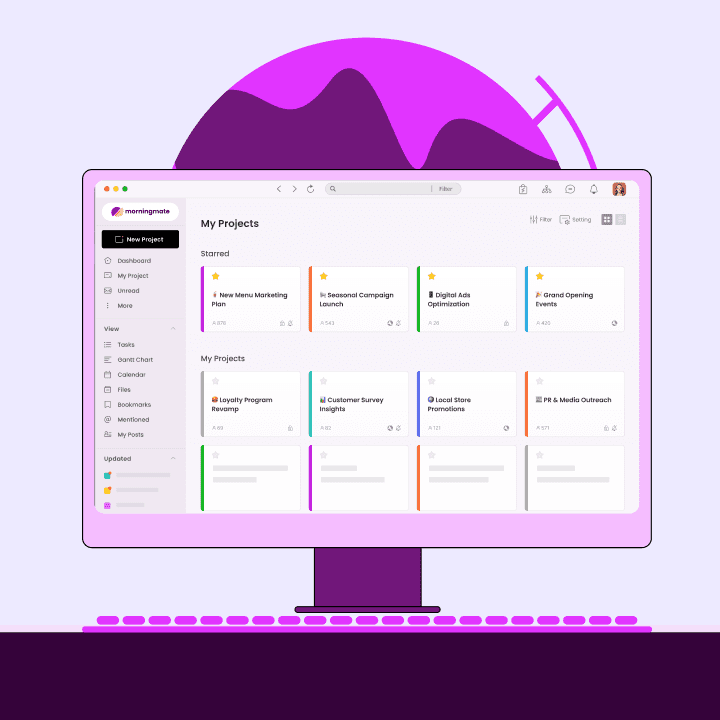
Morningmate is a lightweight work management tool that combines task management, built-in chat, and file management in a single workspace. The interface feels like a social feed — familiar enough that even non-technical freelancers adopt it without a learning curve. And that familiarity is exactly what makes it work for rotating contributors.
A Worked Example: Social Campaign Handoff
Say your freelance copywriter finishes a month-long social content calendar and is rotating off. Here is what a Morningmate-backed handoff looks like versus the typical chaos:
Without a system: The copywriter sends a "final files" email with three attachments and a loose summary in the message body. Two weeks later, your new freelancer cannot find the approved caption for the hero post. You spend an hour cross-referencing email threads and a shared Google Sheet to reconstruct which version was signed off — and you still are not sure.
With Morningmate: Every piece of content lives as a task inside the campaign project. The copywriter logs a handoff note directly on each task before wrapping up. The founder's approval is marked as a formal approval step on the task — timestamped and visible. The replacement freelancer opens the project, sees the task status, reads the decision notes, and picks up exactly where the previous person left off. Total onboarding time: fifteen minutes instead of a full morning.
The built-in chat in Morningmate also means that contextual conversations happen inside the project — not scattered across WhatsApp and email — so the thread of decisions stays attached to the work itself. For SMB marketing teams where context switching is one of the biggest productivity drains, this single structural change has compounding benefits every time someone new joins or exits.
Handoff Element | Scattered Tools (email + chat) | Morningmate Task Workflow |
|---|---|---|
Approval record | WhatsApp / verbal / email | Timestamped on the task |
Decision notes | Buried in chat history | Attached to the relevant task |
File location | Personal Drive / email attachment | Uploaded within the task |
Task status visibility | Unknown until you ask | Visible to entire team instantly |
New contributor onboarding | Half a day of catch-up | 15 minutes in the project feed |
Task Context Retained After Team Member Exit (% of teams reporting full context recovery)
18%
Email + spreadsheets
34%
Chat tools only
81%
Structured task management
Fig 2: Context retention rates by coordination method across SMB marketing teams (illustrative)
Your Task Management Checklist for This Week
You do not need a perfect system before you start. You need a good-enough system that your team will actually use. Here is a practical checklist to implement solid task management handoff habits starting now — no big tool migration required.
☐ Audit open tasks: Do all active tasks have a named owner? Assign any orphaned items today.
☐ Pick one project home: Choose a single tool where tasks, files, and decisions for your next campaign will all live together. Commit to it for the full campaign cycle.
☐ Standardize your task statuses: Draft → In Review → Approved → Published. Add these to every active project this week.
☐ Create a handoff note template: A three-line format — "What I finished / What is pending / Where the files are." Make every outgoing freelancer complete it before their last day.
☐ Move approvals into task tracking: Next time the founder or client approves something, log it on the task. Even a one-sentence note counts. Build the habit before you need it.
☐ Log the next three decisions: The next time your team makes a campaign decision in a meeting or chat, pause and log it as a task note. Do this three times and it becomes automatic.
☐ Brief your next freelancer: Before they start, show them where the project lives and explain that notes and status updates go into the task — not into their personal email.
Strong task management is not about having a sophisticated setup. It is about building the discipline to capture context in the same place, every time — so the next person who touches the work does not have to start from zero. That is how small marketing teams stay fast and stay sane, no matter who is in the seat this week. If you want to see how a unified task tracking and communication space can make this effortless, explore how other small teams structure their work and take a look at what Morningmate can do for your next campaign handoff.