Project Management

Effective task management is the backbone of any smoothly run operation — and right now, yours might be held together by a group chat. If your team is routing work assignments, approvals, and status updates through WhatsApp, you are not alone. But as your team grows, the cracks in that system widen fast. What works for five people becomes a liability at fifteen, and a full breakdown at thirty. This article is about understanding exactly why that happens — and what a structured approach to task management looks like instead.
The problem is not that your team uses WhatsApp. The problem is that WhatsApp was engineered for social communication, not operational coordination. It has no concept of ownership, no due dates, no status tracking, and no audit trail. Every task buried in a message thread is a task at risk of being forgotten, misunderstood, or duplicated. When you multiply that across dozens of ongoing workstreams and multiple departments, the operational cost is enormous.
According to McKinsey's research on workplace productivity, employees spend nearly 20% of their workweek searching for internal information or tracking down colleagues to get simple status updates. In a team of twenty, that is four full-time equivalent roles spent on coordination overhead alone. That is not a communication problem — it is a task management problem, and it starts with using the wrong tool.
The Compounding Cost of Task Management Without Structure
Inconsistent task management does not just cause inconvenience. It compounds. Every missed handoff creates rework. Every ambiguous assignment leads to a follow-up message thread. Every status update chased manually is a context switch that costs the asker and the answerer. Research from the American Psychological Association shows that task-switching can reduce productivity by up to 40%. When your task coordination happens inside a chat app, switching is baked into the workflow.
The compounding effect looks like this: one missed WhatsApp message leads to a delayed deliverable. The delayed deliverable pushes a client deadline. The deadline miss triggers an emergency meeting. The emergency meeting pulls three people off other task workflows. Each of those disrupted tasks then ripples into its own downstream chain. One skipped notification can cascade into a week of catch-up.
For an operations manager trying to standardize processes, this is the central challenge: you cannot build consistent systems on top of a tool that was never designed to hold them.
Operational Area | WhatsApp-Based Task Management | Structured Task Management |
|---|---|---|
Task assignment | Buried in message threads, easily missed | Explicit owner, due date, and priority visible to all |
Status visibility | Requires manual chasing via message | Real-time status updated by assignee |
Accountability | Ambiguous — easy to claim "I didn't see it" | Clear audit trail with timestamps and assignees |
Cross-team coordination | Separate chats per group, no shared view | Unified workspace visible across departments |
Onboarding new hires | No documented process — relies on verbal handoffs | Standardized task templates accessible from day one |
Introducing the SCOPE Framework for Task Management at Scale
To move from ad-hoc chat coordination to a repeatable operations system, you need a model that addresses every layer of the breakdown. Here is a framework built specifically for ops leaders in growing SMBs: SCOPE — Structure, Clarity, Ownership, Process, and Evidence. Each component targets a specific failure mode of messenger-based task tracking.
SCOPE is not a tool — it is a way of thinking about task management design. Once you apply it, choosing and configuring the right tool becomes much more straightforward.
S — Structure: Task Management Needs a Home, Not a Thread
Structure means your task management lives in a dedicated, searchable, organized space — not scattered across group chats segmented by team or project. When work lives in WhatsApp, your ops structure is dictated by the app's architecture: chronological messages, group membership, and chat history. That is not an operations system. That is organized chaos.
In practice, structure means creating standardized workspaces per department or project — with consistent naming conventions, folder hierarchies, and task templates. A new client onboarding should look the same every time: same checklist, same milestones, same handoff points. When every team member follows the same structural template, institutional knowledge stops living in people's heads and starts living in the system.
C — Clarity: Every Task Management Entry Must Answer Three Questions
Who is doing this? By when? What does "done" look like? These three questions define task clarity, and WhatsApp answers none of them by default. A message saying "can someone handle the supplier follow-up?" is not a task. It is a hope.
Clarity in task management means every work item is created with a named assignee, a concrete deadline, and a defined output. This is not about bureaucracy — it is about eliminating the ambiguity that turns a five-minute task into a three-day misunderstanding. When your ops team can look at any open task and immediately understand its scope without asking a single follow-up question, your coordination overhead drops significantly.
O — Ownership: Task Coordination Requires Accountability by Design
In a WhatsApp group, a message addressed to everyone is owned by no one. Ownership must be explicit and singular. This is one of the most common points of failure in messenger-based task tracking: shared responsibility without individual accountability produces consistent under-delivery.
In operational terms, ownership means every task — even collaborative ones — has a single named DRI (directly responsible individual). Others can contribute, comment, and collaborate, but one person owns completion. This design forces clarity about who needs to be chased, who reports status, and who signs off. It also makes performance patterns visible over time, which is essential for ops leaders managing growing teams.
Percentage of Tasks Completed On Time by Coordination Method
41%
WhatsApp / Chat Apps
63%
Email-Based Tracking
87%
Dedicated Task Management
Fig 1: On-time task completion rate by coordination method (illustrative, based on SMB operational benchmarks)
P — Process: Standardized Task Workflows Are Repeatable, Not Reinvented
Every recurring operation — vendor onboarding, monthly reporting, new hire setup, client intake — should have a documented, templated task workflow. Not a PDF stored in someone's downloads folder. A live, reusable process that fires the same way every time.
When your task management system contains standardized process templates, two things happen. First, your team stops reinventing the wheel and wasting time figuring out what step comes next. Second, you create a training ground for new hires — they follow the process, not the person. This is the difference between a team that scales and one that depends on tribal knowledge held by three overworked people who never take vacation.
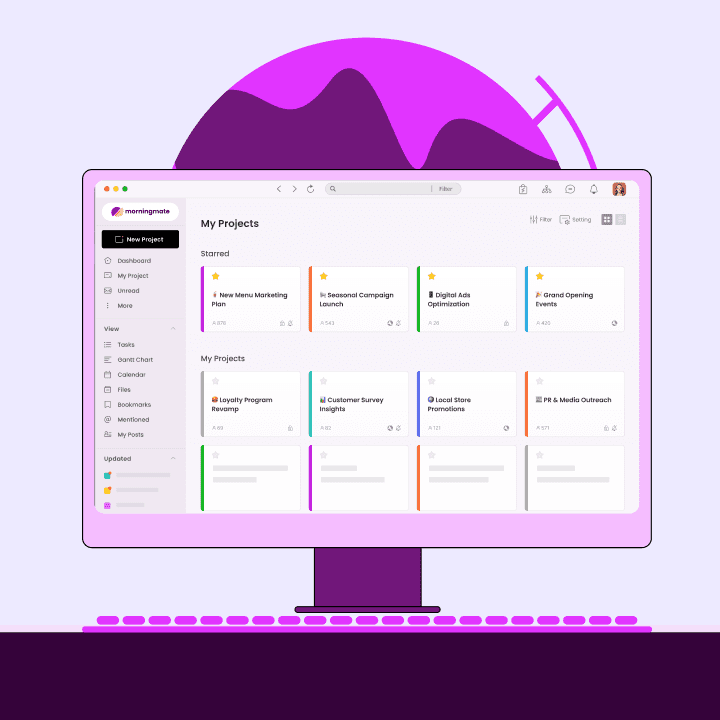
This is exactly where a tool like Morningmate adds structural value. As a lightweight work management platform used by over 550,000 teams worldwide, it lets ops managers build reusable task templates and project boards that can be duplicated and assigned without any manual rebuild. When a new client comes in, you don't set up the workflow from scratch — you activate the template and assign the team.
E — Evidence: Task Tracking Creates the Audit Trail WhatsApp Never Could
Evidence means that your task management system produces a record — automatically. Who created the task, when it was assigned, what comments were added, when it was marked complete, and whether it was delivered on time. This is not micromanagement. It is operational intelligence.
Without an evidence layer, you manage by memory and verbal recollection. With it, you can spot bottlenecks ("three of the last five vendor tasks were delayed at the same handoff point"), identify training needs, and build data-driven cases for resourcing decisions. Gartner research on digital workplaces consistently shows that organizations with structured work tracking systems make faster operational decisions and have lower employee turnover in ops roles.
Applying SCOPE with Morningmate: A Worked Example in Task Management
Let's make this concrete. Imagine you run operations for a 35-person marketing services company. Every month, your team runs a client reporting cycle: gather data from four departments, compile a performance report, get internal approval, and deliver to the client within 48 hours of month-end. Currently, this happens over a mix of WhatsApp groups and email chains. It is late 40% of the time. Two people are spending significant time just chasing updates.
Here is how you apply SCOPE inside Morningmate's task management environment:
Structure: Create a dedicated Morningmate workspace called "Monthly Client Reporting." Every department has its own task board within it — one source of truth, not four group chats.
Clarity: Build a master task template with eight pre-defined subtasks: data pull, QA check, draft compilation, internal review, revision, approval, formatting, and client delivery. Each has a default deadline offset (e.g., data pull due on Day 1, approval due on Day 3).
Ownership: Every subtask is pre-assigned to a named role — not a team, a person. The data analyst owns the data pull. The account manager owns the approval follow-up. No ambiguity.
Process: At the start of every reporting cycle, the ops manager activates the template in one click. Morningmate creates all tasks, assigns them, and sets due dates automatically based on the cycle start date.
Evidence: Throughout the cycle, Morningmate's task tracking captures status changes, comments, and timestamps. The ops manager has a live dashboard — no chasing required. If something is at risk, the system flags it before it becomes a miss.
The result: a repeatable, self-documenting process that any team member can follow — including someone hired last week. Morningmate's built-in chat means context conversations happen right alongside the relevant task, not in a separate WhatsApp thread that no one can find three weeks later.
SCOPE Component | Before (WhatsApp-Based) | After (Morningmate SCOPE Model) |
|---|---|---|
Structure | 4 disconnected group chats per project | One unified workspace with department boards |
Clarity | Vague messages, no deadlines stated | Pre-built templates with defined outputs and deadlines |
Ownership | Shared group responsibility = no individual accountability | Single DRI per task, visible to entire team |
Process | Recreated manually each cycle from memory | One-click template activation with auto-assignment |
Evidence | No audit trail, updates lost in scroll history | Automatic log of all activity, changes, and completions |
Weekly Hours Saved Per Ops Manager After Structured Task Management Adoption
1.2 hrs
Status Update Chasing (After)
7.5 hrs
Status Update Chasing (Before)
6.3 hrs
Net Weekly Hours Reclaimed
Fig 2: Estimated weekly hours reclaimed by ops managers after switching from chat-based to structured task management (illustrative)
Implementation Checklist: Start Standardizing Your Task Management This Week
You do not need a six-month transformation project to apply SCOPE. You need to start with one high-frequency process and build from there. Here is your practical task management checklist:
Audit one recurring workflow — pick something your team runs monthly or weekly. Document every step currently managed via WhatsApp or email.
Define the task structure — break the workflow into discrete tasks with explicit outputs. No vague steps.
Assign a DRI to every task — even if a task requires team input, one person owns it. Write their name on it.
Build it as a reusable template — in your task management platform, create a templated project board that can be duplicated for each new cycle.
Move team conversations to the task, not a chat group — any discussion related to a specific task should live next to that task, not buried in a parallel thread.
Review the evidence weekly — spend ten minutes each week reviewing what was completed on time, what was late, and where the bottleneck occurred. Let the data drive your process improvements.
Expand to the next workflow — once your first process is running cleanly, standardize the next. Momentum compounds.
Consistent task management is not a nice-to-have in a growing SMB — it is the infrastructure that determines whether you scale smoothly or spiral into coordination debt. Tools like Morningmate, with its Feed-style workspace interface and built-in chat that your entire team can use without a learning curve, make it realistic to implement this kind of structure without adding complexity. The goal is a system that runs the work so you can run the business — not the other way around.