Project Management

Good task management is supposed to be the great equalizer — the thing that keeps small marketing teams punching above their weight. But here is the uncomfortable truth: you can have a motivated founder, a capable freelancer, a switched-on marketing manager, and a shared drive full of briefs, and still watch campaigns land half-baked, approvals arrive after the deadline, and nobody quite sure who dropped the ball. Inconsistent results are rarely a talent problem. They are almost always a process problem hiding behind good intentions.
If your team genuinely cares about the work — and most small marketing teams do — the gap between effort and output usually comes down to how tasks are defined, handed off, and tracked. Task management that lives in people's heads, or scattered across inboxes and voice notes, creates invisible bottlenecks that no amount of enthusiasm can clear. This article is about finding those bottlenecks and closing them with a repeatable workflow your whole team can actually follow.
Let's start with a scenario that will probably feel familiar.
The Campaign Day That Went Sideways
It is 8:45 AM on launch day. Your email campaign is scheduled to go out at 10:00. The founder approved the copy — or so you thought. You find a voice message from last Thursday saying "looks good, just tweak the subject line." You tweaked it. But the freelance designer pulled the original version from a shared folder and rebuilt the header around the old copy. Meanwhile, your social posts are queued using a caption the founder has now decided feels "off-brand." Nobody told the freelancer. Nobody updated the task. The campaign launches late, fragmented, and slightly inconsistent in tone.
Every person on that team did their job. The problem was not effort. It was that the task workflow had no single source of truth — so the same campaign existed in three different versions across three different people's understanding of what was approved.
Where Task Management Actually Breaks Down
Task management problems on small marketing teams tend to cluster around three specific moments. Understanding which moment is breaking your team helps you fix the right thing instead of adding more check-ins.
At the Brief Stage: Vague Tasks Look Fine Until They Aren't
A task called "write launch email" feels clear. But it is missing the approved angle, the target segment, the word count expectation, the approval chain, and the deadline for the first draft versus the final version. When those details live in someone's memory or a separate Slack thread, whoever picks up the task fills in the blanks themselves. Two people filling in different blanks produce two different outputs.
At the Handoff Stage: Context Gets Lost Between People
Marketing tasks almost always move between people — from manager to freelancer, from freelancer to founder for approval, back to manager for final sign-off. Each handoff is a moment where context can drop. If the feedback from round one is not attached to the task itself, the next person is working blind. This is where "I thought we fixed that" becomes your team's most common phrase.
At the Approval Stage: Feedback Arrives in the Wrong Place
Approval feedback is the #1 killer of task management consistency on small teams. The founder approves in a voice note. The freelancer gets the note second-hand. The final version reflects a partial interpretation of that feedback. Nobody documented the decision, so next month the same debate happens again from scratch. Task tracking means nothing if the critical decisions that close a task are not captured inside the task itself.
Breakdown Stage | What It Looks Like | What It Actually Costs You |
|---|---|---|
Brief stage | Task title with no detail, no context, no deadline split | Each team member interprets the task differently |
Handoff stage | Context explained verbally or in a separate thread | Next person starts with incomplete information |
Approval stage | Feedback arrives via voice note, DM or verbal conversation | Decisions never recorded, same debates repeat every campaign |
A Repeatable Task Management Play for Small Marketing Teams
The goal is not to add bureaucracy. It is to create just enough structure that every task carries its own context, so your team does not have to chase it down. Here is a five-step task workflow built specifically for teams running campaigns with a mix of in-house staff and freelancers.
Write the task with a complete brief inside it. Every campaign task should include: the deliverable, the goal, the target audience, any creative constraints, who needs to review it, and two deadlines — one for the draft and one for the final version. If a task does not have all of these, it is not ready to be assigned.
Assign with explicit ownership, not shared ownership. "Marketing team" is not an owner. One person owns the task. Others can be tagged as contributors or reviewers, but the owner is the person whose name is on the due date. This removes the ambiguity that causes tasks to slip between people.
Keep all feedback inside the task record. When the founder reviews copy, that feedback goes into the task as a comment — not a voice note, not a DM, not verbally during a stand-up. This sounds rigid but it takes about 30 seconds and saves hours of reconstruction later.
Use status changes as handoff signals. Move a task from "In Progress" to "In Review" as an explicit signal to the next person in the chain. Do not rely on a separate message to trigger the next step. The status is the message.
Close the task with a brief completion note. Before marking a task complete, add one line: what was delivered, where it lives, and any decisions made. This is the institutional memory your team will thank you for three campaigns from now.
Common Failure Points in Task Tracking — and How to Avoid Them
Even well-intentioned teams trip over predictable failure points when they try to improve their task management. Here is what to watch for.
Failure Point 1: The Founder Skips the System
Your task workflow is only as strong as its most powerful exception. If the founder approves things verbally and those approvals never get logged, the rest of the team is always operating on partial information. The fix is not to nag the founder — it is to make logging approvals so frictionless that it takes less effort than a voice note. A one-line comment in the task record is enough.
Failure Point 2: Freelancers Are Not Looped Into the Task Tracking System
A common pattern: the in-house team has a project tool, but freelancers get briefed over email because "it is easier." So the task exists in two places with two different versions of the brief. When revisions come in, the freelancer is working from an outdated version. Bringing freelancers into the same task coordination system — even as limited-access collaborators — closes this gap entirely. If your freelancer management workflow sits outside your main task system, it will always create inconsistency.
Failure Point 3: Tasks Are Tracked but Decisions Are Not
A task tracker shows you what work exists and what state it is in. But it does not automatically capture the decisions that shaped that work — unless your team treats task comments as a decision log. Without that habit, you can have perfect task tracking and still repeat the same conversations every campaign cycle because nobody remembers why you chose the approach you did last time.
Failure Point 4: No Distinction Between "Urgent" and "Important"
When every task looks equally urgent, teams make poor prioritization decisions under pressure. Build a simple priority field into your task workflow — high, normal, low — and use it consistently. This lets the founder and freelancers self-prioritize when they have competing demands, without waiting for you to triage for them.
How Morningmate Keeps Task Management, Approvals, and Context in One Place
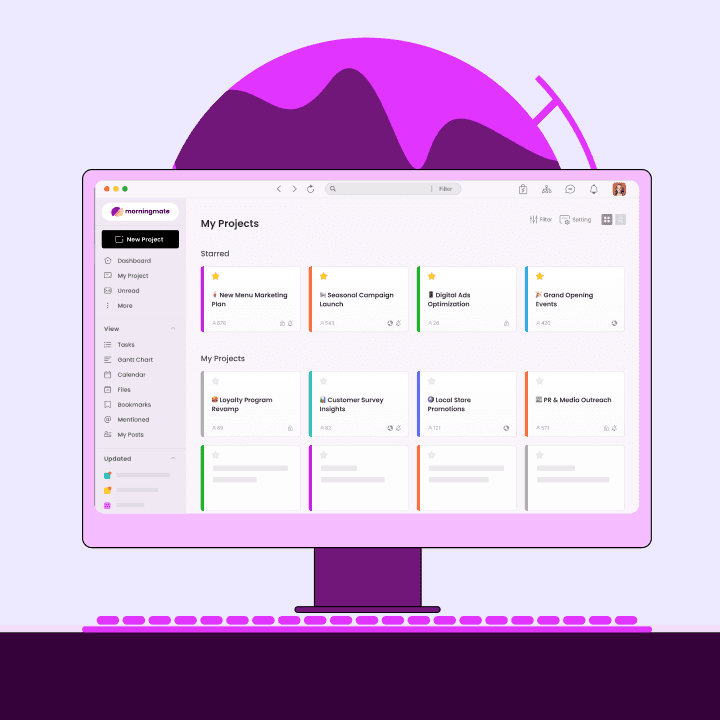
Morningmate is a lightweight work management tool built for teams that need real task coordination without the learning curve of enterprise software. It combines task management, built-in chat, and a shared feed in one workspace — which means your team is not switching between a project tool and a messaging app and an email thread to piece together where a campaign stands.
Here is how a mid-sized product launch campaign might run through Morningmate. The marketing manager creates a task for the launch email, attaches the approved brief directly inside the task, and assigns it to the freelance copywriter. When the draft is ready, the freelancer moves the task status to "In Review" — that status change notifies the founder automatically. The founder adds approval feedback as a comment inside the task. No DMs, no voice notes, no separate thread. The copywriter sees the feedback in context, updates the copy, and moves the task to "Approved." Everyone who touches that campaign can see the full decision trail without asking anyone to reconstruct it.
For campaigns with a lot of moving pieces, Morningmate's task-creation agent — part of its Repattern AI suite — can turn a chat message or a post into a tracked task automatically. If the founder drops a late-night idea into the team feed, the agent converts it into a structured task with an assignee prompt and a deadline field, so no brief gets lost in the scroll. It does the admin so the team can focus on the work itself.
The feed view — which works similarly to a social media timeline — also gives the whole team a passive awareness of where campaigns stand without requiring status meetings. You see updates as they happen, in context, alongside the files and comments that explain them.
Campaign Moment | Without Structured Task Tracking | With Morningmate |
|---|---|---|
Briefing a freelancer | Email with attachments, follow-up questions via DM | Brief lives inside the task, freelancer sees full context on open |
Founder approval | Voice note or verbal, feedback partially relayed | Comment recorded in task, visible to all collaborators |
Tracking revision rounds | Folder of file versions with confusing names | Each revision linked to the task comment that triggered it |
Post-campaign review | Reconstruct from memory or scattered messages | Full task history with decisions already documented |
Your Task Management Checklist to Apply This Week
You do not need to overhaul everything at once. Start with this checklist and apply it to your next campaign. Good task management becomes a habit when it is introduced one campaign at a time, not rolled out as a company-wide policy that exhausts everyone before it sticks.
Every task has a single named owner — not "the team," not "TBD."
Every task brief includes: deliverable, audience, constraints, draft deadline, final deadline, and approval chain.
Freelancers are in the same task tracking system as the in-house team, not briefed separately over email.
All feedback on deliverables goes into the task as a comment — voice notes and verbal feedback get transcribed before end of day.
Status changes are used as handoff signals — "In Review" means the next person's turn, no follow-up message required.
Each completed task has a one-line completion note — what was delivered, where it lives, what was decided.
Priority levels are set at task creation so freelancers can self-triage without waiting for you.
Your task coordination system is reviewed after every campaign — one thing to keep, one thing to improve.
Good intentions do not produce consistent results on their own — repeatable task management does. The gap between a team that means well and a team that delivers reliably is almost always a handful of workflow habits, not a talent gap. Fix the task tracking, fix the approval chain, and you will find that the motivation your team already has finally has somewhere useful to go. Explore how building a campaign workflow around structured task management can transform what your team is able to ship.