Project Management

Good task management is the difference between a campaign that launches on time and one that quietly implodes while everyone assumes someone else handled it. For marketing managers at small businesses, recurring work is the silent killer — the weekly social posts, the monthly newsletter, the quarterly ad spend review. These tasks don't feel urgent until they're late, and by then, you're already putting out fires instead of building campaigns.
Here's what makes recurring task management so brutal for small marketing teams: it's invisible. Nobody schedules a crisis meeting because the Instagram content calendar wasn't updated. It just... doesn't happen. And then your founder asks why engagement dropped, and you're digging through Slack messages, email threads, and a Google Sheet that was last touched three weeks ago trying to reconstruct what went wrong.
This article is a practical playbook for locking down your recurring marketing work so nothing slips, your freelancers stay accountable, and your founder stops becoming the bottleneck on approvals. No overengineered systems. Just a workflow that actually holds up when your team is small and your calendar is full.
Why Recurring Marketing Work Keeps Falling Through the Cracks
Recurring task coordination breaks down differently than one-off projects. With a product launch, the urgency is visible. With a recurring task — say, updating the blog content schedule every Monday — there's no alarm, no kickoff meeting, and often no clear owner once the original setup is forgotten. Asana's Anatomy of Work report found that workers spend 60% of their time on "work about work" — status checks, chasing approvals, clarifying who owns what. For small marketing teams, that overhead is catastrophic because you have no slack in the system.
The Three Failure Modes for Recurring Task Tracking
Before you can fix recurring task management, you have to name where it breaks. In small marketing teams, it almost always comes down to one of these three patterns:
No single owner. The task gets done when someone remembers, not because someone is responsible.
Context lives in chat. The briefing for the monthly email is in a Slack thread from six weeks ago. Good luck finding it.
Approvals are asynchronous chaos. Your founder is CC'd on seventeen things and approves none of them until launch day.
These aren't team failures. They're system failures. And they're completely fixable with the right task workflow.
Recurring Task Type | Common Failure Point | What It Costs You |
|---|---|---|
Weekly social content | No clear owner, freelancer waits on approval | Missed posting windows, inconsistent presence |
Monthly newsletter | Brief buried in email, founder approval delayed | Late send, disjointed messaging |
Quarterly ad review | Spreadsheet not updated, context lost between cycles | Wasted budget, reactive decisions |
Blog publishing cycle | No handoff system between writer and editor | Publishing delays, SEO gaps |
The Scale of the Problem: How Much Recurring Work Gets Dropped
This isn't an edge case. Research published in Harvard Business Review shows that unclear ownership and fragmented communication are the top two reasons collaborative work fails — not lack of effort or skill. For marketing teams running on lean headcount, recurring task tracking is especially vulnerable because there's no redundancy. When one person drops the ball, there's no one else to catch it.
How Often Recurring Marketing Tasks Are Dropped or Delayed Per Quarter
71%
Teams using email only
58%
Teams using chat apps
22%
Teams with structured task workflows
Fig 1: Estimated drop/delay rate for recurring tasks by communication setup (illustrative, based on industry benchmarks)
A Repeatable Play: Your 6-Step Recurring Task Management Workflow
This workflow is designed for a small marketing team — one manager, a founder who needs to approve things, and one or two freelancers executing work. It's lightweight enough to set up in an afternoon and robust enough to hold up week after week.
Audit your recurring work. List every task your team does on a cycle — daily, weekly, monthly, quarterly. Don't skip the "assumed" tasks that currently live in someone's head.
Assign a single owner to each task. Not a team. Not "marketing." One person's name. This is non-negotiable for functional task tracking.
Set the task up once with all context attached. Brief, reference files, previous examples, approval criteria — all attached to the task itself, not scattered across email and chat.
Define the approval chain upfront. Who needs to sign off? What's the deadline for approval? If your founder needs 48 hours, build that into the task due date, not as an afterthought.
Create a handoff trigger. When the task moves from "in progress" to "needs review," the approver gets notified automatically — not via a manual ping in WhatsApp.
Review the system quarterly, not the tasks. Once a quarter, look at which recurring tasks are consistently late or consistently skipped. That's your signal to reassign, simplify, or kill the task entirely.
The whole system only works if context travels with the task. That's where most small teams break down — the work gets assigned, but the briefing stays in a chat thread nobody can find two weeks later.
Common Failure Points in Recurring Task Coordination (and How to Dodge Them)
Even with a solid workflow, there are predictable places where recurring task management breaks down. Here's what to watch for:
Failure Point 1: The Founder Approval Bottleneck
Your founder is not ignoring your tasks on purpose — they're just drowning in context-switching. If approval requests arrive as a chat ping, an email, and a verbal mention all at different times, nothing gets approved cleanly. Fix it by routing all approval requests through one channel with a hard deadline attached. When the approval request comes with context already included ("Here's the draft, here's what changed from last month, approve by Thursday"), sign-off rates improve dramatically.
Failure Point 2: Freelancer Handoffs Without Briefings
Freelancers operate on clarity. When your copywriter starts a new monthly blog cycle and has to dig through a three-week-old email chain to find the brand voice guide, you've already lost two hours and introduced inconsistency risk. Every recurring task that touches a freelancer needs a standing brief attached — updated in place, not resent every cycle.
Failure Point 3: The "I Thought You Had It" Gap
This is the most expensive failure in small-team task tracking. Two people both think the other person is owning something. It surfaces at the worst possible moment — usually the day something was supposed to go live. The fix is dead simple: every task has one named owner, and that name is visible to everyone on the team at all times.
How Morningmate Keeps Recurring Task Management on Track
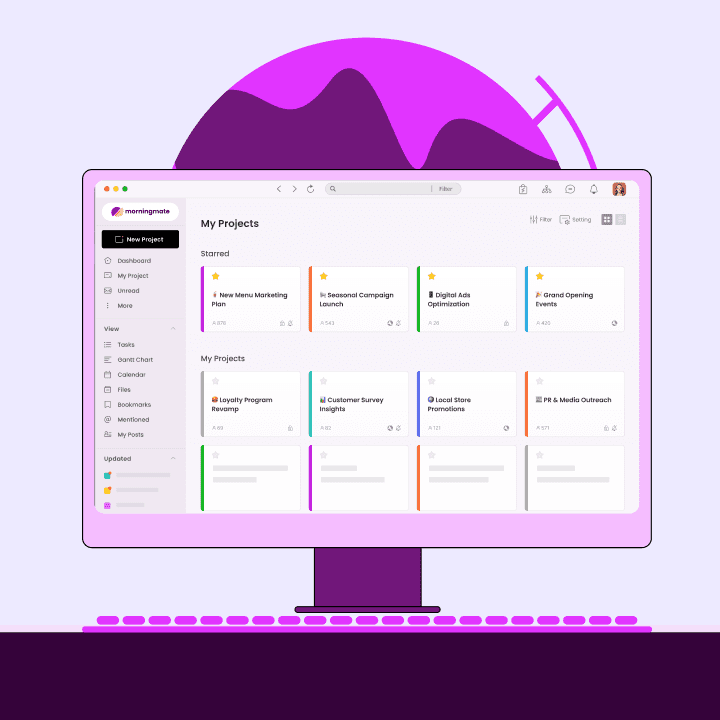
This is where a lightweight tool makes a real difference. Morningmate is a work management platform built for exactly this kind of team — small, fast-moving, with a mix of internal staff and external freelancers. It combines task tracking, built-in chat, and file management in one place, so context never gets separated from the work it belongs to.
Here's a worked example using a real recurring task: the monthly email newsletter.
Without a task management system: You brief the copywriter in Slack. They ask a clarifying question two days later. You respond, but the founder's feedback comes via email. The final draft gets shared in Google Drive, but no one knows if the founder has actually reviewed it. Launch day arrives and the founder hasn't approved it. You delay by 24 hours. The email goes out late, and this exact scenario plays out again next month.
With Morningmate: You create a recurring task called "Monthly Newsletter — [Month]" with the brief, brand guide link, and previous issue attached directly to the task card. The copywriter is assigned as owner. When the draft is ready, they move the task to "Needs Review" — the founder gets an automatic notification with full context already in the task. The founder approves in the task thread. The task moves to "Approved." Your freelancer designer picks up from there. The entire conversation, the files, and the decision trail live in one place. Next month, you duplicate the task card and update the brief. Done in four minutes.
Morningmate's interface deliberately mirrors what people already know — a social-media-style feed for updates and a WhatsApp-style chat for quick communication — so there's no adoption friction, even with non-technical team members or freelancers who aren't used to project management tools. That matters when you need your founder to actually use the system and not revert to email.
Workflow Step | Scattered Tools (Chat + Email + Sheets) | Morningmate Task Workflow |
|---|---|---|
Brief delivery | Sent via Slack or email, buried in thread | Attached directly to task card, always findable |
Approval request | Manual ping via chat or email | Auto-notified when task status changes |
Feedback tracking | Scattered across platforms, context lost | Threaded in task, full history visible |
Next cycle setup | Start from scratch, brief resent manually | Duplicate task card, update brief in 4 minutes |
The Compounding Payoff: What Better Task Tracking Does Over Time
McKinsey research on organizational clarity consistently shows that teams with clear ownership and structured workflows outperform reactive teams on both output quality and speed — not because they work harder, but because they waste less time reconstructing context and chasing decisions. For a small marketing team, that recovered time is the difference between shipping a new campaign and spending another week firefighting the last one.
The gains are especially visible after the first 60 days of running a clean recurring task management system. Approval cycles shrink. Freelancer output improves because briefings are clear. Your founder spends less time being the bottleneck because the approval mechanism actually works. And you spend more time on strategy and less time on coordination overhead.
Time Saved on Recurring Task Coordination After 60 Days (Hours Per Month)
2 hrs
Email-only teams
5 hrs
Dedicated task app, no chat integration
11 hrs
Integrated task + chat + approvals
Fig 2: Estimated monthly hours recovered through structured recurring task management after 60-day adoption (illustrative)
Your Task Management Checklist to Apply This Week
Solid task management for recurring work doesn't require a six-week rollout plan. Here's what you can do right now to stop the drop-off and build a system that actually holds:
☐ List every recurring marketing task your team does across daily, weekly, monthly, and quarterly cycles.
☐ Assign one named owner to each task — not a role, a person.
☐ Attach all context (brief, brand guide, previous examples) directly to each task, not in a separate chat or email.
☐ Define the approval chain for every task that needs sign-off, with a built-in lead time of at least 48 hours.
☐ Create a "Needs Review" status trigger so approvers are notified automatically when something lands in their court.
☐ Set up your first recurring task template in your task management tool so next month's cycle takes four minutes, not forty.
☐ Schedule a quarterly system review — not to review the tasks, but to review the system itself. What's slipping? What's unclear? Fix it at the system level.
Recurring task management isn't glamorous work. But it's the infrastructure that lets you do the glamorous work — campaigns, strategy, creative — without spending half your week chasing context and approvals. Build the system once. Trust it. And get back to marketing.