Project Management

Good task management is supposed to give you control — but when a project runs for three, six, or twelve months, the opposite often happens. Updates pile up, threads multiply, and by month two you are spending more time asking "where are we on this?" than actually moving things forward. If you own a small business and your team is juggling long-running projects alongside daily work, that visibility problem quietly bleeds time and money every single week.
The painful part is that it rarely looks like a crisis. Nobody misses a single big deadline. Instead, small things slip: a deliverable sits in someone's inbox for a week, a decision made in a hallway chat never gets recorded, a contractor waits three days for feedback because nobody realized they were blocked. Multiply that across a six-month project and you have lost weeks of productive time — without a single dramatic failure to point at.
This article is about building a practical task management rhythm that keeps long projects visible without turning your calendar into a wall of check-in meetings or your inbox into an endless status-update chain. No complicated software setup. No new headcount. Just a simple system your lean team can actually stick to.
The Real Cost of Invisible Long-Running Projects
When a project runs long, visibility decays naturally. Early on, everyone knows the plan. By month three, the team is deep in execution, context is scattered across chat threads and email folders, and you — the owner — have moved on to the next fire. Nobody intended for things to get murky. It just happens.
The financial cost is harder to see than a missed invoice, but it is just as real. The Project Management Institute's Pulse of the Profession report consistently finds that poor project performance wastes around 11 cents of every dollar spent. For a small business running a $50,000 project, that is $5,500 gone — not from any single mistake, but from accumulated confusion, rework, and delays caused by poor task coordination.
Beyond the dollars, there is the owner's time. If you are the one holding context for every long-running initiative, your team cannot move without you. Every question that should have an obvious answer lands in your inbox instead. That is not leadership — that is becoming your own bottleneck.
Problem | What it looks like day-to-day | Hidden cost |
|---|---|---|
No central task tracking | Owner chases updates via chat or calls | 3–5 hrs/week per project lost |
Decisions undocumented | Same questions resurface months later | Rework, delays, frustration |
Blockers not surfaced | Team member waits silently for input | Days of idle time cascade |
Status scattered across tools | Nobody has the full picture | Poor decisions made on incomplete info |
Why Task Management Breaks Down on Long Projects
The root cause is almost never laziness or incompetence. It is structure — or the lack of it. Short projects survive on momentum. Everyone is focused, the deadline is close, and urgency keeps things moving. Long projects have none of that natural pressure. They need a lightweight system to replace what urgency does on a short sprint.
Most small business owners set up task tracking at the start of a project and then gradually stop using it. Life gets in the way. The tool feels like overhead when you are busy. Chat becomes the default because it is faster. And then, three months in, nobody can reconstruct what was agreed or who is responsible for what.
Harvard Business Review research on long-term project tracking points to a consistent pattern: teams lose momentum not because the work is too hard, but because there is no regular mechanism to surface progress and blockers. Without that mechanism, managers default to status meetings — which eat time without actually improving task coordination.
Where Time Goes on Long Projects Without a Task Management System
41%
Chasing status updates
28%
Unplanned check-in meetings
31%
Rework from missed context
Fig 1: Illustrative breakdown of wasted time on long-running projects without structured task tracking
A Practical Task Management Fix for Long Projects
You do not need a complex system. You need a consistent one. The following steps are designed for a team of five to twenty people running one or more projects that span more than eight weeks. Each step is something you can implement this week.
Step 1 — Break the project into milestone blocks, not just tasks
Long projects fail at task management because the list of tasks becomes overwhelming and shapeless. Instead, define three to five milestone blocks — each representing a meaningful chunk of deliverable output with a clear end state. Under each milestone, list the specific tasks required. This gives your team a visible finish line every few weeks rather than an endless runway.
Step 2 — Assign a single owner to every task, not a group
Group ownership means no ownership. Every task in your task tracking system needs one named person responsible for it — not a team, not a department. That person does not have to do all the work themselves, but they are the one accountable for moving it forward and flagging if it stalls.
Step 3 — Replace status meetings with a weekly written update
Ask each task owner to post a three-line written update once a week: what moved forward, what is blocked, and what is next. This takes five minutes to write and two minutes to read — versus a thirty-minute meeting that interrupts everyone's deep work. The update becomes part of the task record, so context is never lost when someone is out sick or leaves the team.
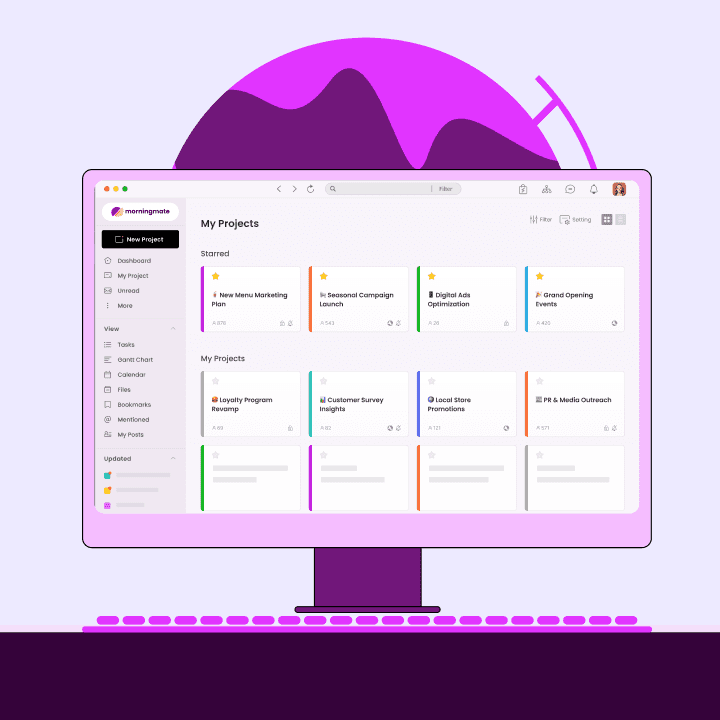
This is where a tool like Morningmate earns its keep. Instead of hunting through email threads or scrolling back through WhatsApp to find last week's update, your team posts those written updates directly on the project's task feed. Morningmate's Feed view works like a social media timeline — familiar to everyone, no training required — so even non-technical team members actually use it. Updates are attached to the relevant task, not buried in a chat thread.
Step 4 — Make blockers impossible to miss
The single biggest source of delay on long projects is a blocked task that nobody escalated. Create a simple rule: if a task has been waiting on something for more than 48 hours, the owner flags it as blocked and notifies you directly. No flag means things are moving. One flag means you need to unblock it that day. This replaces the need for you to constantly check in — the system surfaces problems to you instead.
Step 5 — Do a monthly milestone review, not a weekly all-hands
Once a month, spend twenty minutes reviewing which milestone you are in, what percentage of tasks are complete, and whether the end date is still realistic. This is the only meeting you need for project-level visibility. Daily and weekly task management handles the rest asynchronously.
How One Hub Replaces the Status-Update Spiral
The reason status updates become overwhelming is usually tool sprawl. Tasks are in a spreadsheet, conversations are in WhatsApp, files are in email, and decisions are in someone's head. When everything is scattered, the only way to get a picture of project health is to manually collect fragments from four different places — which is exhausting and error-prone.
Morningmate is built to fix exactly this problem for lean teams. It combines task management, built-in team chat, and file management in one place — without the setup complexity of tools like Jira or Asana that require dedicated admins to configure. The interface deliberately mirrors what people already use: the Feed looks like a social media timeline, and the chat works like WhatsApp. That means your team adopts it without resistance, which is the real obstacle with most project tools.
For long-running projects specifically, having tasks, updates, files, and conversations all attached to the same project workspace means you can open Morningmate, look at the project feed, and get a genuine snapshot of where things stand in under two minutes — without sending a single message or booking a single meeting. That is the ROI: your time back, your team uninterrupted.
McKinsey research on workplace productivity consistently shows that reducing the number of tools people switch between is one of the highest-leverage moves a small business can make — not because each tool is bad, but because context-switching itself destroys focus and creates the gaps where tasks fall through.
Task management approach | Scattered tools (email + chat + spreadsheet) | Single hub (Morningmate) |
|---|---|---|
Project status visibility | Requires manual collection from 3–4 tools | Visible in one feed, under 2 minutes |
Blocker identification | Owner waits for someone to ask | Flagged on task, surfaces to owner automatically |
Decision record | Lost in email threads or chat history | Attached to the relevant task, searchable |
Team adoption | Each tool needs separate onboarding | Familiar interface, team up in hours |
Owner time per week | 4–6 hrs chasing updates | Under 30 minutes on project oversight |
What Better Task Management Actually Looks Like in Practice
Here is a realistic before-and-after for a 12-person marketing agency running a six-month client rebrand project.
Before: The project manager sends a status email every Friday. Half the team does not reply. The owner spends Monday morning piecing together where things stand. Two tasks sit blocked for nine days because nobody flagged them. The client asks for a progress update and the owner has to call three people before they can answer confidently.
After: Each task has a named owner and a milestone attached. Owners post a three-line update every Thursday directly on the task in Morningmate. Blocked tasks are flagged immediately. The owner opens the project feed on Monday morning, reads six updates in eight minutes, and has a complete picture. The client update takes fifteen minutes to prepare instead of an hour of archaeology.
The system does not require more discipline from your team — it requires less, because the structure makes the right behavior the path of least resistance. Good task management is not about adding more process. It is about removing the friction that causes things to fall through.
Weekly Hours Saved on Project Oversight After Adopting Structured Task Management
0.5 hrs
Saved via email-only approach
2.1 hrs
Saved with weekly standups
5.4 hrs
Saved with structured task management hub
Fig 2: Illustrative weekly hours reclaimed by owner/manager per long-running project, by approach
Your Next Step: Make Task Management the Default, Not the Exception
If you have one long-running project right now that you cannot describe the current status of without making three phone calls, that is where you start. This week, take forty minutes and do the following: list the remaining milestones, assign a named owner to every open task, and ask each owner to post their first three-line update by end of week. That single action will tell you more about the health of that project than the last month of status emails.
From there, the task management system sustains itself — but only if it lives somewhere your team can see and use without extra effort. If you are currently managing projects across email, chat apps, and spreadsheets, the single highest-ROI move you can make is consolidating into one lightweight workspace. Tools used by over 550,000 teams globally like Morningmate are designed specifically for teams like yours: small, busy, and allergic to complexity. One place for tasks, updates, chat, and files — so your team runs the project, and you run the business.
Good task management on long projects is not about more oversight. It is about building the right structure so that oversight happens automatically — and you get your time back to focus on what only you can do. That is the whole point.