Project Management

Good task management is not just about writing down what needs to get done — it is about making sure the right work actually moves forward, in the right order, by the right people, without you having to chase anyone. That distinction sounds small, but for a business owner running a lean team of 10 or 20 people, it is the difference between a business that hums and one that stalls every time you step away from your desk.
Most small business owners start with a task list. A spreadsheet, a sticky note board, maybe a shared Google Doc. It works at first. Then the team grows to 15 people, you take on a bigger client, and suddenly that list stops being a plan and starts being a pile. Tasks get missed. People do not know which task is blocking another. You end up fielding status questions instead of making decisions. That is not a task management problem — that is a workflow problem, and the fix is different.
This article breaks down exactly what separates a task list from a real team workflow, why the gap costs you money, and what practical steps you can take this week to close it — without adding new tools, new hires, or new complexity.
A Task List Tracks Work. A Workflow Actually Moves It.
Here is the clearest way to think about it. A task list answers the question: what needs to be done? A workflow answers: who does what, in what order, and what happens next? Both matter, but only one of them scales.
When your team is small and everyone sits together, informal task management works because everyone shares context. You know what Sarah is working on because you heard the conversation. As soon as the team reaches even eight or ten people — or anyone works remotely — that shared context disappears. Tasks become isolated to-dos with no connection to each other, no owner accountability, and no visible sequence.
According to Asana's Anatomy of Work report, workers spend 60% of their time on "work about work" — status updates, chasing approvals, searching for information — rather than the actual skilled work they were hired to do. For a 15-person team, that is the equivalent of nine full-time people not doing their jobs. That is the gap a task list cannot fix, but a workflow can.
Why Task Management Alone Is Not Enough: The Real Cost
The financial drain of poor task coordination is quiet. It does not show up as a line item. It shows up as a project that takes three weeks instead of two. A client deliverable that falls through the cracks because two people each thought the other was handling it. An invoice that goes out late because approvals were stuck in a WhatsApp thread nobody checked.
Gallup research consistently shows that unclear roles and unclear priorities are among the top drivers of disengagement at work. Disengaged employees cost businesses roughly 34% of their annual salary in lost productivity. On a team of 20 people earning an average of $50,000, that is a potential $340,000 drain — from a task coordination problem that most owners dismiss as just "how things are."
Symptom You See | Root Cause | What It Actually Costs |
|---|---|---|
Missed deadlines | No task dependencies defined | Client churn, rework hours |
Duplicate work | No single source of task ownership | Wasted salary hours |
Owner as bottleneck | No defined approval workflow | Decisions delayed, growth stalled |
Constant status meetings | Task progress not visible to team | 4–6 hours per person per week |
Why This Happens: The Root Cause in Plain Terms
Here is why small teams keep relying on a task list when they need a workflow. When the business was tiny, the owner was the workflow. You held all the context in your head — who was doing what, what depended on what, what was urgent. The "system" was you, and it worked because you were always available.
As the team grows, that system breaks down, but the habit of just writing tasks down persists. Nobody sat down and deliberately designed how work moves from start to finish. There is no stage between "assigned" and "done." There is no structure for what gets prioritized when everything feels urgent. And because the owner is still the one who holds all the context, every question routes back to you.
The fix is not a fancier to-do list. It is treating task coordination as a designed system rather than an improvised habit.
Where Small Teams Lose Time Each Week (Hours Per Person)
6 hrs
Chasing Status Updates
5 hrs
Searching for Files & Info
4 hrs
Avoidable Meetings
3 hrs
Duplicate or Reworked Tasks
Fig 1: Estimated weekly time lost per employee due to poor task coordination (illustrative, based on industry research)
The Practical Fix: Building a Real Task Workflow in Five Steps
You do not need to overhaul everything at once. These five steps are designed for a lean team with no dedicated operations person — just you and a handful of people who need to coordinate better.
Step 1: Define Your Task Stages, Not Just Your Task List
Every type of recurring work your team does — onboarding a client, producing a report, fulfilling an order — should have named stages. A basic example: To Do → In Progress → Waiting for Approval → Done. Write these down for your top three recurring work types. That is the skeleton of a real task workflow.
Step 2: Assign One Owner Per Task, Not a Group
The biggest reason tasks stall is that they are assigned to "the team" or "everyone." Task management only works when one named person is responsible for moving each item forward. That does not mean they do it alone — it means they are accountable for its completion.
Step 3: Link Dependent Tasks Explicitly
Identify which tasks cannot start until another is done. Even marking this in plain language — "Task B starts after Task A is approved" — eliminates the most common source of dropped work. When task tracking makes these dependencies visible, your team self-organizes instead of waiting for you to direct traffic.
Step 4: Set a Weekly Rhythm, Not Daily Check-ins
Replace ad-hoc status questions with a single weekly review of open tasks. Each person updates their task status before the meeting. The meeting itself becomes a decision session — what is blocked, what needs reprioritizing — rather than a reporting session. This alone can recover three to four hours per person per week.
Step 5: Keep Tasks and Conversations in the Same Place
This is the step most small teams skip. When the discussion about a task lives in WhatsApp and the task itself lives in a spreadsheet, context gets lost and decisions are impossible to trace. The task coordination system only works when the conversation and the task are attached to each other.
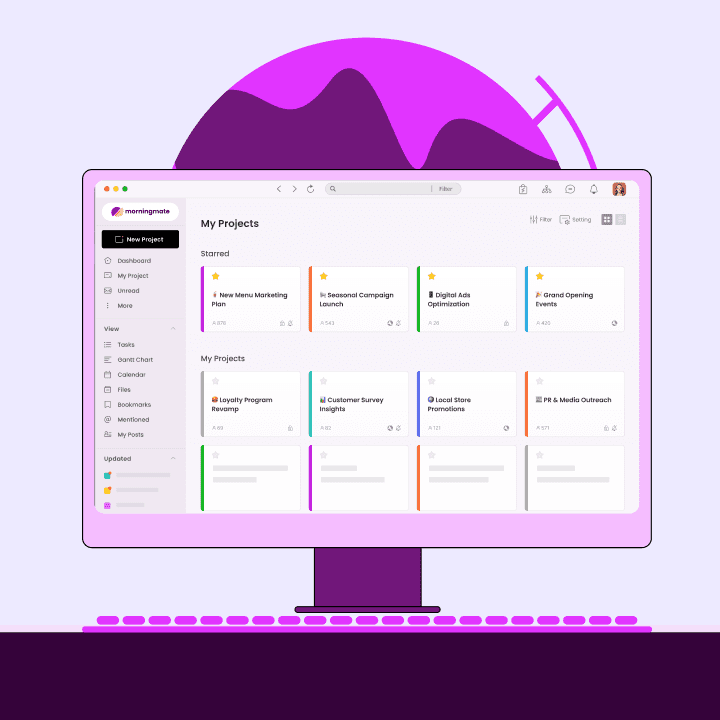
This is exactly where a tool like morningmate earns its keep. It combines task management with a built-in chat that works like a familiar messaging app — so your team does not have to learn anything new. Every task has a comment thread attached to it, so the decision that determined an outcome lives right next to the outcome itself. No more digging through old WhatsApp messages to figure out why something was done a certain way.
Task Management vs. a Real Workflow: What the Difference Looks Like in Practice
To make this concrete, here is what the same scenario looks like under a task list versus a proper task workflow.
Scenario: Onboarding a new client. Your team has six steps that need to happen over two weeks.
Onboarding Step | With a Task List Only | With a Task Workflow |
|---|---|---|
Send welcome email | Listed, no due date, no owner | Assigned to Sarah, due Day 1, auto-notified |
Set up client portal | Started before welcome email sent | Locked until welcome email marked done |
Internal kickoff call | Scheduled by owner manually each time | Part of reusable workflow template |
Approval from owner | Requested via WhatsApp, often missed | Task assigned to owner, visible in their queue |
Progress visibility | Owner must ask individually | Live task board, visible to whole team |
Morningmate handles exactly this kind of setup — without requiring your team to learn a complex project management tool. Its Feed view displays tasks and updates in a familiar social-media-style layout, so even non-technical team members pick it up within minutes. You can build repeatable task workflows, assign owners, attach files, and have all the relevant chat happen right inside the task — not scattered across three different apps. Over 550,000 teams worldwide use it to replace the chaos of disconnected tools with one organized workspace.
What Teams Gain When Task Management Becomes a Workflow
The outcomes are measurable. McKinsey research on social and collaborative technologies found that improving team coordination and task visibility can boost productivity by 20 to 25 percent. For a 15-person team, that is the equivalent of three to four additional full-time contributors — without hiring anyone.
The less obvious gains matter just as much. When task coordination is clear, you stop being the human routing system. Decisions get made at the right level. New hires ramp up faster because the workflow tells them what to do and in what order. Clients get a more consistent experience because the process does not depend on one person's memory.
Reported Improvement After Switching from Task Lists to Structured Task Workflows
72%
Fewer Missed Deadlines
65%
Less Time on Status Updates
58%
Improved Team Accountability
47%
Owner Less Involved in Daily Tasks
Fig 2: Self-reported team outcomes after adopting structured task workflows (illustrative, based on aggregated SMB surveys)
Your Next Move: One Action That Pays Off This Week
Here is the practical starting point. Pick one recurring process your team runs — client onboarding, weekly reporting, product delivery, whatever happens most often. Write out its steps in sequence. Assign one owner to each step. Define when each step is complete and what triggers the next one. That is your first real task workflow, and it will immediately reduce the number of questions that land on your desk.
If you want to move that workflow into a shared system — one that keeps tasks, files, and conversations in one place without adding complexity — morningmate's free plan lets your whole team get started today. The interface is familiar enough that you will not spend a week on training, and the task management features are robust enough that you will not outgrow it when the team doubles.
Proper task management is not about being more organized for its own sake. It is about getting your time back, delivering more consistently to clients, and building a business that does not depend entirely on you to function. The difference between a task list and a workflow is the difference between a business that runs — and one that you have to run constantly yourself.