Project Management

Good task management is the difference between a campaign that ships clean and one that quietly falls apart at the seams. When your team is small — a marketing manager, a founder who dips in and out, maybe two freelancers on rotation — informal coordination feels natural. A voice note here, a quick reply there, a shared Google Sheet that everyone promises to update. It works, until the day it absolutely doesn't.
The breaking point rarely announces itself. It sneaks up during your busiest week, when task tracking has been replaced by memory and goodwill, and suddenly no one can agree on what was approved, what's live, or who was supposed to handle the caption change before the ad went out.
This article is about recognizing that moment — the specific point where informal coordination stops being a reasonable approach and starts being an active risk to your campaigns. And more importantly, what to actually do about it.
The Campaign Morning That Goes Wrong
Picture this. It's the Tuesday your product launch campaign goes live. You scheduled the email last week, the social posts are queued, and the paid ads are ready. At 8:47 a.m., the founder messages asking if the revised pricing copy made it into the email. You check the thread. Then another thread. Then your sent items. The freelance copywriter updated the doc three days ago — but no one confirmed it was pulled into the final version. The email went out with the old price.
Nobody dropped the ball on purpose. There was just no formal task coordination moment where someone owned the final check. The task existed in conversation. It never lived anywhere trackable.
That is the exact moment informal coordination stops being enough. And if it's happened to you once, it will happen again — unless the underlying workflow changes.
Why Task Management Breaks Down on Small Marketing Teams
Small teams default to informal coordination because it feels efficient. No meetings, no systems to learn, no overhead. The problem is that informal task management only works when everyone holds the same mental model of what's happening. The moment your team grows beyond two people — or the moment you bring in a freelancer who isn't in every conversation — that shared mental model starts to crack.
The Three Cracks That Appear First
The first crack is ownership ambiguity. When tasks live in conversations rather than a task management system, it's easy for two people to think the other is handling something — or for no one to own it at all. "Can you sort the brief?" is not a task assignment. It's a request floating in chat.
The second crack is approval drift. Feedback comes in across three channels, revisions happen in the doc, but the approval itself — the actual "yes, this is final" — never gets recorded anywhere. When something goes wrong, no one can reconstruct what was signed off and by whom.
The third crack is context loss. Freelancers rotate in. The founder forgets a conversation from two weeks ago. You switch from a launch campaign to an event campaign and back again. Without structured task tracking, institutional context disappears the moment someone's attention moves on.
Here's how informal coordination compares to structured task management across the moments that matter most:
Coordination Moment | Informal Approach | Structured Task Management |
|---|---|---|
Assigning work | Mentioned in chat or a meeting | Task created, named owner, due date set |
Getting approval | Email or message reply, easy to miss | Approval recorded on the task, visible to all |
Tracking progress | Ask around, check multiple threads | Status visible at a glance in one place |
Onboarding a freelancer | Catch-up call, forwarded emails | Task history and files already there |
Post-campaign review | Try to reconstruct from memory | Full task trail to reference and learn from |
A Repeatable Play for Campaign Task Management
The fix doesn't require a complex project management overhaul. For a small marketing team, what works is a lightweight campaign rhythm — a consistent loop of task creation, ownership, approval, and closure that runs the same way every time regardless of campaign size.
Here's the play, step by step:
Open a campaign workspace before any work starts. Every campaign gets its own space — not a new group chat, but a dedicated project where tasks, files, and discussions live together. This takes five minutes and saves hours of context-hunting later.
Convert every deliverable into a named task with one owner. "Create launch email copy" is a task. "Sort out the email" is not. Each task needs a single owner, a due date, and a brief description of what done looks like. No co-owners. If two people need to touch it, create two tasks in sequence.
Build an approval task for every piece of content that goes external. Founder approval, legal sign-off, client review — each of these is a discrete task, not an assumption. The approval task only closes when the named approver explicitly marks it done.
Use task status as the team's shared status update. Instead of asking "where are we on the ad creative?", the answer should already be visible in the task status. This means your team needs to actually move tasks through stages — Draft, In Review, Approved, Live — rather than just leaving them open.
Run a 10-minute campaign close when the work ships. Before moving to the next campaign, close out every task, note what changed from the original plan, and tag any assets in the shared workspace. This is your institutional memory — the thing that makes the next campaign faster.
Common Task Management Failure Points — and How to Sidestep Them
Even teams that commit to structured task management hit the same predictable walls. Knowing them in advance makes them easier to avoid.
The Founder Who Lives Outside the System
In most small marketing teams, the founder is both a key approver and the least disciplined system user. They'll approve things verbally or in a text message, and that approval becomes invisible to the rest of the team. The fix: make approval tasks so low-friction that responding inside the task system takes less effort than sending a message. Keep it simple — a status change and one line of comment is enough.
Task Management That Only Works at Campaign Start
Many teams set up beautiful task boards at the beginning of a campaign and abandon them by week two. This happens when updating tasks feels like extra admin rather than the actual work. The solution is to keep task updates atomic — one sentence, one status change. If updating a task takes more than 30 seconds, the task is probably too big or too vague.
Freelancers Who Never Quite Sync
Freelancers who work across multiple clients have their own systems. Expecting them to adopt yours without a clear onboarding moment is optimistic. Give every new freelancer a 15-minute task orientation — here's the workspace, here's how tasks are structured, here's where to post questions. That investment pays back every time they deliver work that's actually integrated into your workflow rather than dropped over the fence.
How Morningmate Pulls Task Management, Approvals, and Chat Into One Place
The reason informal coordination persists even when teams know it's breaking down is that the alternative feels heavier. Most task management tools are built for engineering teams or large project offices — they require setup time, training, and ongoing administration that a two-person marketing team simply doesn't have.
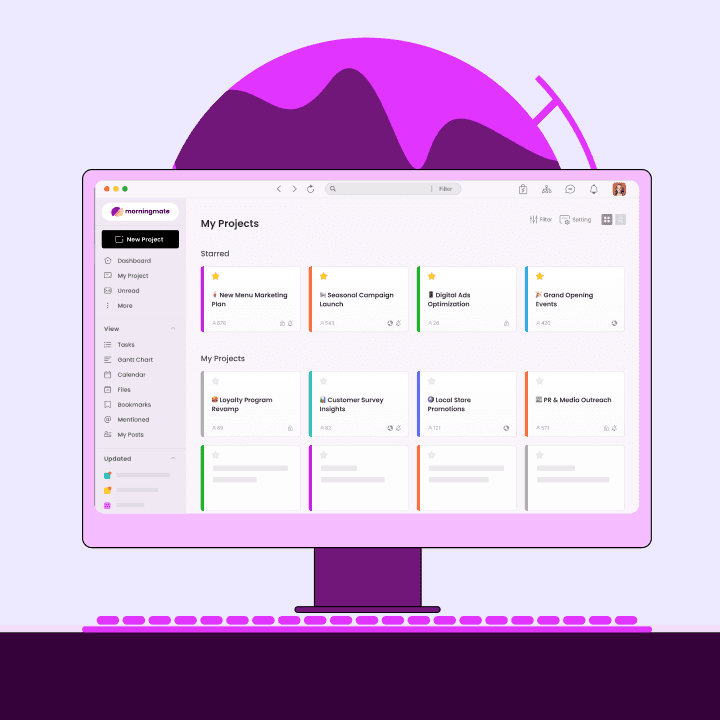
Morningmate is built differently. It's a lightweight work management tool designed so that non-technical teams can pick it up immediately. The interface uses a social-media-style feed and a familiar chat layout, so your freelancers and your founder don't need a tutorial to figure out what's happening.
Here's what that looks like in practice. Picture a three-person campaign team — a marketing manager, a part-time designer, and a freelance copywriter — running a seasonal promotion. In Morningmate, they create a campaign workspace. Every deliverable becomes a task with an owner and a due date. The designer posts the first draft of the banner directly in the task comments. The marketing manager leaves feedback in the same thread. The founder, who only checks in twice a week, opens the task, sees the full conversation, leaves a one-line approval, and moves the status to Approved. Nobody had to chase anybody. No context was lost across channels.
When the copywriter has a question about brand voice mid-campaign, they use Morningmate's built-in chat — which sits right alongside the task board, so the answer stays connected to the work rather than disappearing into a separate messaging app.
For teams dealing with repeated questions about past decisions, Morningmate's AI Smart Search (part of its Repattern AI suite) lets anyone search the workspace in plain language — "what did we decide about the discount headline?" — and surfaces the exact comment, with the date and author attached. That's the kind of task coordination that actually scales with a small team's reality.
You can learn more about how lightweight task coordination works for small marketing teams or explore how to build an approval workflow your whole team will actually use.
Your Task Management Checklist for This Week
You don't need to overhaul everything at once. Start with your next campaign and apply this checklist. Each item takes minutes to implement — the payoff compounds over every campaign that follows.
Action | When to Do It | Done? |
|---|---|---|
Create a dedicated workspace for your next campaign | Before kickoff | ☐ |
Turn every deliverable into a task with one named owner | Day one of campaign | ☐ |
Create a specific approval task for every external asset | When drafts are ready | ☐ |
Brief freelancers on the task system at the start of each project | First day they're on the project | ☐ |
Use task status instead of status-update messages to share progress | Throughout the campaign | ☐ |
Close out all tasks and tag final assets after the campaign ships | Within 24 hours of going live | ☐ |
Informal coordination isn't a flaw — it's a feature of early-stage teams that moves fast and communicates well. But every team reaches the point where speed without structure starts costing more than the structure would have. Good task management doesn't slow your team down. It's what keeps the campaign from going out with last month's pricing at 8:47 on a Tuesday morning.
Pick one campaign this week. Apply the five-step play. Close every task when the work is done. That habit, repeated consistently, is what separates teams that scale from teams that stay stuck in the same fire drills.