Project Management

Task management is only as strong as the work it actually captures — and for most small teams, a surprising amount of real work never enters any system at all. That approval sitting in someone's inbox. The onboarding checklist that lives in a senior hire's head. The recurring vendor call that produces action items nobody writes down. These invisible tasks don't disappear just because they're untracked. They pile up, create bottlenecks, and eventually cost your team far more than you'd expect.
Growing SMBs tend to underestimate this problem because things "seem to be working." Deliverables go out. Projects close. But underneath, coordinators are spending hours chasing status by DM, managers are re-explaining context that should already be documented, and new hires take weeks longer to contribute than they should. The operational drag is real — it just doesn't appear on any dashboard because it was never tracked in the first place.
This article gives you a concrete framework for identifying where work hides outside your task tracking system, quantifying what it costs, and building standardized flows that capture everything. Not because structure is satisfying in theory — but because the compounding cost of doing without it is one of the highest silent taxes a growing operations team pays.
The Compounding Cost of Work That Lives Outside Your Task Management System
The numbers are harder to ignore than the symptoms. Atlassian's State of Teams research found that workers switch between tools and contexts over 1,000 times per day, with each context switch adding measurable cognitive load and recovery time. Meanwhile, McKinsey's research on knowledge work estimates that employees spend roughly 20% of their working week searching for information or tracking down colleagues to get it — time that scales linearly as your headcount grows.
For a 20-person team where average loaded labor cost is $50/hour, that's $100,000 per year spent on information retrieval alone. And that figure doesn't include the cost of decisions made on incomplete information, onboarding delays caused by undocumented processes, or the attrition risk that follows when high performers burn out on coordination overhead.
The root cause is almost never laziness or poor intent. It's structural: your task tracking lives in one place, but the work itself originates in a dozen places — meetings, email threads, chat messages, verbal walk-bys, shared drives that nobody audits. Until you build a system that pulls all of it into one visible, accountable space, task management will always be incomplete.
Work Origin | Typically Tracked? | Common Failure Mode |
|---|---|---|
Project management tool | Yes | Incomplete — only formal tasks entered |
Meeting action items | Rarely | Lost in meeting notes or not recorded |
Email requests | Almost never | Buried in threads, no owner or deadline |
Chat/messenger asks | Almost never | Scrolled past, forgotten, no accountability |
Verbal requests | Never | Fully invisible unless self-documented |
Recurring process steps | Inconsistently | Exists only in individual memory |
Introducing the SURFACE Framework for Task Management Visibility
To systematically bring hidden work into your task management system, you need a way to identify where work hides before you can capture it. The SURFACE framework gives you six diagnostic lenses — each targeting a common origin point for untracked tasks. The name stands for: Systems, Uncaptured meetings, Requests via chat, File-based work, Assumed knowledge, Cross-team handoffs, and Escalations.
Run through each lens for any team or workflow and you'll consistently surface task coordination gaps that nobody has formally acknowledged. The goal isn't to micromanage every task — it's to make sure every piece of work has an owner, a deadline, and a visible status. Here's what each component looks like in practice.
S — Systems: Task Management Only Captures What People Enter
Your task tracking tool is only as complete as the data your team puts into it. The most common failure: people use the tool for "official" project tasks but handle day-to-day asks through chat or email, with no crossover. You end up with a beautiful project board that represents maybe 60% of what's actually in flight.
Fix this at the process level. Make it a team norm — not a suggestion — that any request generating more than 30 minutes of work gets logged as a task with an owner and due date. The tool matters less than the habit. Consistency is the system.
U — Uncaptured Meetings: Where Task Coordination Goes to Die
Meetings generate more untracked work than almost any other source. Action items get discussed, heads nod, and then nothing gets written down in a place where it can be assigned and followed up. Two weeks later, someone asks "whatever happened to that?" and the answer is always the same: it lived in the meeting and never made it out.
The operational fix is simple: end every meeting with a two-minute action item capture. Each item needs a name, an owner, and a due date. Those three fields get posted to your shared task management space immediately after the call — not to a meeting notes doc that nobody revisits, but to the same workspace where the rest of your work lives.
Where Untracked Work Originates in Small Teams
34%
Chat / Messenger
28%
Meetings
21%
11%
Verbal
6%
Other
Fig 1: Estimated distribution of untracked work origins in SMB teams (illustrative)
R — Requests via Chat: The Task Coordination Black Hole
Chat tools are fast and convenient — which is exactly why they've become the default channel for work requests that should be tasks. "Can you update the vendor list?" sent at 2pm on a Tuesday has no deadline, no priority, no audit trail, and no clear accountability. When things slip, nobody can reconstruct why.
The standard to enforce here: chat is for communication, your task management system is for work. Anything actionable that arrives via chat gets converted into a task immediately — by the recipient, not the sender. This shifts the burden in a healthy direction and builds a muscle your team will use automatically within a few weeks.
F, A, C, E — The Hidden Layers of Untracked Task Coordination
File-based work is work that lives in documents, spreadsheets, and shared drives with no connection to a task or timeline. A Google Sheet being updated weekly by three people across two teams is a workflow — but if it has no owner, no deadline, and no visibility into whether it's current, it's also a liability. Link files explicitly to tasks in your task tracking system so there's always a thread back to intent and accountability.
Assumed knowledge is the most expensive item on this list. It's the process that only Sarah knows because she built it two years ago. The vendor contact that only Marcus calls. The formatting standard that's never been written down. According to Gallup's workforce research, knowledge loss from employee turnover costs businesses 50–200% of a departing employee's annual salary in productivity drag. Document these processes as templated task workflows — not a knowledge base that gets stale, but repeatable task sequences that actually get executed.
Cross-team handoffs are where task coordination breaks down most visibly at scale. Marketing finishes a campaign brief and "sends it over" to design. Design does something with it. Whether the right version is being worked on, who approved what, and where it stands right now — all invisible unless it's tracked. Every handoff is a task. Treat it that way.
Escalations are tasks that stall, get bumped up to a manager, and then either get resolved or disappear into someone's inbox. Build a visible escalation path into your task management process so that blocked tasks have a defined next step and don't just become silent failures.
Applying the SURFACE Framework with Morningmate: A Worked Example
Here's what applying the full framework looks like for a real ops scenario: standardizing a new-hire onboarding process across departments.
Before standardization, onboarding looked like this: HR sends a welcome email (S — system gap), the hiring manager does a verbal kickoff (A — assumed knowledge), IT gets a chat message about laptop setup (R — chat request), the new hire is pointed to a Google Drive folder with no context (F — file-based work), and the cross-functional teams they'll work with are never formally looped in (C — cross-team handoff). No single person has visibility into whether any of these steps are complete.
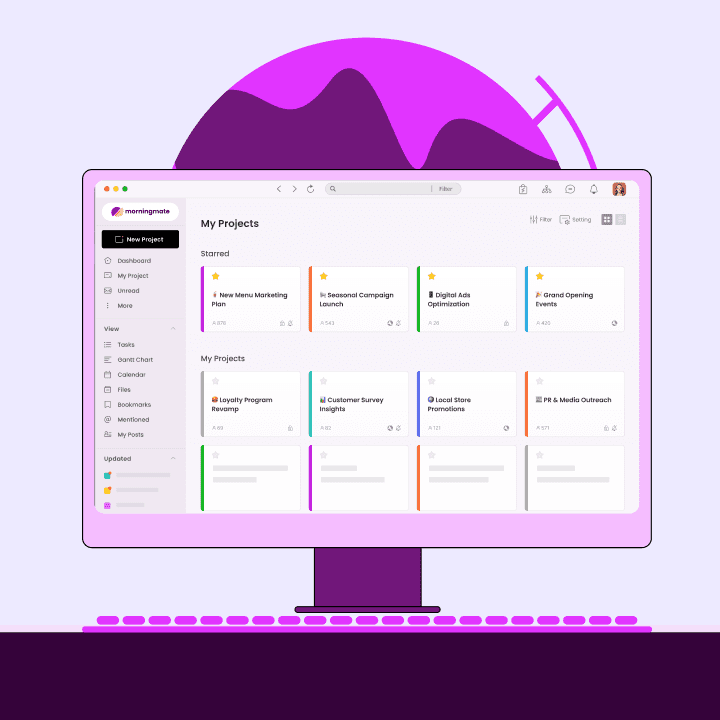
With Morningmate — a lightweight work management tool that combines task boards with built-in team chat — the entire onboarding flow becomes a reusable task template. Each step in the process is a task with an assigned owner and due date. The template is triggered the moment a new hire's start date is confirmed, automatically populating tasks for HR, IT, and the hiring manager in their respective workspaces. Files attach directly to the relevant task so nothing lives in a disconnected Drive folder. The built-in chat means questions from the new hire land in the same workspace as the tasks they relate to — not in a separate app that nobody checks consistently.
The result: onboarding coordinators stop chasing status across three tools. Every stakeholder sees exactly what's done, what's pending, and what's blocked — without a single status meeting. That's what standardized task workflows actually produce at the operational level.
Onboarding Step | Manual / Ad-hoc Approach | Standardized Task Management Flow |
|---|---|---|
Welcome communication | Email, varies by manager | Task auto-assigned to HR on hire confirmation |
IT setup request | Chat message, often forgotten | Templated task to IT with deadline + checklist |
Process documentation | Drive link in email, context-free | Files attached to specific tasks with annotations |
Cross-team intro | Verbal, sometimes skipped | Assigned task to hiring manager, due day 3 |
30-day check-in | Remembered or forgotten | Scheduled task, auto-reminder to manager |
Task Completion Rate: Before vs After Standardized Task Workflows
41%
Ad-hoc / No System
63%
Partial Task Tracking
89%
Standardized Workflows
Fig 2: Task completion rates by workflow maturity level (illustrative)
Your Task Management Standardization Checklist
Implement the SURFACE framework with these concrete steps. This is a repeatable ops audit you can run on any team or workflow — not just onboarding.
Audit your task origins. Run through the six SURFACE lenses for your three highest-volume workflows. Identify which work origins are currently untracked.
Set a 30-minute rule. Any request that will take more than 30 minutes to complete gets logged as a task — owner, deadline, context. No exceptions.
End every meeting with a task capture. Block the last two minutes of any working meeting for action items. Post them to your shared task management workspace, not a notes document.
Convert chat requests to tasks at the point of receipt. The person receiving a work request via chat is responsible for converting it into a tracked task before acting on it.
Build three recurring processes as task templates. Start with onboarding, a monthly reporting cycle, and a cross-team handoff. Templated task workflows eliminate the "who does what" question every single time.
Attach files to tasks, not to folders. If a file is relevant to a piece of work, it belongs attached to the task — not sitting in a shared drive with no context.
Define an escalation path for blocked tasks. Every blocked task needs a named next step and a person responsible for unblocking it. Blocked tasks without a path become invisible failures.
Review task management coverage monthly. Ask: what work happened last month that we can't see in our task tracking system? That gap is your next standardization target.
Morningmate's task boards and built-in chat sit in the same workspace, which makes this kind of standardization practical even for non-technical teams. When the tool is simple enough that everyone actually uses it, task coordination stops being something ops managers have to enforce and starts being how work naturally flows. Over 550,000 teams use it precisely because the learning curve doesn't become its own project to manage.
Consistent task management isn't about control — it's about giving every person on your team a clear view of what they own, what's moving, and what needs their attention today. That clarity compounds over time into something far more valuable: a team that doesn't need to be chased, because the work is visible to everyone who needs to see it. Start with one workflow. Apply the SURFACE lens. Build from there.