Project Management

Good task management is not something most small business owners think about until something breaks. A client deliverable goes out late because the person who owned it thought someone else had picked it up. A new hire spends their first week piecing together half-finished context from old chat threads. A key employee takes a week off and the whole team grinds to a halt. These are not management failures — they are handoff failures, and they happen in every small business that has not yet built a system to pass work from one person to the next cleanly.
Most teams assume task management means assigning to-dos and checking them off. That is part of it. But the real job of task management is making sure work does not fall into the gap between people — the moment when one person finishes their part and the next person needs to start theirs. That gap, multiplied across a 10- or 20-person team running dozens of projects at once, is where small businesses quietly lose time and money every single week.
The good news is that you do not need a complex system to fix this. You need a lightweight handoff process built into the way your team already works. Here is how to build one before the next dropped ball costs you a client — or a good employee.
Why Small Teams Hit the Handoff Wall
When your team is small, almost everything runs on informal communication. Someone messages someone else, work gets done, and the owner keeps it together in their head. This works fine at five people. It starts to crack at ten. By fifteen or twenty, it quietly becomes one of your biggest operational risks.
The problem is not that your team is disorganized. It is that your task management is invisible. There is no shared record of who owns what, what context they need to do it, or when it needs to move to the next person. When people leave, go on holiday, or simply get busy, work stalls — and nobody notices until a deadline is missed.
Research published in Harvard Business Review found that coordination failures — not individual performance — are the primary cause of execution breakdowns in small and mid-size teams. The root cause is almost always the same: work lives in people's heads and private messages instead of a shared system.
The table below shows how task management typically looks without a handoff system versus with one in place.
Situation | No handoff system | With a handoff system |
|---|---|---|
Employee takes leave | Work stalls; owner scrambles | Next owner is pre-assigned with full context |
New team member onboards | Days lost piecing together context | Task history and files are immediately accessible |
Multi-step project | Owner chases each transition manually | Each stage triggers the next assignee automatically |
Client deadline missed | Root cause unclear; blame shared | Exact gap is visible; fast to fix |
The Real Cost of Poor Task Management in Small Teams
Most owners underestimate what broken handoffs actually cost. They see the symptom — a missed deadline, a confused employee, an angry client — but not the pattern underneath it.
It eats more time than you think
Atlassian's research on team productivity found that employees spend an average of 31 hours per month in unproductive meetings and status chases — most of which exist because there is no clear task coordination system. In a 15-person team, that is hundreds of hours a year spent asking "where are we on this?" instead of actually moving work forward.
It keeps the owner as the bottleneck
When task ownership is unclear, people default to asking the founder. Every clarifying question that comes to you is a sign that your task management system is not carrying the context it should. You become the handoff — and that does not scale.
It makes good employees leave
Capable people get frustrated working in systems where nothing is clear. They spend energy navigating confusion instead of doing their best work. Gallup's State of the Global Workplace report consistently shows that unclear roles and responsibilities are among the top drivers of disengagement — especially in small teams where people are already stretched.
Hours Lost Per Month Per Employee Due to Poor Task Handoffs
12 hrs
Chasing status updates
9 hrs
Re-explaining context
7 hrs
Duplicated work
3 hrs
With clear handoff system
Fig 1: Estimated monthly hours lost per employee by failure mode (illustrative, based on industry research)
Why It Happens: The Root Cause of Task Coordination Failures
The root cause is almost never laziness or incompetence. It is that your task management lives in formats that cannot be transferred. A conversation in WhatsApp. An email thread that only two people are on. A mental note the owner made in a meeting last Tuesday.
None of those things can be handed off. They exist in a single channel, tied to a single person. The moment that person is unavailable — or moves on — the context disappears with them.
Small teams also skip the handoff step because it feels like overhead. When everyone is busy, stopping to document task context seems like admin that slows things down. In reality, skipping it is what slows things down — just on a delay, and usually at the worst possible moment.
A Practical Task Management Handoff System Your Team Can Start This Week
You do not need software expertise or a project manager to set this up. You need four habits that become part of how your team creates and closes tasks.
Step 1: Every task needs one owner and one deadline — always
The most common task coordination failure is shared ownership. "Marketing will handle that" is not an assignment. One name, one date. If a task does not have both, it does not exist in your system — it exists in someone's head, which means it will be dropped eventually.
Step 2: Attach context to the task, not to the person
When you create a task, add the three things the next person needs to pick it up without a conversation: what the task is, why it matters right now, and where the relevant files or decisions live. This takes 90 seconds when you create the task. It saves 30 minutes when someone else needs to step in.
Step 3: Define the handoff trigger before work starts
For any multi-step task or project, decide upfront what "done" looks like for each stage and who picks it up next. Write this into the task itself — not in a separate document, not in a chat thread. The handoff instruction should be part of the task record.
Step 4: Do a weekly five-minute task review
Once a week, scan all open tasks as a team. Flag anything that is stalled, reassign anything where ownership is unclear, and close anything that is actually done. This is not a status meeting — it is a five-minute hygiene check that prevents the buildup of invisible backlog.
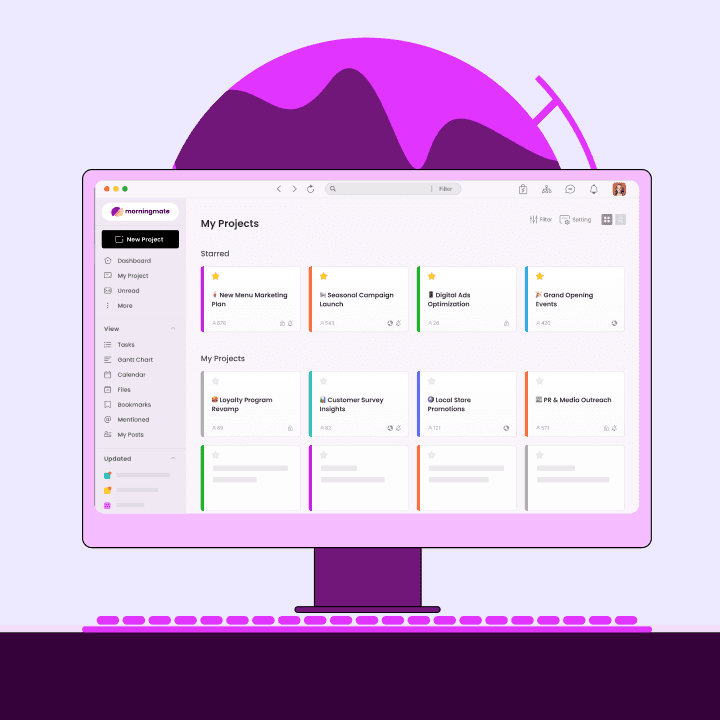
This is where a tool like Morningmate makes a real difference. Instead of keeping tasks in scattered chat threads, Morningmate gives your team one feed-style workspace where every task carries its own owner, deadline, attached files, and comment history. When a task needs to move to the next person, all the context moves with it — no chasing, no re-explaining.
How to Choose a Task Management Tool That Does Not Add Complexity
Most task management tools are built for teams larger than yours. They have Gantt charts, sprint boards, permission hierarchies, and onboarding workflows that take weeks to set up. Your team will use them for two weeks and then go back to WhatsApp.
What a small team actually needs from task tracking is simple: one place where tasks are created, owned, and updated — with a built-in way to communicate about them without switching to a separate chat app.
Morningmate is built for exactly this. Its interface looks like a social media feed — something everyone on your team already knows how to use — so there is no learning curve and no resistance. Tasks sit inside project posts, with assignees, due dates, and file attachments built in. The built-in chat means your team can discuss a task without it getting buried in a WhatsApp thread that nobody else can see. Everything stays in one place, organized by project rather than by conversation.
For a team of 5 to 50 people, that is exactly the right level of structure — enough to run cleanly, not so much that it becomes a system you have to manage on top of your actual work.
The table below compares the key task management capabilities across common small team approaches.
Feature needed | Chat apps (WhatsApp/Slack) | Heavy PM tools (Jira/Asana) | Morningmate |
|---|---|---|---|
Task ownership + deadline | No | Yes, complex setup | Yes, built in |
Attached context and files | Scattered, hard to find | Yes, with training | Yes, per task |
Built-in team communication | Chat only, no task link | Needs integration | Yes, native |
Ease of adoption (non-tech teams) | High (wrong tool) | Low (too complex) | High (familiar interface) |
Cost for small team | Low but no task tracking | High | Affordable, no tool sprawl |
What Teams Gain When Task Management Actually Works
The shift from informal task coordination to a proper handoff system does not just fix dropped balls. It changes how your team operates day to day. People stop waiting for permission to move forward because the next step is already written into the task. The owner stops being the connector between every piece of work. New hires get up to speed in days instead of weeks.
Teams that adopt structured task workflow consistently report measurable gains in throughput — not because they work harder, but because less time and energy is lost to coordination overhead. You can explore how structured work management drives team output in more detail.
Team Efficiency Improvement After Adopting Structured Task Handoffs
+41%
On-time delivery rate
+35%
Reduction in status meetings
+28%
New hire ramp-up speed
+22%
Owner time freed per week
Fig 2: Estimated efficiency gains after implementing structured task handoff workflows (illustrative)
Your Next Step: Start with One Project's Task Management
You do not need to overhaul everything at once. Pick one active project this week — ideally one that involves three or more people — and apply the four steps above to every task in it. Assign a single owner, attach the context, define the handoff trigger, and review it once at the end of the week.
If you want the task management structure to hold without adding admin work, set that project up in Morningmate. The feed-style layout means your team will recognise it immediately, and the built-in task coordination keeps everything — assignments, files, comments, deadlines — in one place rather than spread across three apps. Over 550,000 teams use it precisely because it gives small businesses the structure they need without the tool sprawl they cannot afford.
The ROI is straightforward. One dropped client deliverable can cost you more than a year's subscription to any work management tool. One week of a new hire spinning their wheels because context is scattered costs you real salary. A solid task management handoff system — simple, consistent, lived in by the whole team — is one of the highest-return investments a small business owner can make. And unlike hiring, it does not take months to pay off. You will feel the difference in the first week.