Project Management

Good task management is supposed to fix the chaos — so why does every new tool your team adopts end up as another abandoned tab by month three? If you've been here before, you're not alone. The pattern plays out constantly in small marketing teams: a shiny new platform gets launched with enthusiasm, everyone nods in the kickoff call, and then six weeks later your freelance designer is still sending files over WhatsApp and your founder is scribbling approvals in a text message. The tool didn't fail because it was bad. It failed because the team never actually changed how they worked.
This article is about the real reason tools get dropped — and it has almost nothing to do with features. It's about the gap between picking a task management system and actually building the daily habits that make it stick. According to Harvard Business Review, most organizational change efforts fail not because of bad strategy but because of poor adoption at the team level. Task tracking tools are no different.
Here's the scenario that probably sounds familiar — and the repeatable play to stop it from happening again.
The Campaign That Went Off the Rails Before Noon
It's the morning of your product launch. You're three hours from sending the email blast when you realize the final banner image was never approved. You ping the founder on WhatsApp. She's in a meeting. You check the Slack thread — or was it email? You find three versions of the creative, no clear sign-off, and a comment from the freelancer that got buried two days ago. The campaign goes out late. The founder is frustrated. The freelancer blames unclear feedback. You're already exhausted before 10 a.m.
This isn't a communication problem. It's a task management problem. Specifically, it's what happens when approvals, files, conversations, and deadlines all live in different places — and your team's "system" is really just whoever shouts loudest.
Where Task Management Actually Breaks Down
Most small marketing teams don't have a task management problem on day one. They have a growth problem. What worked with two people — a shared Google Sheet, a quick DM — starts cracking when you add a founder's input, two freelancers, and a quarterly campaign calendar. The cracks show up in predictable places.
Context Gets Lost Between Tools
The brief is in Google Docs. The feedback is in email. The approval is in WhatsApp. The updated file is in Dropbox. Your task workflow technically exists — it's just spread across six apps and nobody can reconstruct the full picture without 20 minutes of archaeology. Atlassian's research found that employees spend up to 60% of their time on "work about work" — status updates, searching for files, chasing approvals — instead of the actual creative output.
Approvals Slip Through Without a Trail
In a small team, approval processes are informal by design. But informal doesn't mean frictionless. When feedback lives in chat messages, it gets buried. When sign-offs happen verbally or over text, there's no record. You end up with "I thought you approved the copy" moments right before launch — every single time.
New Tools Add Friction Instead of Removing It
The team adopts a project management tool. Then nobody logs tasks consistently because it feels like extra work on top of existing work. The tool becomes a ghost town. According to Gartner's workforce research, tool overload is one of the top reasons employees disengage from new software — especially when the tool requires behavior change without delivering immediate personal value.
Breakdown Point | What Goes Wrong | The Real Cost |
|---|---|---|
Approval tracking | Sign-offs buried in chat or email | Campaigns delayed, versions confused |
File management | Latest version unknown | Wrong assets go live |
Task assignment | Verbal or chat-based only | Nobody owns the deadline |
Freelancer onboarding | Context shared piecemeal over DM | Rework, missed briefs |
Why Task Management Tools Get Abandoned: The 90-Day Drop-Off
The 90-day window is where adoption lives or dies. Research consistently shows that software habits either solidify or collapse within the first three months. For marketing teams, the drop-off follows a predictable arc: week one is enthusiastic setup, week two is partial use, week three is "I'll log it later," and by week six the tool is open in a pinned tab that nobody clicks.
Why Teams Stop Using Task Management Tools Within 90 Days
61%
Too complex to use daily
48%
Team reverts to chat apps
39%
No single owner for adoption
Fig 1: Top reasons task management tools are abandoned within 90 days (illustrative, 2026)
The core issue? Most task tracking tools are built for project managers, not for the marketing manager juggling content, campaigns, freelancer wrangling, and founder approval — often in the same hour. When the tool adds steps instead of replacing them, people quit.
A Repeatable Play: The 5-Step Task Management Habit Stack
The fix isn't a better tool — it's a lightweight workflow that makes the tool unavoidable. Here's the play that works for small marketing teams specifically.
One place for every task, no exceptions. Every piece of work — a blog draft, a social post, a founder review — gets logged as a task. Not a DM. Not a calendar invite. A task, with a name, an owner, and a due date. This is the non-negotiable foundation of any task workflow that actually holds.
Attach the brief to the task, not to an email. When you assign work to a freelancer or a teammate, link the brief, the reference files, and the deliverable spec directly to the task card. No more "can you resend the brief?" messages.
Use comments on tasks for feedback, not chat. Every round of feedback goes as a comment on the task — not in WhatsApp, not in a DM. This keeps the context in one place and gives you a clean audit trail for every approval.
Set a weekly task review ritual. Every Monday, spend 15 minutes reviewing open tasks with your team. What's stuck? What needs approval? What's overdue? This keeps your task coordination alive without requiring everyone to check the tool constantly.
Make the founder's approval a task step, not an afterthought. Build founder review as a formal stage in your task workflow — not a ping when you remember. Assign it, deadline it, and follow up inside the task thread.
This five-step habit stack works because it collapses six apps into one behavior: open the task, do the work, record the outcome. The tool becomes the job, not extra admin on top of it.
Common Task Management Failure Points — and How to Dodge Them
Even with the right workflow, small teams hit the same walls. Here's where things typically go sideways and what to do instead.
The "I'll Log It Later" Trap
Task tracking falls apart when logging feels like a second job. The fix: make task creation take under 30 seconds. If your tool requires five fields before you can create a task, your team will skip it. Choose a task management system where a task can be born from a quick note and get details added as work progresses.
Freelancers Living Outside the System
Your freelance designer shouldn't need a separate login or a different app. When your external collaborators live outside your task workflow, you lose visibility on their work instantly. The best task coordination systems let you invite freelancers directly into specific projects without giving them access to everything else.
Founder Bottlenecks That Kill Momentum
When the founder's approval is unstructured, it becomes the single biggest drag on your campaign calendar. Build a lightweight approval stage into every content or campaign task: "Ready for review" status, tagged to the founder, with a hard deadline attached. When the approval step is a task — not a Slack ping — it gets treated like a task.
Nobody Owns the Tool
Tools without a single internal champion die fast. Someone on your team — probably you — needs to own the task management system: setting up templates, nudging the team when tasks go unlogged, and enforcing the Monday review ritual. This isn't overhead. It's the difference between a system that works and one that quietly fades out.
How Morningmate Makes Task Management Stick for Marketing Teams
This is where tool choice actually matters — but not in the way most reviews frame it. The question isn't "which tool has the most features." It's "which tool will my team actually open tomorrow morning." That's the problem Morningmate was built to solve.
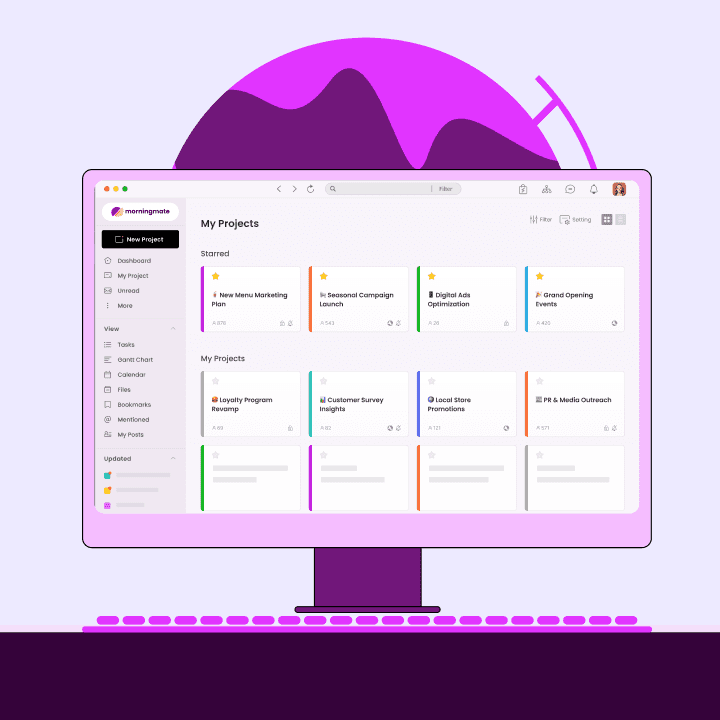
Morningmate is a lightweight work management platform that combines task tracking, built-in team chat, and file management in one workspace. The interface looks and feels like a social media feed — familiar enough that even non-technical team members and external freelancers get comfortable in under a day. There's no six-hour onboarding. No certification required. You create a project, add tasks, invite your freelancer, and you're running.
Here's what that looks like in practice for a marketing team running a product launch campaign:
Before Morningmate: The campaign brief is in Google Docs. Design feedback is in WhatsApp. The founder's approval comes via email at 11 p.m. The freelancer sends the final file over DM. Nobody is sure which version went live.
With Morningmate: The campaign is a project. Every deliverable — copy, design, email template — is a task with an owner and a deadline. The brief is attached directly to the task. Design feedback goes in the task comments. The founder gets tagged for approval as a formal task step inside the same thread. The freelancer sees only their tasks and uploads the final file directly to the card. The whole trail — from brief to sign-off — is in one place.
The built-in chat in Morningmate also means your team doesn't need to flip between the task tool and a separate messenger. Quick questions happen in the same workspace as the work itself — which is the single biggest reason teams stop bouncing between apps. Used by over 550,000 teams worldwide, morningmate has helped marketing teams consolidate scattered task management workflows without adding complexity.
Workflow Step | Scattered Approach | Morningmate Approach |
|---|---|---|
Brief delivery | Email or Google Doc link in chat | Attached directly to task card |
Design feedback | WhatsApp thread, multiple DMs | Task comments, full history visible |
Founder approval | Text message, easy to miss | Formal task step with deadline and tag |
Final file delivery | DM or email attachment | Uploaded to task, version clear |
Campaign review | Retrospective meeting from memory | Full task history available instantly |
Task Management Adoption Rate After 90 Days: Tool Comparison
31%
Complex PM tools
44%
Standalone chat tools
79%
Lightweight all-in-one tools
Fig 2: Sustained task management adoption at 90 days by tool type — small marketing teams (illustrative, 2026)
Your Task Management Checklist: Apply This Week
Stop planning to fix your task workflow next quarter. Here's what you can do in the next five working days to build a task management system that actually holds past the 90-day mark.
✅ Day 1: Audit where tasks currently live. List every app where work gets assigned (chat, email, spreadsheets). This is your baseline problem map.
✅ Day 2: Pick one tool and commit. Set it up with your three active campaigns as projects. Every task tracking decision starts there from now on.
✅ Day 3: Migrate your freelancers in. Send them a task — not a DM — and attach the brief to it. Test whether the handoff actually works without a follow-up message.
✅ Day 4: Build your approval workflow. Create a "Pending Founder Review" task stage for every campaign. Set a deadline. Tag the founder. Make it a task, not a ping.
✅ Day 5: Schedule the Monday task review ritual. Block 15 minutes every Monday morning. Open the tool, review open tasks, unblock what's stuck. Do this for four weeks straight and it becomes habit.
✅ Ongoing: Run your task coordination from one place. Every brief, every feedback round, every approval lives in the task — not in chat, not in email, not in your head.
The teams that succeed at task management long-term aren't the ones with the most sophisticated tools. They're the ones who chose something simple enough to use every day and built real rituals around it. Your next campaign launch doesn't have to start with a scrambled approval and three conflicting file versions. It can start with a task board that everyone actually opened this morning — and a workflow that keeps context exactly where it belongs.