Project Management

Effective task management is not just about knowing what needs to get done — it is about knowing what is stopping everything else from moving forward. Most operations managers can name the tasks on their team's plate. Far fewer can instantly identify which ones are actively blocking three other workstreams and which ones are simply sitting untouched because nobody owns them. That distinction, quiet as it seems, is where delivery timelines collapse and cross-team coordination falls apart at the seams.
The problem compounds fast. A blocked task in onboarding delays a new hire's first productive week. That delay pushes back a team lead's ramp-up timeline. The ramp-up slip bleeds into a quarterly target that now needs re-forecasting. None of this shows up as a crisis on day one — it shows up as a pattern of missed deadlines three months in, when the root cause is long buried under chat messages and status meetings. Harvard Business Review has noted that most managers dramatically underestimate the downstream cost of a single stalled dependency, treating it as an isolated inconvenience rather than a systemic drag.
This article gives you a practical framework for separating genuinely blocking tasks from idle backlog — and a structured approach to making that distinction visible across your entire operation, not just in your own head.
The Real Cost of Conflating Blocked Tasks with Backlog
When task management is inconsistent, everything gets treated as roughly equal urgency. A task labeled "In Progress" might mean someone is actively working on it, or it might mean it was touched two weeks ago and is now waiting on an approval nobody followed up on. There is no visual or structural difference between the two — they look identical in a spreadsheet, an inbox, or a chat thread.
According to the Project Management Institute, organizations waste an average of 11.4% of their total investment due to poor project performance — and a significant driver of that figure is unresolved task dependencies that managers never surfaced in time. For a team of 30 people with a $2M annual payroll, that is roughly $228,000 in wasted capacity per year. Not from laziness. From invisible blockage.
Before you can fix this, you need a shared language for what "blocked" actually means inside your operation.
Task State | What It Looks Like on Surface | What It Actually Means | Ops Risk Level |
|---|---|---|---|
In Progress | Someone is working on it | May be stalled pending input or approval | High — invisible |
To Do | Not started yet | Could be unblocked backlog or a hard dependency | Medium — unclear |
Overdue | Past its deadline | Blocker already cascaded — damage done | Critical — reactive |
Blocked (explicit) | Flagged as waiting | Dependency clearly named — actionable | Manageable — visible |
Introducing the GATE Framework for Task Management
To consistently separate blocking tasks from idle backlog, your team needs a classification model — not just better status labels. The GATE framework gives every task a functional identity based on its relationship to forward momentum. GATE stands for: Gating, Active, Trailing, and Expired. Each category tells you not just where a task is, but what role it plays in the flow of work.
This is not a theoretical exercise. It is a task coordination discipline you apply during triage, sprint planning, or your weekly ops review. Once your team internalizes GATE, the question "what's blocking us?" gets a specific, structured answer instead of a vague list of things that feel urgent.
G — Gating Tasks: The True Blockers in Your Task Management System
A Gating task is one that must be completed before one or more other tasks can begin or continue. These are your true blockers. They sit upstream of dependent work, and their delay creates a multiplier effect — every day a Gating task is stuck adds compounding delays to everything downstream.
In an ops context, a concrete example: your onboarding checklist requires IT to provision system access before HR can schedule tool training. The access provisioning task is Gating. If it sits in a queue for three days without a clear owner or escalation path, new hire productivity is delayed by exactly those three days — minimum. The training task looks "not started" in your task tracking system, but the real problem is upstream.
How to identify Gating tasks during triage: ask "if this task does not move today, what else cannot move?" If the answer is more than one other task, you have a Gating task. Tag it explicitly, assign a resolution owner, and set a 24-hour follow-up cadence until it clears.
A — Active Tasks: Legitimate Work in Motion
Active tasks are genuinely in progress — someone is working on them right now, they have the resources they need, and they are not waiting on another team or decision. These tasks do not require your intervention. Your job here is to protect the person doing the work from being pulled into status meetings or asked to re-explain context that should already be documented.
The ops failure mode here is treating Active tasks as if they need the same oversight as Gating tasks. That micromanagement drains productivity and signals distrust. Instead, establish a lightweight check-in cadence — a brief async update posted to a shared workspace is sufficient — so you have visibility without interruption.
This is where a tool like Morningmate, a lightweight work management platform used by over 550,000 teams, earns its keep. Its Feed view lets task owners post quick updates that the whole team can see without triggering a meeting or a message thread. Active tasks stay visible and documented without anyone having to chase anyone.
T — Trailing Tasks: Idle Backlog That Looks Like Progress
Trailing tasks are the quiet danger in your task management system. They have been started — or at least touched — but are no longer moving. They are not explicitly blocked, so they do not get flagged. They are not overdue yet, so they do not trigger alerts. They simply sit there, consuming mental real estate in standups and roadmap reviews while contributing nothing to output.
A typical ops example: a process documentation task was assigned during a team offsite three weeks ago. The assignee drafted an outline, shared it in a group chat, received no feedback, and moved on to other work. The task is still "In Progress." It is not blocking anything — but it is also not being completed. It is Trailing.
The fix is a structured weekly audit. Any task that has had no update in five or more business days should be reviewed: either re-activate it with a concrete next action, reassign it, or formally deprioritize it. Leaving it in limbo is the worst option because it creates false confidence in your task workflow coverage.
How Teams Identify Blocked Tasks Without a Framework
18%
Formal task review
29%
Status meetings
53%
Someone flags it manually
Fig 1: Primary blocker discovery methods in SMB teams — most rely on reactive, manual detection (illustrative, based on PMI workflow research)
E — Expired Tasks: Dead Weight Disguised as Backlog
Expired tasks were relevant at some point — but the context that made them important has changed. The project pivoted, the client deadline moved, the business decision was made without this task's input. Yet the task lives on in your system, inflating your backlog count and muddying your team's sense of actual workload.
Expired tasks are particularly damaging during cross-team onboarding. A new coordinator joins, sees 80 open tasks in the shared board, and assumes all 80 are legitimate priorities. Forty of them are Expired. Without a disciplined task management cleanup process, that new hire spends their first two weeks building context on work that will never happen.
Assign one person per quarter to run an Expiry Review — a systematic pass through all open tasks older than 30 days. Any task that cannot be connected to a current business objective gets closed with a brief note explaining why. This is not deletion; it is archival. The record stays, the clutter goes.
Applying the GATE Framework in Morningmate: A Worked Task Management Example
Here is how a standardized GATE-based task workflow looks inside Morningmate for a common ops scenario: onboarding a new operations coordinator across three departments — IT, HR, and Finance.
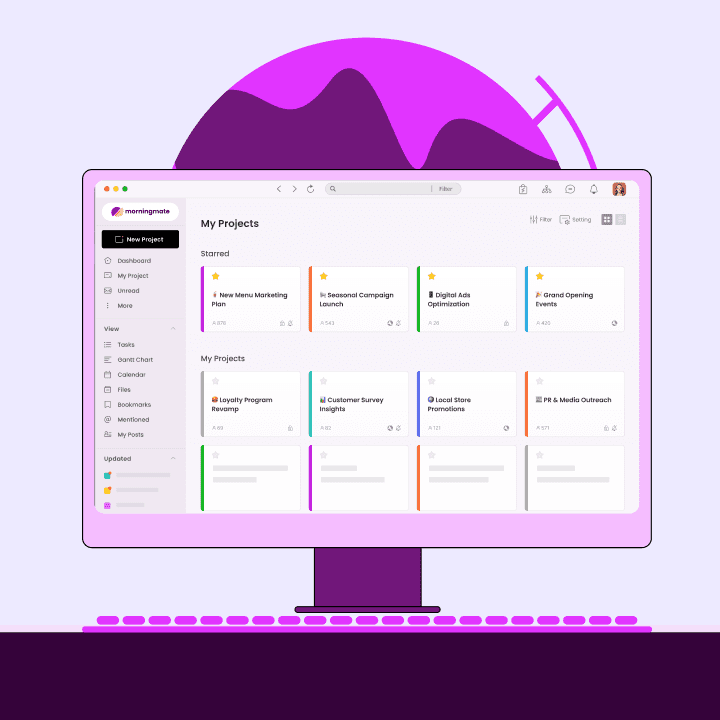
Step 1 — Create the onboarding project in Morningmate. Set up a dedicated workspace with tasks for each department's onboarding steps. Each task is tagged with its GATE category at creation: IT access provisioning is tagged Gating (Finance can't run payroll setup until access is live). Benefits enrollment is tagged Active (HR is working through it). Equipment procurement is tagged Trailing (ordered two weeks ago, no update received). Old role-specific SOP review tasks from the previous coordinator's tenure are tagged Expired and closed immediately.
Step 2 — Use Morningmate's built-in task management features to assign owners and due dates with visible status. Gating tasks get a 24-hour resolution flag. Active tasks get a five-day update cadence. Trailing tasks get a re-activation deadline or a reassignment decision within 48 hours.
Step 3 — Post async updates via the Feed. Each task owner drops a brief status note directly on the task or in the team Feed — no meeting required. The ops manager sees the full picture in one view: what is moving, what is blocked, and what needs a decision. Standardizing your onboarding workflow this way cuts the average new hire time-to-productivity by eliminating the guesswork from dependency chains.
Step 4 — Weekly GATE audit. Every Monday, the ops manager runs a five-minute review: any task with no update in five days gets reclassified. Gating tasks without resolution get escalated. This single habit, embedded into the workflow rather than bolted on as a separate meeting, is what keeps the system honest over time.
Workflow Dimension | Without GATE Framework | With GATE + Structured Task Management |
|---|---|---|
Blocker identification | Discovered reactively, often after damage done | Proactively flagged at task creation |
Status update method | Chased manually via chat or meeting | Async updates on tasks, visible to all |
Backlog clarity | Mixed live, stalled, and irrelevant tasks | Clean, current, categorized by function |
Cross-team onboarding | New hires inherit confusing backlog | Clean handoff with context attached to tasks |
Manager time on status | 3–5 hours per week chasing updates | Under 30 minutes weekly review |
Reduction in Unresolved Blockers After Adopting Structured Task Tracking
61%
Before GATE adoption
34%
After 4 weeks
14%
After 12 weeks
Fig 2: % of tasks classified as unresolved blockers over time with structured task management (illustrative, based on ops efficiency benchmarks)
Task Management Implementation Checklist
Adopt the GATE framework and structured task management practices in phases. Use this checklist to get started without overhauling everything at once. According to McKinsey's operations research, process standardization efforts that begin with a pilot team and expand gradually have a significantly higher adoption rate than organization-wide rollouts.
Week 1 — Define your GATE categories with your team. Write a one-paragraph definition for each (Gating, Active, Trailing, Expired) that uses examples from your actual workflow.
Week 1 — Audit your current task backlog. Classify every open task into one of the four categories. Close all Expired tasks with a note. Flag all Gating tasks with a resolution owner and a 24-hour SLA.
Week 2 — Standardize task creation. Every new task must include: owner, due date, GATE category, and any upstream dependencies named explicitly.
Week 2 — Set up your async update cadence. Active tasks require an update every five business days. Gating tasks require daily check-ins until resolved. Use a shared workspace — not a chat thread — so updates are searchable and persistent.
Week 3 — Run your first weekly GATE audit. Fifteen minutes, every Monday. Re-classify any task that has shifted state. Escalate unresolved Gating tasks immediately.
Week 4 — Review cross-team dependencies. Identify which task categories most frequently create blockers between departments. Adjust your onboarding and handoff SOPs to name these dependencies upfront.
Ongoing — Quarterly Expiry Review. Assign one team member to close out Expired tasks and archive them with context notes. Keep your active task management system clean and current.
Structured task management is not about adding bureaucracy. It is about giving every task a clear identity so that you — and everyone on your team — can make better decisions faster. When you know which tasks are Gating and which are simply sitting there, you stop reacting to noise and start managing with intention. That shift, applied consistently, is what separates operations teams that scale cleanly from those that grow louder and more chaotic with every new hire. If you want a workspace where this kind of task coordination is built in from day one, Morningmate's combination of task tracking and team communication in one lightweight platform makes the GATE framework straightforward to run without additional tooling overhead. Learn how to standardize workflows across your growing team before the complexity of scale makes the problem harder to solve.