Project Management

Effective task management doesn't stop at your full-time headcount. If you manage a growing SMB, chances are freelancers now handle a meaningful slice of your deliverables — design sprints, content batches, development modules, or campaign assets. The operational challenge isn't finding good freelancers. It's building a task management system that keeps them productive and aligned without handing them the keys to your entire workspace.
Most ops managers solve this problem the wrong way: they either over-share access (exposing sensitive data, internal financials, or HR threads) or under-share context (leaving freelancers to guess at requirements, chase approvals, and miss dependencies). Both extremes kill momentum. The result is rework, delays, and a frustrated internal team that spends more time managing the freelancer relationship than benefiting from it.
This article gives you a concrete framework for structured freelancer task coordination — one that scales as your external roster grows, without adding administrative overhead or security risk. Every component maps directly to a repeatable ops process you can implement this week.
The Compounding Cost of Ad-Hoc Freelancer Coordination
Inconsistent task management with external contributors doesn't create one problem — it creates a cascade. A freelancer receives a brief over email, asks a clarifying question in WhatsApp, receives feedback in a comment thread on Google Docs, and submits a final file in Slack. Your internal team now has to reconstruct the full thread of that engagement manually every single time a stakeholder asks for a status update.
According to McKinsey, knowledge workers spend an average of 19% of their work week searching for information or tracking down colleagues for updates. When external contributors are added to that mix — without standardized task tracking — that number climbs further. Multiply that across five freelancers, three concurrent projects, and four internal stakeholders, and you're losing dozens of productive hours per month just on coordination overhead.
The fix isn't hiring a dedicated freelancer coordinator. It's standardizing the task workflow so the system does the coordination for you.
Coordination Aspect | Ad-Hoc Approach (Email + Chat) | Standardized Task Management |
|---|---|---|
Brief delivery | Email attachment, often outdated | Structured task card with all context attached |
Status visibility | Manual check-ins via message | Real-time status visible on task board |
Feedback loop | Scattered across apps and threads | Centralized in task comments |
File handoff | Email attachments, version confusion | Files attached to task, versioned |
Approval tracking | No audit trail | Logged within task timeline |
Sensitive data exposure | High risk — full inbox access | Scoped access by project or task |
The SCOPE Framework for Freelancer Task Management
The framework below is built specifically for ops managers who need to standardize external contributor workflows without overhauling their entire process stack. It's called the SCOPE Framework — five components that define how freelancers receive work, execute it, and hand it back cleanly.
S — Scoped Access: Define exactly what the freelancer can see and touch
C — Contextualized Briefs: All task information lives in one place, not spread across tools
O — One-Channel Communication: Feedback, questions, and updates happen inside the task
P — Progress Checkpoints: Defined status milestones, not free-form updates
E — Exit-Ready Handoffs: Delivery is structured so any team member can pick up where the freelancer left off
Each component below includes a concrete operational example you can adapt immediately.
S — Scoped Access: Task Management Without Oversharing
The most common freelancer access mistake is giving someone a full workspace login "just to make it easier." Easier for them, yes. But you've now exposed internal team discussions, client data, HR files, and financial reports to someone on a short-term contract.
Scoped access means the freelancer only sees the project workspace or task board relevant to their engagement. In practice, this looks like: one project space for a content freelancer that contains their brief, style guide, task list, and a direct chat channel — nothing else. No visibility into your marketing planning board, no access to client onboarding files, no way to accidentally stumble into a sensitive internal thread.
This isn't about distrust. It's about reducing noise for them and reducing risk for you. Upwork's 2026 Freelance Forward report notes that clarity of scope and organized task delivery are among the top factors freelancers cite when evaluating whether to continue working with a client. Scoped access is good for the relationship, not just internal compliance.
C — Contextualized Briefs: Task Coordination That Cuts Clarification Time
Every hour a freelancer spends waiting for clarification is an hour of delay you pay for twice — once in missed deadline pressure and again in the follow-up back-and-forth. The solution is a brief that lives inside the task itself, not in a separate document they have to hunt down.
A contextualized task brief should include: the deliverable description, the acceptance criteria, relevant reference files, the internal owner they report to, the deadline, and any dependencies (e.g., "do not start until the brand guidelines are approved on Task #12"). When all of this lives in one task card, the freelancer can self-serve 80% of their questions before they ask them.
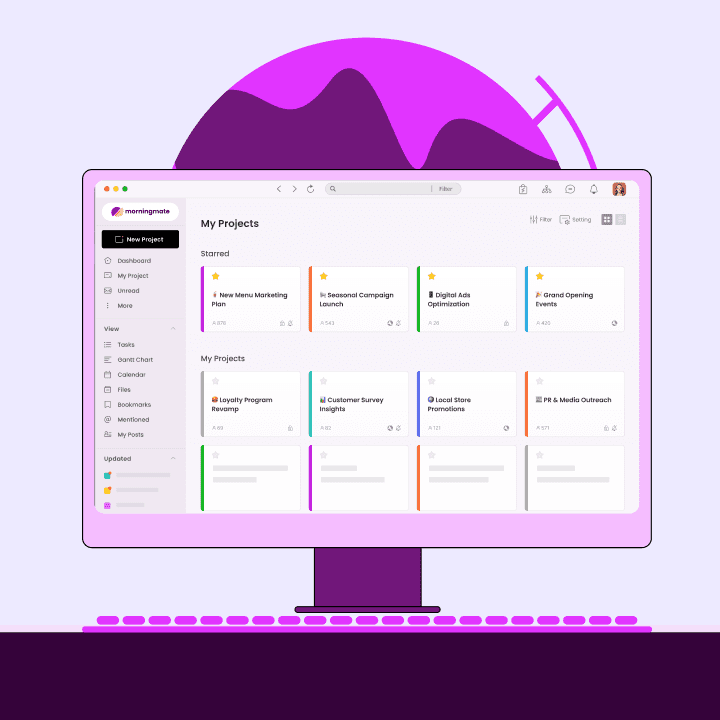
This is where tools like Morningmate — a lightweight work management platform used by over 550,000 teams — become practical for external task coordination. You can build a task card with a full description, attach reference files directly, set a deadline, and assign it to a freelancer who only has access to that specific project space. No email threads, no version confusion, no "which brief is the latest one?"
Where Freelancer Clarification Time Is Lost
62%
Hunting for the brief
48%
Waiting on approvals
71%
Chasing status in chat
Fig 1: % of ops managers reporting each as a top time drain in freelancer coordination (illustrative, 2026)
O — One-Channel Communication: Keeping Task Feedback Centralized
When feedback on a freelancer's work lives in three places — a comment in Notion, a Slack DM, and a follow-up email — nobody has the full picture. The freelancer is guessing which feedback is final. You're guessing whether they saw your revision note. The task management loop is broken before it completes.
One-channel communication means all task-related discussion happens inside the task itself. Questions, revisions, approvals, and status updates are threaded to the task card. If a stakeholder asks "where did we land on this?" you can point them directly to the task and they'll see the full history in one scroll.
Morningmate's built-in chat and task comment system handles this natively. Instead of bouncing between a separate messaging app and a project board, your internal team and the freelancer communicate inside the same workspace — with the conversation anchored to the relevant task. It removes the "I said it in chat but forgot to update the task" problem entirely.
P — Progress Checkpoints: Structured Task Tracking Over Free-Form Updates
Asking a freelancer "how's it going?" is not a task tracking system. It's a conversation that produces a narrative you then have to interpret and translate into a project status. Standardized progress checkpoints replace that with predefined task statuses: Not Started, In Progress, In Review, Revision Requested, Approved, Delivered.
Each status transition is an event, not a conversation. When a freelancer moves a task to "In Review," your internal reviewer gets a notification and knows exactly what action is required of them. No nudging, no chasing. Asana's Anatomy of Work Index consistently finds that unclear ownership and status ambiguity are the leading causes of missed deadlines in cross-functional teams — and external contributors amplify both risks when left unstructured.
Operationally, this means building your task board so that every freelancer task has a mandatory status field, a defined owner for each status stage, and a due date tied to each checkpoint — not just the final delivery.
E — Exit-Ready Handoffs: Task Management That Outlasts the Engagement
When a freelancer wraps up, the work shouldn't walk out with them locked in their inbox or personal file storage. Exit-ready handoffs mean the final deliverable, the revision history, the approved brief, and all associated feedback are stored inside the task itself — accessible to any internal team member without asking the freelancer for a re-send.
This matters more than most ops managers realize until something goes wrong. A client asks for the source files six months later. The original freelancer is unavailable. The internal team digs through email archives for 40 minutes and finds nothing. That's a knowledge silo created not by laziness but by a missing exit standard in your task workflow.
The rule is simple: no task is marked "complete" until all deliverables are attached to the task card and the task description reflects the final approved scope. It takes 90 seconds and saves hours downstream.
Applying the SCOPE Framework with Morningmate: A Worked Example
Here's how the full task management flow looks in practice for a content production team onboarding a new freelance writer.
Scenario: You need a freelance writer to produce four blog posts per month. You have an internal editor, a brand manager who approves final copy, and a content strategist who owns the editorial calendar.
Create a dedicated project space in Morningmate for the freelancer. Add them as an external member with access only to this space. No visibility into other team projects or internal feeds.
Build a task card for each article that includes the title, target keyword, word count, tone guidelines, reference links, internal deadline, and publication deadline. Attach the brand style guide as a file directly to the task.
Set status stages: Brief Received → Draft Submitted → In Editorial Review → Revisions Requested → Final Approved → Published. The freelancer updates their own status; the editor is notified automatically at each transition.
All feedback goes into task comments. The editor leaves revision notes on the task. The brand manager gives final approval in the same thread. No parallel email chains.
At completion, the final approved draft is attached to the task. The task is closed. Six months later, anyone on the team can open that task and see the full brief, revision history, and final file in one place.
The entire workflow runs inside Morningmate's task management and built-in chat system — a single, structured workspace that the freelancer finds simple to use (no steep learning curve) and that your internal team can audit at a glance without chasing anyone for updates.
SCOPE Component | Without the Framework | With SCOPE + Morningmate |
|---|---|---|
Scoped Access | Full workspace login or email chain | Isolated project space, no data exposure |
Contextualized Briefs | PDF in email, often version-confused | All context in one task card with files |
One-Channel Comms | Slack + email + Docs comments | Task comments + built-in chat, all threaded |
Progress Checkpoints | "How's it going?" messages | Defined status stages, auto-notifications |
Exit-Ready Handoffs | Files in freelancer's Dropbox, lost later | Deliverables stored in task, always retrievable |
Ops Manager Time Saved Per Month After Standardizing Freelancer Task Workflows
2 hrs
Ad-hoc / No system
6 hrs
Partial process (docs only)
11 hrs
Full SCOPE framework
Fig 2: Estimated monthly coordination time recovered per ops manager (illustrative, 2026)
Implementation Checklist: Your First Week of Standardized Freelancer Task Management
Standardizing your freelancer task coordination doesn't require a multi-week rollout. Start with these actions and build from there. Consistent task management at the onboarding stage sets the tone for every engagement that follows.
☐ Create a dedicated project space for each freelancer or freelancer category (design, content, dev) — separate from internal team workspaces
☐ Build a brief template as a task card with fields for deliverable, acceptance criteria, reference files, owner, deadline, and dependencies
☐ Define your status stages and add them as mandatory task fields: at minimum, Draft / In Review / Revision Requested / Approved / Delivered
☐ Establish the one-channel rule: all task feedback goes in task comments, not separate chat or email threads
☐ Add a task completion checklist that requires final file attachment before any task is closed
☐ Brief every freelancer on the workflow at onboarding — one 15-minute walkthrough replaces weeks of confusion
☐ Audit one completed freelancer task per month to check whether all five SCOPE components were followed
Freelancer task management is ultimately a process design problem, not a people problem. When the system is clear — scoped access, contextualized briefs, one communication channel, defined checkpoints, and clean handoffs — your external contributors perform better, your internal team spends less time managing them, and your task tracking gives you actual visibility instead of a collection of status messages to decode. Build the system once, and it compounds in your favor every engagement after.