Project Management

Good task management is one of those things that feels invisible when it works — and catastrophic when it doesn't. For small business owners, the cracks rarely show up all at once. They show up the moment half your team is in the office and the other half is remote, and suddenly nobody agrees on what was decided, who owns what, or when anything is actually due.
That is the hybrid trap. The coordination habits that held your team together — the quick desk check-in, the whiteboard huddle, the "just shout across the room" update — stop working the moment people are in different places on different days. Task tracking falls apart not because your team stopped caring, but because the system you were using was never really a system. It was proximity.
If you run a team of 10, 20, or 40 people and you've moved to any kind of hybrid schedule in the past year or two, you've almost certainly felt this. Work gets duplicated. Deadlines slip quietly. You only find out something fell through the cracks when a client asks about it. This article breaks down exactly why it happens, and what a lean team can do about it without adding new tools, new headcount, or new headaches.
The Real Cost of Broken Task Coordination in a Hybrid Team
Most owners underestimate this cost because it doesn't show up as a line item. It shows up as friction. According to McKinsey's research on hybrid work models, teams that lack structured coordination systems lose significant productivity to rework, miscommunication, and duplicated effort — costs that compound quietly over weeks and months.
Here is what that actually looks like in a small business: your operations person sends a task update in WhatsApp. Your designer sees it six hours later on a different device. Your account manager, who works remotely on Tuesdays, missed the meeting where the scope changed. By Friday, three people have done overlapping work, and the client deliverable is still late. That is not a people problem. That is a task management problem.
Where the Hours Actually Go
A report from Asana's Anatomy of Work Index found that workers spend more than half their time on what researchers call "work about work" — status updates, chasing approvals, searching for information, and sitting in redundant meetings. For a small team, that is hours per person per week that could be spent on actual output.
Now layer hybrid on top of that. When task coordination depends on physical presence — seeing someone at their desk, overhearing a conversation, reading a room — remote days create blind spots. And blind spots in task management turn into missed deadlines and dropped balls.
Coordination Habit | Works in-office? | Breaks in hybrid? |
|---|---|---|
Verbal task assignments | Yes | Almost always |
WhatsApp / chat-based updates | Partially | Yes — context lost |
Email threads for task tracking | Poorly | Yes — very quickly |
Shared task board with deadlines | Yes | No — scales well |
Stand-up meetings for status | Yes | Partially — async gap |
Why Your Task Management Habits Break Down in Hybrid: The Root Cause
The root cause is not that people are lazy or disorganized. The root cause is that your task coordination system was built for one physical location. When everyone is in the same room, information moves through air. Someone asks a question, someone hears the answer, and the whole group stays aligned without any formal system doing the work.
Hybrid destroys that. Remote days create an information gap that informal habits cannot bridge. A task assigned verbally to someone in the office on Monday is invisible to the person working from home on Tuesday. A decision made in an impromptu hallway conversation never reaches the person who needs to act on it.
And here is what makes it worse for small businesses specifically: you probably cannot afford a dedicated project manager or operations coordinator to manually keep everything synchronized. The task management burden falls on you, which is exactly why you end up spending your afternoons chasing status updates instead of running the business.
Top Reasons Task Coordination Breaks Down in Hybrid Teams
71%
No shared task log
63%
Tasks assigned verbally
58%
Updates in chat only
44%
No clear ownership
Fig 1: Common failure points in hybrid task management (illustrative, based on industry patterns)
A Practical Fix: Five Coordination Habits That Actually Work in Hybrid
The good news: you do not need to overhaul everything or buy five new tools. You need to replace three proximity-dependent habits with three written, visible ones. Here is a simple sequence a lean team can adopt in one week.
Step 1 — Stop Assigning Tasks Out Loud, Start Writing Them Down
Every task assignment needs to exist somewhere in writing before it counts. That means an owner, a deadline, and a clear description — not just "hey, can you handle that thing?" in a hallway. This single habit eliminates the most common source of dropped balls in hybrid task management.
If you currently use WhatsApp or a chat app for this, the problem is that tasks disappear into the scroll. A message from Tuesday is essentially gone by Thursday. Written task tracking in a dedicated place — not a chat thread — is non-negotiable for hybrid teams.
Step 2 — Give Every Project One Home, Not Four
One of the fastest ways to break task coordination in a hybrid setup is spreading work across email, chat, a shared drive, and a spreadsheet simultaneously. Your team cannot keep track of where the latest version of anything lives, so they stop trying and start guessing. Pick one place per project for task workflow and stick to it.
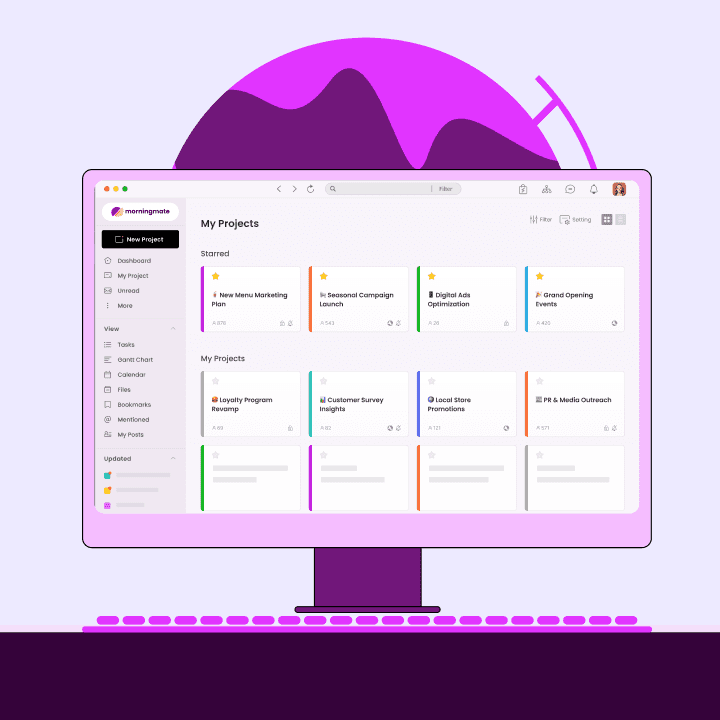
This is where a tool like Morningmate fits naturally. It combines task management and built-in chat in one workspace, so your team does not need to switch between apps to find out what they are supposed to be doing and talk about it. For a small team already tired of tool sprawl, having tasks, files, and conversation in a single feed removes a significant amount of daily friction.
Step 3 — Make Task Status Visible Without Meetings
In a hybrid team, you cannot call a status meeting every time you need to know where something stands. That is expensive in time and it breaks the flow of remote workers. Instead, build a habit of status being visible by default — anyone can see what is in progress, what is blocked, and what is done, without asking.
This is what a proper task tracking system gives you. When tasks have statuses attached — not just completion checkboxes — you get a live view of work without chasing anyone. Research consistently shows that visibility into work-in-progress reduces the need for status meetings and interruptions, which disproportionately hurt remote team members who cannot easily signal their availability.
Step 4 — Create a Simple Weekly Rhythm That Works Async
Replace the daily stand-up with a lightweight async check-in. Every Monday, each team member posts their top three priorities for the week inside your shared task workspace. Every Friday, they mark what's done and flag what's carrying over. That is it. No extra meeting. No extra tool. Just a consistent written rhythm that keeps everyone oriented regardless of where they are working from.
Step 5 — Attach Files and Decisions to Tasks, Not to Emails
When someone needs to find the brief, the approval, or the latest version of a document, they should be able to find it attached to the relevant task — not buried in an email thread from three weeks ago. This habit alone saves small teams hours per week in information retrieval, and it is the difference between task coordination that actually works and one that collapses the moment someone is offline.
Morningmate makes this straightforward. Its feed-style interface — familiar to anyone who has used social media — lets you post task updates, attach files, and keep comments threaded to specific work items. There is no learning curve for non-technical team members, which matters enormously when you have a small team and cannot spend a week onboarding people to new software.
Task Management Setup: Before and After a Hybrid-Ready System
Here is an honest comparison of how task coordination typically looks before and after adopting a proper hybrid-ready task management approach for a small team:
Scenario | Without a system | With hybrid-ready task management |
|---|---|---|
Assigning a task to a remote team member | WhatsApp message, no deadline, forgotten by Wed | Written task, owner assigned, due date visible |
Checking project status | Send a message, wait for reply, interrupt someone | Open task board, see status in seconds |
Finding a file or brief | Search through 4 apps, ask 2 people | Attached to the task where it belongs |
Weekly team alignment | 45-min meeting everyone half-listens to | Async post, 10 min per person, visible to all |
Onboarding a new hire to active work | Walk them around, hope they remember | Send them the task board — they're caught up |
What Happens to Task Management Outcomes When Hybrid Teams Adopt Structured Systems
The payoff from fixing task coordination habits is measurable. Teams that move from informal, proximity-based coordination to structured task tracking see fewer missed deadlines, fewer status meetings, and less owner involvement in day-to-day follow-up. Gallup's State of the Global Workplace data consistently links employee clarity — knowing what is expected of them and when — to higher output and lower attrition, even in small business contexts.
For small business owners, that clarity does not come from hiring a project manager. It comes from replacing informal coordination habits with a lightweight task management system that the whole team actually uses.
Team Performance Improvement After Adopting Structured Task Management (Hybrid Teams)
34%
Fewer missed deadlines
47%
Less time in status meetings
61%
Better task visibility
55%
Reduced owner follow-up
Fig 2: Reported improvements after structured task tracking adoption in hybrid SMB teams (illustrative)
One Hub Instead of Five Apps: The Task Management ROI for Small Teams
The fear most small business owners have is adding another tool that nobody uses. That is a legitimate concern. The answer is not more tools — it is fewer, better-chosen ones. The goal is to find something that handles task tracking, team communication, and file management in one place, so you are not paying for three subscriptions or training your team on three interfaces.
Morningmate is built for exactly this. Used by over 550,000 teams worldwide, it is specifically designed for non-technical teams who need solid task management without the complexity of enterprise tools like Jira or Asana. The interface feels like a social media feed — something every team member already knows how to navigate — which means adoption happens fast without a big rollout.
For a hybrid team of 10 to 40 people, that means you get task workflow, built-in chat, and file management in one affordable workspace. No tool sprawl. No per-feature pricing that creeps up. And no need to hire someone just to keep track of who is doing what.
The Next Step: One Task Management Change That Pays Off This Week
If you take nothing else from this article, take this: the coordination habits your team relies on right now were designed for a world where everyone was in the same room every day. They were not designed for hybrid. And patching them with more chat messages or more meetings will not fix the underlying problem.
Proper task management — written assignments, visible status, one home per project, files attached where they belong — is what keeps a lean hybrid team moving without the owner becoming the human glue holding everything together.
The ROI is concrete: fewer dropped balls, less time in status meetings, fewer client escalations, and more of your own time back. That is not a productivity article promise. That is what happens when task tracking works the way it should, regardless of where your team is sitting on any given day.
Start with one project this week. Write every task down. Assign an owner and a deadline. Put it somewhere the whole team can see it. Then watch how much less you have to chase. If you want a single place to do all of that without adding complexity, Morningmate is free to start — and your team will be up and running before the end of the day.