Project Management

Effective task management is supposed to prevent missed deadlines — yet in most growing SMBs, teams that are genuinely working hard still slip. Regularly. The common assumption is that someone didn't try hard enough, stayed late enough, or prioritized correctly. But after studying how operational breakdowns actually happen, the evidence points somewhere else entirely: the system, not the person, is almost always the culprit.
Deadline slippage is a task management failure before it is a performance failure. When task coordination relies on scattered information, undocumented handoffs, and no single source of truth for who owns what, even your most diligent employees will drop the ball — not because they are careless, but because the structure around them makes it nearly impossible to succeed consistently.
Research from the Project Management Institute consistently shows that schedule overruns are rooted in poor scope definition, unclear ownership, and weak communication flows — not insufficient effort. As an ops manager, that distinction matters enormously. It means the fix is structural, not motivational.
The Compounding Cost of Inconsistent Task Management
One missed deadline is a disruption. A pattern of them is a tax on your entire operation. When task tracking is inconsistent — different people using different systems, some using none — the downstream costs multiply fast. A 2026 Asana Anatomy of Work report found that employees spend nearly 60% of their time on work about work: chasing status updates, searching for files, and clarifying who is responsible for what. That is time not spent on actual delivery.
The compounding effect is where it gets operationally painful. A delayed handoff in week one shifts a dependent task in week two, which blocks a review in week three, which pushes a client deliverable in week four. Nobody intended any of it. But without a standardized task workflow, there was no mechanism to catch the first slip before it cascaded.
For ops managers specifically, this creates a secondary cost: manual intervention. You become the human glue holding disconnected task coordination together — sending follow-up messages, running status meetings, cross-referencing spreadsheets. That is a systems failure wearing the costume of a management responsibility.
Operational Area | Without Standardized Task Management | With Standardized Task Management |
|---|---|---|
Deadline visibility | Discovered after the slip | Flagged 3–5 days before due date |
Task ownership | Assumed, rarely confirmed | Assigned, logged, acknowledged |
Cross-team handoffs | Via chat or email, often lost | Documented within the task record |
Status updates | Manually chased by manager | Visible in real time, no prompting |
Onboarding new team members | Tribal knowledge, inconsistent | Standardized templates, repeatable |
Introducing the ROAD Framework for Task Management
To systematically address deadline slippage, ops teams need a diagnostic model — something that separates the structural causes from the surface symptoms. The ROAD Framework does exactly that. ROAD stands for: Responsibility, Ownership handoff, Awareness gaps, and Dependency blindness. These are the four root causes behind nearly every recurring deadline failure in growing SMBs.
Each component maps to a specific breakdown in task coordination — and each has a concrete operational fix. Work through all four and you will have closed the structural gaps that no amount of effort or urgency can compensate for.
R — Responsibility: Task Management Starts With a Named Owner
The most common reason a task misses its deadline is that nobody was explicitly accountable for it. Group assignments — "the marketing team will handle this" — are a particularly common trap. When responsibility belongs to everyone, it effectively belongs to no one.
In practice, this means every task in your system needs a single named owner, a clear due date, and a defined scope. Not a team. Not a department. One person whose name is on it. That person may delegate or collaborate, but the task tracking system shows exactly who is responsible for the outcome.
Ops example: A product launch checklist shared over email with five contributors will drift. The same checklist as individual assigned tasks — each with a specific owner and due date — moves forward predictably. The work didn't change. The accountability structure did.
O — Ownership Handoff: Where Task Coordination Most Often Breaks
Task workflow breaks most frequently at the transition point between teams or roles. One person finishes their portion and considers the task done. The next person in the chain either doesn't know it's coming or doesn't realize it has arrived. This gap — the ownership handoff — is where deadlines quietly disappear.
Harvard Business Review research on team productivity highlights that handoff failures are among the most underestimated productivity killers in organizational workflows. The fix is to make handoffs a documented event inside your task management system — not a verbal acknowledgment or a chat message that scrolls away.
Ops example: When your operations team hands a vendor contract to finance for approval, that transition should exist as a logged status change within the task record — not a Slack ping that may or may not be seen. The task stays open until finance confirms receipt and acceptance. No assumption, no ambiguity.
Where Deadline Slippage Originates: Root Cause Breakdown
41%
Unclear ownership
29%
Missed handoffs
19%
Hidden blockers
11%
Actual effort gap
Fig 1: Structural causes of missed deadlines — effort is the smallest factor (illustrative, based on PMI research patterns)
A — Awareness Gaps: The Visibility Problem in Task Tracking
Awareness gaps happen when information about task status exists somewhere — in someone's head, in a chat thread, in an email — but is not visible to the people who need it to make decisions. This is the knowledge silo problem that plagues growing teams. Everyone is technically informed within their own bubble. Nobody has the cross-team picture.
The ops manager is usually the one absorbing this cost. You spend significant time in a given week simply aggregating status — not because you want to micromanage, but because the task management infrastructure doesn't surface it automatically. That is a structural problem, not a leadership style problem.
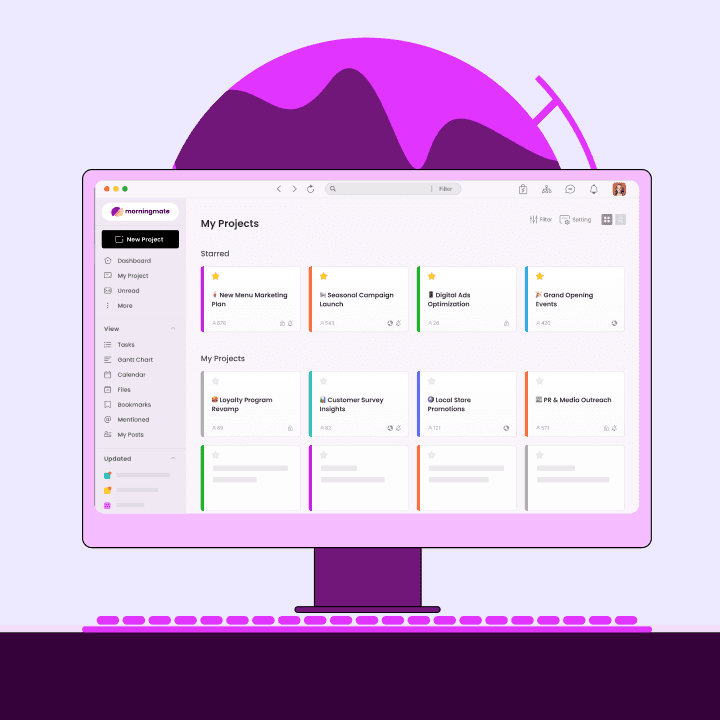
The fix is centralized, real-time task tracking that any stakeholder can check without scheduling a meeting or sending a follow-up. This is where tools like lightweight work management platforms create immediate operational value. Morningmate, for example, gives every task a visible status that updates in real time — anyone with access to the workspace can see current progress without pinging the task owner. That eliminates the awareness gap without adding reporting overhead to your team.
D — Dependency Blindness: Task Coordination Across Interconnected Work
Dependency blindness is when a team member doesn't realize — or has no way to see — that their task is blocked by, or is blocking, someone else's. In a small team, this gets managed informally. As the organization grows, informal coordination breaks down and tasks stall silently.
Ops example: Your compliance team is waiting on a legal review before they can finalize an onboarding document. Legal thinks compliance hasn't sent the materials yet. Meanwhile, the new hire start date is in four days. No one missed a deadline deliberately. The dependency was simply invisible to the system and the people in it.
Standardized task management requires that dependencies are explicit and logged. When a task cannot start until another is complete, that relationship needs to be documented — not assumed. This is also where onboarding standardization pays dividends: new hires can see exactly what is waiting on what, without relying on institutional knowledge that isn't written down anywhere.
Applying the ROAD Framework with Morningmate: A Worked Example
Here is how a standardized task workflow using the ROAD Framework plays out in practice — specifically for a client onboarding process at a 40-person services company.
The before state: New client onboarding was managed through a combination of email threads, a shared Google Sheet, and ad hoc WhatsApp messages between the account manager, operations coordinator, and technical setup team. Handoffs were verbal. No one had full visibility. Average onboarding took 11 days when the target was 7.
The after state using Morningmate: The ops manager built a standardized onboarding task template in Morningmate — a repeatable task workflow that triggers every time a new client is signed. Each task in the template has a named owner, a due date, a defined predecessor task (making dependencies explicit), and a status that updates as the owner progresses. The built-in chat feature in Morningmate links directly to each task, so any discussion about a specific deliverable lives alongside the task itself — not scattered across a separate messaging app.
When a task is completed and the handoff to the next team is required, the next owner receives a direct notification. No chasing. No assumption. The ops manager monitors overall progress through the workspace feed — a real-time view of all active tasks — and only intervenes when a blocker is flagged. Average onboarding dropped to 6.5 days within the first month.
ROAD Component | Manual Approach | Standardized Task Management |
|---|---|---|
Responsibility (R) | Team-level assignment, ownership unclear | Single named owner per task, logged in system |
Ownership Handoff (O) | Verbal or chat-based, frequently missed | Status change triggers next-owner notification |
Awareness Gap (A) | Manager manually aggregates status weekly | Real-time task tracking visible to all stakeholders |
Dependency Blindness (D) | Dependencies assumed, blockers surface late | Predecessor tasks logged, blockers flagged early |
On-Time Delivery Rate: Before vs. After Standardized Task Management
54%
Pre-standardization
71%
Basic task tools
89%
Full ROAD implementation
Fig 2: On-time delivery improvement by task management maturity level (illustrative)
Implementation Checklist: Standardizing Task Management With the ROAD Framework
Effective task management doesn't require a complex rollout. Start with these concrete steps and build from there. Use this checklist to audit your current state and identify your highest-priority fix.
Audit every recurring workflow — identify which ones have no documented task structure and prioritize the ones most prone to slippage
Assign a single named owner to every task — eliminate team-level assignments entirely; shared responsibility is no responsibility
Document all handoff points — for every workflow where one person's output becomes another's input, make that transition a formal, logged event in your task tracking system
Create reusable task templates for repeatable processes — onboarding, monthly reporting, vendor review, and campaign launches should all run from standardized templates, not recreated each time
Make task status visible without a meeting — choose a task management platform where anyone with access can see real-time progress; if your current setup requires you to ask, it isn't good enough
Log dependencies explicitly — before a workflow launches, map which tasks cannot begin until others are done, and record this in the task itself
Set a 48-hour early-warning convention — any task at risk of slipping should be flagged at least two business days before the due date, giving you time to intervene before the deadline passes
Review and iterate monthly — task management standardization is not a one-time project; treat it as an ongoing ops discipline and refine templates based on what keeps breaking
Morningmate is designed specifically for this kind of lightweight standardization — giving growing teams a single workspace where task tracking, file sharing, and team communication live together without the learning curve of enterprise-grade tools. Used by over 550,000 teams globally, it is built for the ops manager who needs structure without complexity.
Deadline slippage is a solvable problem. The evidence is clear and the ROAD Framework gives you a precise map to the fix. Standardize your task management structure, close the handoff and visibility gaps, and watch your team's delivery rate climb — not because they're working harder, but because the system is finally working with them.