Project Management

Good task management should not require a calendar invite. Yet in small businesses everywhere, a predictable and painful pattern plays out daily: someone needs to move a piece of work forward, they are not sure of the details, so they schedule a meeting to figure it out. That meeting pulls three people away from focused work for forty-five minutes. Half of what gets discussed could have been written in a two-sentence message. And the actual task? It finally starts — two days later than it should have.
If you run a team of five to fifty people, this is not a minor inconvenience. It is a structural leak in your business. Every hour spent in a "let's sync to kick this off" meeting is an hour not spent delivering, selling, or building. And when your team is already stretched thin, those hours are the difference between hitting your targets and constantly playing catch-up.
The fix is not hiring a project manager or adopting a complex new system. It is changing how work gets started in the first place — building a lightweight task workflow where enough context travels with every task that your team can move without waiting for you to explain it in person.
Why "Let's Set Up a Quick Meeting" Is Costing You Real Money
The individual meeting feels harmless. Forty-five minutes, a few people, no big deal. But zoom out and the math gets uncomfortable fast. Research published in Harvard Business Review found that executives spend an average of nearly 23 hours per week in meetings — and much of that time is categorized by participants as unnecessary. For a small business owner, unnecessary meetings do not just waste time. They delay task execution, interrupt deep work for every attendee, and create a culture where nobody feels empowered to start anything without a group blessing.
Think about what a single "kick-off" meeting actually costs. If you have three team members earning an average of $25 per hour sitting in a 45-minute meeting that could have been a task card with clear instructions, that is roughly $56 in salary cost — before you account for the context-switching penalty those employees pay for the rest of the morning. Multiply that by four or five such meetings per week across your team, and you are looking at hundreds of dollars per week quietly evaporating.
Task Scenario | Meeting-First Approach | Context-First Task Management |
|---|---|---|
New client deliverable | 45-min meeting + 1-day delay to start | Task created with brief, starts same day |
Internal process update | Group chat ping → meeting scheduled | Task card with context, assigned directly |
Recurring weekly report | Reminder sent in chat, person asks questions | Template task reused, no clarification needed |
Approval on supplier quote | Email chain, then follow-up call | Task with file attached, approved in one click |
The Root Cause: Tasks Launch Without Enough Context
Here is the honest reason this keeps happening: when a task lives only in someone's head — or buried in a chat message — it arrives at the assignee with none of the information they need to act. No deadline. No reference files. No clarity on what "done" looks like. So the natural response is to ask. And the fastest way to ask is to call a meeting.
This is not a people problem. It is a process problem. Your team is not lazy or over-reliant on hand-holding. They are operating in a system where task coordination has no standard format. Every task is a blank slate, and every blank slate triggers a clarification loop. Gallup's research on employee engagement consistently highlights that unclear expectations are one of the top drivers of disengagement and low productivity — and for small teams, that fog is especially costly because there is no buffer.
The cycle looks like this: task is mentioned informally → assignee needs more detail → meeting is called → context is shared verbally → meeting ends → task finally begins. That loop might add 24 to 48 hours to work that should have started immediately. Across a month, that is weeks of capacity quietly lost to coordination overhead.
Average Hours Lost Per Week Per Team Member Due to Task Clarification Meetings
1.5 hrs
Structured task workflow
4.2 hrs
Chat-based coordination
6.5 hrs
No system (verbal only)
Fig 1: Estimated weekly hours lost to task clarification by coordination method (illustrative, based on industry benchmarks)
A Practical Fix: Build a Context-First Task Management Habit
You do not need new software to start solving this. You need a new standard for how work gets handed off. Think of it as a simple rule: no task gets assigned without enough information for someone to start it without asking a single question. Here is how to build that habit in a lean team.
Step 1 — Define What a Complete Task Looks Like
Every task your team receives should answer five questions before it lands in someone's queue: What is being asked? Who owns it? When is it due? What does a completed version look like? And where are the relevant files or references? If a task cannot answer all five, it is not ready to be assigned. The person creating the task — often you, the owner — needs to front-load that thinking instead of offloading it to a meeting.
Step 2 — Replace Verbal Kick-Offs with Written Task Briefs
For any recurring task or project, write a brief once and reuse it. This does not have to be elaborate. A three-paragraph description with a deadline, an attached file, and a clear outcome is enough for most tasks. The goal is that the person receiving it can read it in two minutes and start working. If your task tracking tool makes this easy — attaching files, setting deadlines, tagging people — the habit sticks faster.
Step 3 — Reserve Meetings for Decisions, Not Orientations
Meetings should be for moments where real-time judgment is needed — resolving a conflict, deciding a direction, reviewing something complex together. They should not be for explaining what a task is or who is doing it. Once your team trusts that tasks arrive with full context, the number of "let's quickly sync" requests drops on its own.
Step 4 — Create a Single Place Where Tasks Live
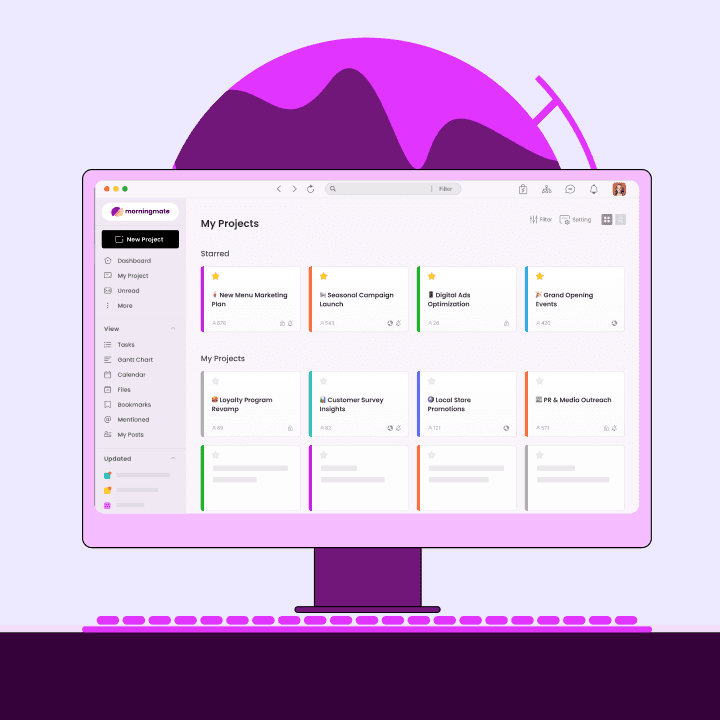
If tasks are scattered across email, WhatsApp, a shared spreadsheet, and someone's memory, context will always be incomplete. A single task coordination hub fixes this. This is where morningmate fits naturally for small teams. Rather than adding another complex tool, morningmate gives your team one lightweight workspace where tasks are created with descriptions, files, deadlines, and assignees — all in one place. The interface is built to feel familiar, similar to social media feeds and chat apps your team already uses, so adoption is not a fight.
What Good Task Management Actually Looks Like in Practice
Let's say you need your operations person to update your supplier contracts before the end of the month. Instead of pulling them into a meeting to explain the background, you create a task in morningmate: title is "Update Q3 supplier contracts," description includes which contracts, what needs changing, the deadline, and a linked folder with the current versions. Your ops person opens it, reads it in ninety seconds, and gets to work. No meeting. No follow-up ping asking for clarification. No delay.
That is what healthy task workflow looks like. It is not complicated. But it requires the person assigning the work — usually the owner or a manager — to do a bit more thinking upfront rather than scheduling a meeting to think out loud. McKinsey's analysis of organizational performance points to front-loaded clarity as one of the simplest levers for improving team output, particularly in smaller organizations without dedicated project leadership roles.
Task Management Checklist | Meeting-First Team | Context-First Team |
|---|---|---|
Task has a clear owner | Decided in meeting | Set at task creation |
Due date is visible to all | Mentioned verbally, often forgotten | Attached to task record |
Reference files attached | Shared separately, hard to find later | Attached directly to the task |
Progress visible without asking | Requires status update meeting | Tracked in task management board |
Definition of done is clear | Often assumed, not stated | Written into task description |
One Hub, Not Five Tools — How morningmate Solves This Without the Sprawl
One concern small business owners have when they hear "fix your task tracking" is that it means buying yet another subscription and convincing the team to learn another platform. That is a fair concern. Tool sprawl is real, and most complex project management tools are built for teams twice your size with a dedicated project manager to administer them.
morningmate is built differently. It combines task management, built-in chat, and file sharing in one workspace — without the steep learning curve of tools like Jira or Asana. The feed view works like a social media timeline, which means even non-technical team members pick it up fast. Your team does not need training days. They need about fifteen minutes to feel at home.
The practical benefit for a lean team is that tasks, conversations, and files all live in one place. When someone gets assigned a task, the context is right there — not in a separate email, not buried in a chat thread, not in a document folder no one can find. That single source of truth is what breaks the meeting-first habit, because the meeting stops being the only way to get the information needed to start work. Over 550,000 teams worldwide use morningmate to run work this way, including teams in industries where people are not desk-bound and do not have time for complex systems.
Team-Reported Reduction in Kick-Off Meetings After Adopting Structured Task Management
12%
No formal system
41%
Partial task tracking
73%
Structured task management hub
Fig 2: Estimated reduction in unnecessary kick-off meetings by coordination approach (illustrative, based on SMB workflow research)
Your Next Step: Start With One Task Today
Good task management is not a transformation project. It starts with one decision: the next time you are about to schedule a meeting to kick something off, write a task card instead. Put in the owner, the deadline, the context, and the files. Send it. See if the person comes back with questions.
If they do, add what was missing to the task description for next time. Within a few weeks, your team will start expecting that standard — and they will start creating tasks that way themselves. The meeting load drops. Work starts faster. You stop being the bottleneck who has to explain everything in person before anything moves.
The ROI is not abstract. Fewer kick-off meetings means more hours of productive output per week per person. For a team of ten, even recovering three hours per person per week adds up to thirty hours of capacity — without hiring a single new employee. That is the real value of structured task management: your business gets bigger outputs from the same team, and you get your calendar back. Start with one task, build the habit, and let the system do the work that meetings used to do.