Project Management

Task management is not a luxury reserved for large organizations with dedicated project offices — it is the operational backbone that determines whether a small or mid-sized team scales smoothly or collapses under its own growth. And yet, the teams that need structured task management most urgently are often the ones least likely to have it. Lightweight teams of 10 to 100 people routinely operate on informal communication, tribal knowledge, and personal messenger apps, assuming that structure is something they will introduce "once we get bigger." That assumption is exactly backwards.
Enterprise organizations have entire departments — PMOs, process engineers, compliance teams — whose sole purpose is to enforce consistency. When a Fortune 500 company lacks a defined workflow for onboarding a new vendor, someone will eventually flag it. In a 30-person SMB, no one flags it because everyone is too busy doing the work. The absence of task coordination goes unnoticed until it compounds into a crisis: a missed client deadline, a duplicated order, a new hire who never received the correct information.
This article introduces a practical framework for operations managers who are ready to stop patching problems and start building repeatable systems. The framework is called CORE — Capture, Organize, Route, Evaluate — and it maps directly onto the task tracking challenges that growing SMBs face every day. Each component comes with a concrete operations example and a clear path to implementation.
The Compounding Cost of Inconsistent Task Coordination
Inconsistent task management is not just an inconvenience — it carries a measurable financial and operational cost. Gallup research consistently shows that unclear roles and poorly coordinated work are among the top drivers of employee disengagement, which costs businesses an estimated $8.9 trillion globally in lost productivity. For a 50-person team, the local math is sobering: if each team member loses just 30 minutes per day chasing status updates, clarifying ambiguous tasks, or re-doing work someone else already completed, that is over 6,000 hours of lost capacity per year.
The compounding effect is what makes this dangerous for SMBs specifically. A missed handoff in week one becomes a customer complaint in week three. A knowledge silo in operations prevents the sales team from quoting accurately. A new hire who never received a proper process document makes the same avoidable error for six months before anyone notices. Harvard Business Review has reported that knowledge workers spend nearly 20% of their workweek searching for information or tracking down colleagues who hold it. In a lightweight team, that percentage is frequently higher because there are fewer redundant systems and fewer people to absorb the friction.
Operational Area | Without Structured Task Management | With Structured Task Management |
|---|---|---|
New hire onboarding | Ad-hoc, depends on who is available | Repeatable checklist, consistent every time |
Cross-team handoffs | Verbal or chat-based, frequently lost | Assigned task with clear owner and deadline |
Status visibility | Manager must chase individually | Live dashboard, no chasing required |
Process documentation | Stored in someone's head or inbox | Attached to the task, searchable and shared |
Accountability | Unclear — things fall between the cracks | Named owner, logged completion, full audit trail |
Introducing the CORE Framework for Task Management
The CORE framework gives ops managers a memorable, sequential model for building consistent task management across a lightweight team. Unlike enterprise-grade methodologies that require weeks of training and dedicated administrators, CORE is designed to be implemented incrementally — one workflow at a time — without disrupting how your team currently operates.
CORE stands for: Capture every request as a formal task, Organize tasks by team, project, and priority, Route each task to a named owner with a clear deadline, and Evaluate completion against defined criteria. Each step is distinct, and skipping any one of them is what creates the gaps that small teams routinely fall into.
C — Capture: Turning Every Request into a Trackable Task
The first failure point in most SMB task coordination systems is that work requests never become formal tasks at all. A colleague messages you on WhatsApp asking for a vendor quote. A team lead mentions in a meeting that the SOP needs updating. Your CEO emails a one-liner about following up with a client. None of these become assigned, tracked work items — they live in someone's memory or inbox until they are either completed by chance or forgotten entirely.
Capture means enforcing a single rule: every work request, regardless of source, becomes a task in your task management system before anyone acts on it. This is not bureaucracy — it is the minimum viable act of making work visible. For an ops team managing procurement, facilities, HR coordination, and vendor relations simultaneously, the inability to capture incoming work systematically is the root cause of almost every dropped ball.
Ops example: Your facilities coordinator receives a maintenance request via text, an IT ticket via email, and a verbal request for extra office supplies during a hallway conversation — all on the same morning. Without a capture protocol, two of those three will be forgotten by end of day. With a capture rule in place, all three become tasks within five minutes, each with a description, a source, and a timestamp.
O — Organize: Task Tracking by Context, Not by Person
Captured tasks become noise unless they are organized into meaningful structures. Most small teams organize work by person — they assign tasks to individuals and assume that person will manage priority and sequencing themselves. This approach breaks down the moment that person is sick, overwhelmed, or leaves the company. The work was organized around a human being rather than around a system.
Effective task management organizes work by context: by project, by team function, by workflow stage, and by priority tier. An operations manager overseeing onboarding, vendor management, and internal compliance should have three separate task spaces — not three separate people who each manage their own inboxes.
Ops example: The onboarding workflow for a new hire involves HR, IT, facilities, and the hiring manager. Instead of four separate to-do lists held by four separate people, a structured task management board has one "New Hire Onboarding" project with sub-tasks assigned to each department. Anyone can see the overall progress, and no step requires a status check meeting to confirm completion.
Time Spent per Week Chasing Task Status Updates (Hours per Manager)
7.5 hrs
No system (chat + email)
4.5 hrs
Partial task tracking
1.2 hrs
Full CORE framework
Fig 1: Estimated weekly hours lost to status-chasing by system type (illustrative, based on industry benchmarks)
R — Route: Assigning Clear Ownership in Task Workflows
A task without a named owner is a wish, not a work item. Routing is the act of assigning every task to exactly one accountable person — not a team, not a department, not "whoever has bandwidth." This is where many ops managers resist, worried about seeming micromanagerial. But routing is not about surveillance — it is about removing ambiguity so that no one has to wonder whether someone else is handling it.
McKinsey research on organizational performance consistently finds that unclear roles and decision rights are among the primary barriers to execution speed — even in small, agile organizations. The solution is not more meetings to clarify ownership; it is a task management system that makes ownership explicit at the moment of assignment.
Ops example: A vendor invoice arrives that requires approval, payment processing, and filing. Without routing, all three people assume one of the others is handling it. With routing, three separate sub-tasks are created — one assigned to the finance lead for approval, one to the accounts payable coordinator for payment, one to the ops assistant for filing — each with its own deadline and status.
E — Evaluate: Closing the Loop on Every Task Cycle
Most task management systems are good at the front end — capturing and assigning — but poor at the back end. Tasks get marked complete without verification. Recurring processes run for months before anyone checks whether they are still producing the right output. Evaluate is the discipline of closing every task loop with a defined completion criterion, and periodically auditing whether your task workflows are actually delivering results.
For an ops manager, this means building a simple review cadence: a weekly glance at overdue tasks, a monthly review of recurring workflow performance, and a quarterly audit of which processes have changed without the corresponding task templates being updated. This is not additional overhead — it is what separates a system that continuously improves from one that decays back into chaos.
Ops example: Your team runs a monthly compliance checklist. For six months, everyone marks it complete on time. But on the seventh month, a regulatory requirement changed and no one updated the checklist. An Evaluate step — a quarterly template audit — would have caught this before it became a compliance gap.
Applying the CORE Framework with Morningmate: A Worked Example
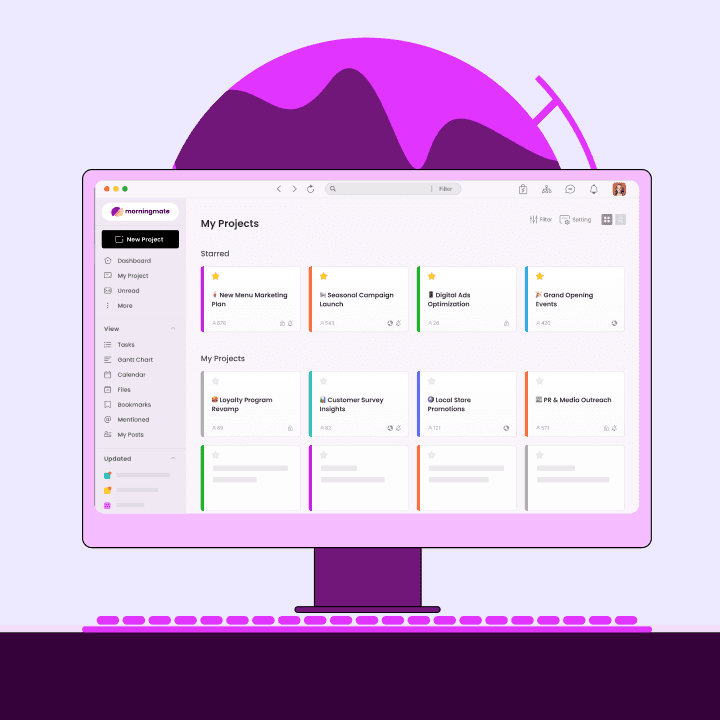
To make this concrete, here is how an operations manager at a 45-person logistics company applied all four CORE components using Morningmate — a lightweight work management tool built for teams that need structured task tracking without the complexity of enterprise platforms like Jira or Asana.
The scenario: onboarding a new operations coordinator. Previously, this involved a flurry of emails, a shared Google Doc that was perpetually out of date, and multiple "just checking in" messages across three different chat apps.
Capture: The ops manager creates a new project in Morningmate titled "Onboarding — [New Hire Name]" the moment the start date is confirmed. Every onboarding requirement is logged as a task: IT account setup, building access, tool access credentials, HR paperwork, first-week meeting schedule, and a 30-day check-in reminder.
Organize: Tasks are grouped by department (IT, HR, Facilities, Manager) using Morningmate's project board view. Each department sees only its own tasks, but the ops manager has full visibility across the entire onboarding workflow in one place — using the Feed view that surfaces updates as they happen, without requiring anyone to send a status message.
Route: Each task has a named assignee and a due date. IT account setup is assigned to the IT lead, due three days before start date. HR paperwork is assigned to the HR coordinator, due five days before start. Building access is assigned to the office manager, due two days before start. No one is waiting to be told what to do — the task management system has already done that.
Evaluate: Two days before the new hire's start date, the ops manager opens the Morningmate board and sees at a glance which tasks are complete, which are in progress, and which are overdue. A quick message via Morningmate's built-in chat — which works like a familiar messaging interface without the disorder of WhatsApp — resolves the one outstanding item without a single status-check meeting.
The result: a repeatable onboarding template that is reused for every new hire. The next time someone joins the company, the setup takes ten minutes instead of two hours of coordination.
Manual vs. Standardized: Task Management Comparison
Process | Manual / Ad-hoc Approach | Standardized Task Management |
|---|---|---|
Onboarding a new team member | 2–4 hrs of coordination per hire | Template reused in 10 mins per hire |
Cross-team project handoff | Lost in chat threads or email | Formal task reassignment with full context |
Weekly ops status report | Manager assembles manually from 5+ sources | Auto-generated from live task board |
Process knowledge retention | Leaves with the employee | Embedded in task templates and SOPs |
Scaling to new team members | Each hire = same coordination chaos | Each hire = same reliable outcome |
Task Management Adoption Outcomes: Before and After Standardization
Team Performance Metrics Before vs. After Structured Task Tracking (% of Teams Reporting Improvement)
31%
On-time delivery (before)
78%
On-time delivery (after)
44%
Cross-team visibility (after)
Fig 2: Reported improvements in SMB teams after adopting structured task management systems (illustrative, based on industry benchmarks)
Implementation Checklist: Start Your CORE Task Management System
You do not need to restructure your entire operation overnight. Start with one workflow, standardize it fully using CORE, then expand. Here is your implementation checklist for getting structured task management running within two weeks:
Week 1 — Capture: Identify the single highest-friction workflow in your team (e.g., onboarding, vendor invoicing, or cross-team project handoffs). Log every step as a task in your task tracking system. Set the rule: nothing is acted on until it exists as a task.
Week 1 — Organize: Create one project space for that workflow. Group tasks by function or department. Attach any relevant SOPs, templates, or reference documents directly to the tasks — not in a separate folder that no one opens.
Week 2 — Route: Assign every task to exactly one named person with a specific due date. Remove any task that says "team" or "TBD" as the owner. If you cannot identify an owner, that is a process gap to solve before proceeding.
Week 2 — Evaluate: Define what "done" means for each task category. Set a recurring calendar block — 30 minutes, weekly — to review overdue and stalled tasks. Schedule a monthly review of the workflow itself to catch drift before it becomes a problem.
Ongoing: Once the first workflow is stable, repeat for the next highest-friction area. Within three months, you will have a task management system that covers your core operational processes — and a team that no longer relies on your memory to keep things moving.
Morningmate supports exactly this kind of incremental rollout. Because its interface is built to feel like tools your team already uses — a social-feed-style work view and a built-in chat that mirrors familiar messaging apps — adoption resistance is minimal even with non-technical staff. You can start with one project and expand at a pace your team can absorb, without the configuration overhead of enterprise task management platforms.
Structured task management is not what large teams eventually earn the right to use. It is what small teams need first — before scale makes the gaps impossible to close. The CORE framework gives you a clear, repeatable path to get there, one workflow at a time.