Project Management

Good task management is the difference between a campaign that launches on time and one that quietly falls apart three days before the deadline. You already know this — you've lived it. Your team is small, everyone wears multiple hats, and things move fast. That speed is your superpower. But without even a lightweight structure underneath it, that same speed is exactly what causes things to slip through the cracks.
Informal teams — a marketing manager, a founder who weighs in on everything, a couple of freelancers, and maybe a part-time designer — tend to run on trust, Slack messages, and vibes. And for a while, that works. Until it doesn't. Until a campaign goes sideways not because the idea was bad, but because nobody could confirm whose job it actually was to hit "publish."
This article is about building just enough task coordination structure to hit consistent deadlines, without turning your scrappy team into a bureaucracy. No Gantt charts required. No hour-long standups. Just a repeatable system that keeps your marketing machine moving.
The Campaign That Almost Wasn't
Picture this: it's 9 AM on a product launch day. You've got a promotional email, three social posts, a landing page update, and a blog article that all need to go live before noon. The email copy is somewhere in a Google Doc that the founder last commented on four days ago. The designer sent the final banner to you via WhatsApp — but that was a different version of WhatsApp from the one you use on your laptop. The freelance copywriter is pretty sure she submitted the blog post, but it's buried under forty other comments in a shared Sheet.
Nothing is technically broken. Everyone did their part. But the task tracking fell apart — not because the work wasn't done, but because no one could confirm it was done and ready. You spend the first two hours of launch day just finding files and chasing confirmations. That's not a people problem. That's a structure problem.
Where Task Management Actually Breaks Down for Small Teams
Most small marketing teams don't fail at doing the work. They fail at coordinating it. The task workflow exists — it's just invisible, scattered, and entirely dependent on memory and good intentions.
The Approval Black Hole
Approvals are where task tracking goes to die. You send copy to the founder over email. They reply three days later with "looks good, a few tweaks" — but don't specify which version they reviewed. By then, the designer has already built graphics around the old headline. You're now running two parallel versions of your own campaign.
Freelancer Context Loss
Every time a freelancer joins a project, you re-explain everything. The brief lives in email, the feedback lives in comments, and the final files live in a folder only you can find. Task coordination with external contributors requires more structure than with in-house staff, precisely because there's no ambient context — no hallway conversations, no shared history.
The Handoff Gap
Small teams often assume handoffs are implicit. "You'll know when it's ready." But implicit handoffs break down the moment anyone is juggling more than two projects. Asana's Anatomy of Work report found that workers spend nearly 60% of their time on work about work — status checks, chasing updates, searching for files — rather than the actual skilled work they were hired to do. For a team of four or five, that percentage is even more devastating.
Here's a quick breakdown of where informal teams tend to lose time in their task workflow:
Breakdown Point | What It Looks Like | Time Lost Per Campaign |
|---|---|---|
Approval delays | Founder feedback buried in email threads | 2–4 days |
File version confusion | Multiple "final" versions across platforms | 3–5 hours |
Unclear ownership | "I thought you were doing that" | 1–2 days |
Freelancer re-briefing | Context lost between projects | 2–3 hours per person |
The Cost of Skipping Task Tracking Structure
It's tempting to assume that structure slows small teams down. The opposite is true. Research from Harvard Business Review shows that unclear roles and ad-hoc coordination actually increase the cognitive load on everyone involved — meaning your team works harder but delivers less. For a marketing team running campaigns on tight timelines, that hidden tax is brutal.
Where Informal Teams Lose Time Each Week (Hours)
6 hrs
Chasing approvals
4 hrs
Finding files
5 hrs
Re-briefing freelancers
8 hrs
Total coordination waste
Fig 1: Estimated weekly hours lost to coordination failures in small marketing teams (illustrative)
A Repeatable Task Management Play for Small Marketing Teams
You don't need a 40-field project brief or a dedicated project manager. You need a repeatable task workflow that every campaign runs through — the same way, every time. Here's a lightweight five-step play that works for teams of two to ten.
Step 1: Create One Campaign Hub Before You Start
Every campaign gets a single home — one post, board, or folder where all assets, tasks, and conversations live. Not in your inbox. Not in a shared Drive folder that nobody actually opens. One dedicated space that the whole team can reference.
Step 2: Break the Campaign Into Named, Owned Tasks
Write down every deliverable and assign it to a specific person — not "the team." The email copy is owned by the copywriter. The social graphics are owned by the designer. The approval sign-off is owned by the founder. If two people share a task, one of them is the lead. Task coordination only works when ownership is unambiguous.
Step 3: Set a Staged Deadline, Not Just a Launch Date
Work backwards from your launch date. Set a "ready for review" deadline 48 hours before launch. Set a "final approval" deadline 24 hours before. Task tracking without staged deadlines means everything rushes toward the end — and that's where mistakes happen.
Step 4: Route Approvals Through One Channel
Pick one place where the founder gives feedback. Not email AND Slack AND voice notes. One place. When approval comments are attached directly to the task — not floating in a chat thread — everyone can see the current status without asking.
Step 5: Run a 15-Minute Launch-Day Check
On launch morning, do a quick visual scan of every task. Is every deliverable marked done? Is the final approved version attached? Are the links live? This isn't a meeting — it's a five-second per-task status check that catches the 10% of things that always slip.
Common Failure Points in Small Team Task Coordination
Even with a solid play in place, small teams tend to hit the same failure modes. Here's what to watch for and how to sidestep each one.
"We'll Figure It Out As We Go"
This kills campaigns for teams who've worked together a long time and trust each other deeply. That trust is real — but it doesn't replace clarity on who owns what. Add a five-minute kickoff to every campaign where you verbally confirm each person's tasks. It feels redundant until the one time it isn't.
Feedback That Lives Outside the Task
When the founder drops feedback in a WhatsApp message on a Saturday, that comment is effectively invisible to your task tracking system. If it doesn't get captured back into the task, it simply disappears. Instill a simple rule: all feedback gets posted to the task, even if someone mentions it verbally first.
Freelancers Working Without Context
Freelancers aren't mind readers. They need the same campaign context your in-house team has — brand voice, target audience, campaign goal, linked assets. Gallup research on distributed work consistently shows that clarity of expectations is the single biggest predictor of contributor performance. Build a one-paragraph brief into every task you assign to external contributors.
Task Management Tools That Add More Work
If your task tracking system requires thirty minutes to set up a campaign, your team will stop using it after week two. Lightweight is not a compromise — it's a feature. The best task workflow tool is the one your whole team actually opens every day.
How Morningmate Brings Task Management and Approvals Into One Place
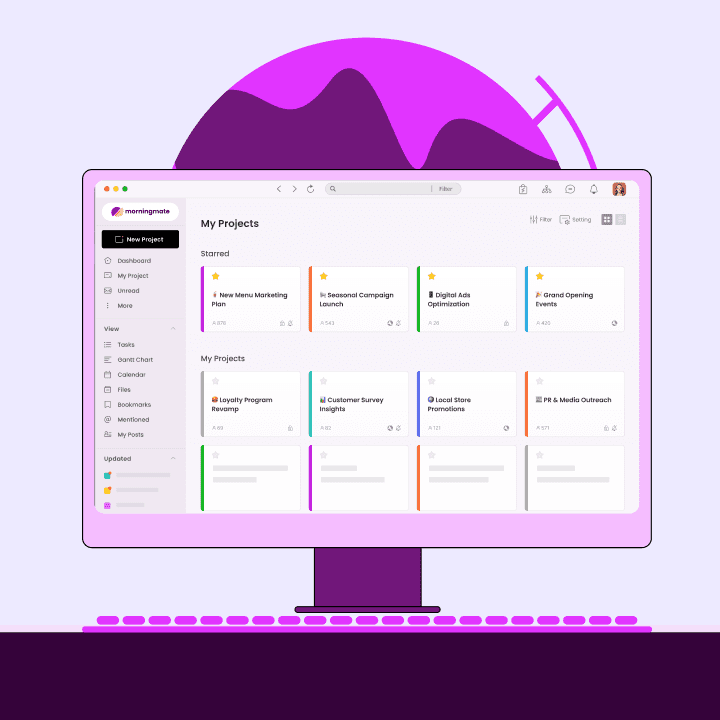
This is where a tool like Morningmate earns its place in a small marketing team's stack. Morningmate is a lightweight work management platform that combines task tracking, built-in chat, and file management in a single workspace — without the setup overhead of tools like Asana or Jira.
A Worked Example: Product Launch Campaign
Let's run the same launch-day scenario from earlier — but this time with a proper task workflow in Morningmate. The marketing manager creates a campaign post in the team's shared workspace. She breaks it into five tasks: email copy, social graphics, landing page update, blog post, and final approval. Each task is assigned to a specific person with a due date.
The founder gets tagged directly on the approval task — not emailed, not messaged on WhatsApp. He reviews the copy from the same workspace, leaves a comment attached to the task, and marks it approved. The designer sees the approved copy update in real time and attaches the final banner file to the same task. The freelance copywriter submits the blog post as a file attachment directly within her assigned task. By launch morning, every task shows a green status. The marketing manager runs her 15-minute check in under ten minutes.
The interface in Morningmate looks like a familiar social media feed — so even non-technical team members like a founder or a part-time freelancer can navigate it without a tutorial. The built-in chat works like a messaging app they already know, but conversations are tied to projects rather than floating in a personal inbox. That's the practical difference between task coordination that works and one that requires constant enforcement.
Campaign Step | Without a Task System | With Morningmate Task Workflow |
|---|---|---|
Assigning deliverables | Verbal or Slack message, often forgotten | Named task, assigned owner, due date visible to all |
Getting founder approval | Email thread, 2–3 day wait, version confusion | Tagged on task, comment recorded, status updated |
Freelancer submission | Email attachment, hard to find later | File attached to task, context intact |
Launch-day status check | Sending "is this done?" messages to each person | One-glance task board shows every status |
What Lightweight Task Management Actually Delivers
Teams that shift from scattered coordination to even a basic task management system see measurable results — not just in on-time launches, but in team confidence and reduced re-work. When task tracking is consistent, your freelancers produce better work because they have context. Your founder gives faster approvals because the ask is clear and contained. And you spend your launch-day energy on the campaign itself, not on crisis management.
On-Time Campaign Delivery Rate by Coordination Method (%)
41%
Chat + Email only
63%
Spreadsheet tracking
87%
Unified task management
Fig 2: On-time delivery rates by coordination method for small marketing teams (illustrative)
Your Task Management Checklist for This Week
You don't need to overhaul everything at once. Pick one campaign you're running right now and apply this task coordination checklist to it. If it works — and it will — roll it out to every campaign going forward.
Create a single campaign hub (one workspace, board, or folder) before any work begins
Write out every deliverable as a named task with one assigned owner and a staged due date
Set a "ready for review" milestone at least 48 hours before the launch deadline
Establish one approval channel — founder feedback goes there, nowhere else
Add a one-paragraph brief to any task assigned to a freelancer
Attach all files directly to the relevant task, not in a shared folder or chat message
Block 15 minutes on launch morning for a task-by-task status scan
After the campaign wraps, note which tasks slipped and why — update your template for next time
Effective task management doesn't mean your team loses its informal, fast-moving culture. It means that culture gets a backbone — one that lets you launch more campaigns, hit more deadlines, and spend less time on launch mornings feeling like everything is on fire. Start with one campaign, one checklist, one workspace. That's all the structure you need to begin.