Project Management

Good task management is supposed to give your whole team clarity on who is doing what and by when. But in most small businesses, it quietly collapses into something far messier: a handful of fast-moving, highly verbal people become the unofficial keepers of every decision, deadline, and update. If you need to know whether the client proposal went out, you ask Marcus. If a delivery is delayed, Sarah will know. This feels efficient — until Marcus is on holiday, Sarah quits, and your entire business grinds to a halt because the knowledge walked out the door with them.
This is one of the most common and quietly expensive failure modes in small businesses. It is not a people problem. Your fastest communicators are usually your best people. The problem is structural: when task coordination lives inside people's heads and private conversations instead of a shared system, you have built your operations on a foundation that can disappear overnight.
This article breaks down exactly what goes wrong, why it happens, and what you can do about it without adding a new layer of complexity or cost to your already stretched team.
The Real Cost of Human-Dependent Task Management
When your task tracking relies on specific people rather than a shared system, the costs are not always obvious on a spreadsheet. They show up as small recurring failures: a client deliverable sent without the final round of changes because nobody knew it had been revised, a vendor payment missed because the person who handled it was sick, a new hire asking the same questions for three weeks because there is nowhere to look for answers.
According to McKinsey research, employees spend nearly 20 percent of their working week searching for information or tracking down colleagues who have it. In a 10-person business, that is two full-time roles' worth of time spent on information retrieval every single week — time that is not going toward serving customers or growing revenue.
The compounding effect is worse. Every time someone leaves — even temporarily — the informal task workflow built around them breaks. You end up spending owner time, which is the most expensive time in any small business, fixing problems that a simple task tracking system would have prevented entirely.
What Goes Wrong | When It's Person-Dependent | When Task Management Is in a Shared System |
|---|---|---|
Finding a decision made last month | Ask around, dig through chat history, hope someone remembers | Search the task thread or post — found in seconds |
Key person is sick or leaves | Work stalls, owner steps in to triage | Tasks reassigned in minutes, context intact |
New hire onboarding | Weeks of shadowing and repeated questions | They can see active tasks and workflows from day one |
Missed deadlines | No one noticed until the client called | Due dates visible to the whole team with reminders |
Why This Happens: The Root Cause in Plain Terms
Small businesses do not set out to make one person the source of truth. It happens because fast communicators are rewarded for being fast. They reply quickly, they remember things, they connect dots across the team. Over time, people stop checking any shared record and start going directly to those individuals instead. The informal system works — until it does not.
The deeper issue is that most small teams never build a proper task management habit in the first place. You start with email and group chats because that is what everyone already uses. Decisions get buried in thread replies. Tasks get assigned verbally in meetings and never written down anywhere. The person who was in the room remembers; everyone else guesses.
Asana's Anatomy of Work report found that knowledge workers switch between apps more than 25 times a day. In a small business without a dedicated task coordination system, that switching is almost entirely reactive — responding to whoever is loudest or most persistent, rather than working from a shared priority list. The result is that your team is busy but not necessarily working on the right things in the right order.
Where Work Gets Lost: % of Teams Reporting Each Problem
71%
Tasks assigned verbally, never logged
64%
Decisions buried in chat or email
58%
No visibility on task status without asking
49%
Work stalls when one person is absent
Fig 1: Common task tracking failure points in small teams (illustrative, based on industry research)
A Practical Task Management Fix for Lean Teams
The goal is not to build a bureaucratic process. It is to make work visible enough that your business does not depend on any single person's memory. Here is a simple sequence your team can adopt without weeks of training or a tool that costs more than it saves.
Step 1: Establish one place where tasks live
Pick a single tool for task management and make it non-negotiable. Every piece of work gets logged there — not just sent in a chat message, not just mentioned in a meeting. If it is not written down as a task with an owner and a due date, it does not officially exist. This sounds strict but it takes less than two minutes per task and saves hours of follow-up later.
Step 2: Attach context to every task
A task that says "follow up with client" is nearly useless to anyone other than the person who wrote it. Good task coordination means attaching the relevant file, a link to the brief, or a short note explaining what "done" looks like. This is where most teams skip a step and then wonder why handoffs break down. When your task workflow includes context, any team member can pick up where another left off.
Step 3: Make task status visible without asking
This is the single change that most reduces the load on your fastest communicators. When task tracking shows current status — not started, in progress, blocked, done — people stop asking "where are we on X?" and start checking. You stop being a communication relay and start being a business owner with actual oversight. Read more about building task visibility into your team's workflow.
Step 4: Run a weekly five-minute task review
Once a week, spend five minutes scanning open tasks as a team. Flag anything blocked, confirm priorities, reassign anything that has slipped. This is not a status meeting — it is a quick calibration. Done consistently, it catches problems before they become emergencies and keeps task management from reverting to verbal chaos.
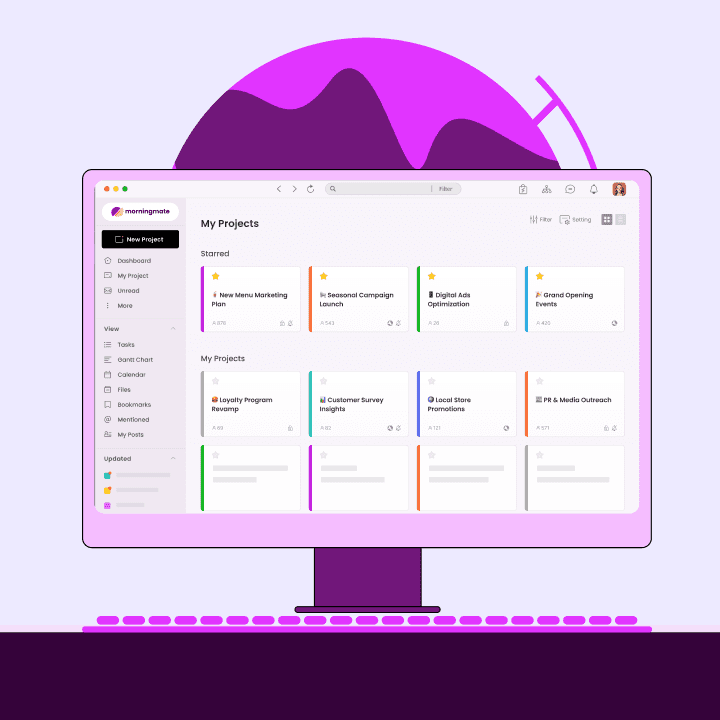
This is exactly the kind of workflow that morningmate was designed to support. It is a lightweight work management tool with built-in task tracking, a shared feed where work is visible to the whole team, and an integrated chat — so your team is not bouncing between five different apps. The interface feels like a social media feed, which means even non-technical team members pick it up in minutes, not weeks.
What Shared Task Management Actually Changes Day-to-Day
Moving from person-dependent task tracking to a shared system does not just reduce dropped balls. It changes how your team operates at a fundamental level. Accountability becomes structural rather than personal. People stop relying on being chased and start owning their task list because it is visible to everyone.
According to Gallup's employee engagement research, clarity of expectations is one of the strongest drivers of team performance. When task coordination is clear and documented, people perform better — not because they are being watched, but because they know exactly what is expected and when.
For a small business owner specifically, the shift means you can actually step back. When task management is running in a system rather than in people's heads, you can take a day away from the business without your phone buzzing every 20 minutes. That is not a small thing. That is the difference between owning a business and being trapped by one.
Task Management Scenario | Person-Dependent System | Shared Task Workflow |
|---|---|---|
Owner takes a day off | 10+ messages to check in by midday | Team runs on the task board without interruption |
Top employee resigns | 2–4 weeks of chaos and lost context | Tasks, files, and context transfer immediately |
Client asks for project status | You have to ask three people before answering | You open the task view and answer in 30 seconds |
Scaling from 8 to 15 people | Coordination breaks, owner becomes the bottleneck again | New people plug into the same task system from day one |
Why Most Small Teams Avoid Task Management Tools — and Why That Math Is Wrong
The usual objection is straightforward: tools cost money, take time to set up, and the team will not use them anyway. That concern is legitimate if you are thinking about something like Jira or a full enterprise project management suite. Those tools are genuinely too complex for a 10-person team and they create more overhead than they remove.
But the alternative — relying on fast communicators as your unofficial task coordination system — has a real cost too. You just do not get an invoice for it. You pay in dropped projects, re-done work, overtime, and owner time spent firefighting instead of growing the business.
Morningmate is specifically built for this gap. It gives small teams proper task management without the complexity of enterprise tools. The feed-based interface looks familiar — your team will not need training because it works like the apps they already use every day. Tasks can have assigned owners, due dates, file attachments, and status updates. The built-in chat means you are not adding yet another app to the stack. Over 550,000 teams worldwide use it as their single workspace for task tracking and team communication. See how lightweight work management supports lean team growth.
Team Confidence in Work Continuity: Before vs. After Shared Task Management
29%
Before: task workflow person-dependent
41%
After: using email + chat only
83%
After: shared task management system
Fig 2: Team confidence that work continues uninterrupted if one person is absent (illustrative)
Your Next Step: One Week, One Habit
The ROI of fixing your task management is not complicated. Every hour you spend setting up a shared task tracking system pays you back in avoided firefighting, fewer missed deadlines, and the ability to grow without adding headcount just to manage coordination. A business where work lives in a system — not in people — is a business you can actually scale.
Start with one team. Pick the area where dropped balls hurt most — client delivery, operations, sales follow-up — and move that team's task workflow into a shared tool this week. Spend 30 minutes setting up the space, agree that every task gets logged with an owner and a due date, and do a five-minute check-in at the end of the week. That is the whole habit. Build from there.
Morningmate is free to start and takes minutes to configure. If your fastest communicators are currently the only thing holding your task coordination together, this week is a good time to change that. Your team gets clarity, your business gets resilience, and you get your time back. Learn how to set up your first team task management system.