Project Management

Task management is the backbone of any functioning team — but when every person on your team uses a different system to track their work, that backbone quietly starts to crack. One person swears by sticky notes and a personal to-do app. Another logs tasks in a shared spreadsheet nobody updates. A third keeps everything in their email inbox. And the fourth? Their task workflow lives entirely inside a WhatsApp group chat. Sound familiar? This fragmentation is not just inconvenient — it is one of the most common and costly reasons task ownership breaks down in modern workplaces.
The problem compounds fast. When task tracking happens across five different tools, accountability becomes murky. Deadlines slip not because people are irresponsible, but because nobody has a clear, shared view of who owns what. Updates get buried. Priorities shift without anyone noticing. And managers spend more time chasing status updates than actually moving work forward.
If you lead a team — whether remote, hybrid, or in-office — you have probably felt this friction. The good news is that it is a solvable problem, and it starts with understanding exactly why fragmented systems cause task coordination to fall apart in the first place.
The Hidden Cost of Fragmented Task Management
Most teams do not realize how much fragmented task management costs them until the damage is already done. A missed deadline here, a duplicated effort there — individually, these feel like small hiccups. Collectively, they represent a significant drain on productivity and morale.
Asana's Anatomy of Work report found that knowledge workers spend on average 58% of their time on work about work — status checks, chasing updates, searching for information — rather than the skilled tasks they were actually hired to do. Fragmented task tracking is a direct driver of this problem. When task workflow is scattered, every status update becomes a mini investigation.
Here is what typically happens inside a team running on mismatched systems:
Task ownership is assumed but never confirmed — two people think the other is handling it, or nobody is
Deadlines exist in someone's personal calendar but not in a shared view the whole team can see
Progress updates happen in a chat message that gets buried under 40 other messages within hours
New team members have no way to understand the state of ongoing work
Managers cannot spot bottlenecks until a project is already at risk
This is not a people problem. It is a systems problem. And the solution is not to hire more organized people — it is to give your team a shared task coordination system that everyone can actually use.
Pain Point | Fragmented Systems | Unified Task Management |
|---|---|---|
Task ownership clarity | Unclear, assumed, often duplicated | Assigned, visible, confirmed |
Status update process | Manual check-ins, chasing messages | Live progress, shared dashboard |
Deadline visibility | Siloed in personal tools | Team-wide, centralized |
Onboarding new members | Chaotic, relies on tribal knowledge | Structured, self-service context |
Manager visibility | Reactive, meeting-dependent | Proactive, always-on overview |
Why Different Systems Break Task Ownership Specifically
Task ownership is not just about knowing who is responsible. It is about everyone on the team having the same understanding of who is responsible, what the scope is, when it is due, and what "done" looks like. That shared understanding is nearly impossible to maintain across different systems.
Think about what happens when a task is assigned verbally in a meeting, noted in one person's personal app, mentioned in a group chat, and then referenced in an email thread. By the time that task is due, the details have mutated across four different contexts. The person doing the work thinks the deadline is Friday. Their manager thinks it was Wednesday. And the stakeholder who originally requested it has no visibility at all.
Research from Harvard Business Review consistently shows that ambiguity in ownership and accountability is one of the primary drivers of team dysfunction. When people are not sure who owns a task — or when the systems they use give different signals — they default to either over-communicating (endless check-in meetings) or under-communicating (assuming someone else has it covered).
The "I Thought You Had It" Problem
This is one of the most common failure modes in task coordination: the gap between who assigned a task and who understood they received it. Without a centralized system where tasks are formally assigned and acknowledged, this gap widens. Personal messenger apps like WhatsApp or iMessage are especially prone to this — a task mentioned in a chat is not the same as a task formally assigned with a due date, a priority level, and a named owner.
The result is not just dropped work. It is eroded trust. When tasks fall through cracks repeatedly, team members start to second-guess each other. Managers add more oversight. Meetings multiply. The entire team becomes less efficient because the system — or lack thereof — forced them into it.
% of Teams Reporting Missed Deadlines Due to Unclear Task Ownership
71%
Email-based teams
63%
Chat-only teams
44%
Mixed tool teams
18%
Unified task system
Fig 1: Illustrative comparison of deadline miss rates by team communication setup (2026 estimates)
When Team Size Grows, Fragmented Task Management Gets Exponentially Worse
A two-person team can survive on shared spreadsheets and WhatsApp. The moment you add five more people, the cracks appear. At twenty people — especially across departments or time zones — a fragmented task workflow becomes genuinely unmanageable.
Growing companies face a compounding challenge: as the team expands, the number of tools in use tends to expand with it. Each new hire brings their own preferred setup. Each department adopts whatever works for them. Before long, engineering is running on Jira, marketing is living in Notion, operations is using a shared Google Sheet, and leadership is still relying on email threads to coordinate cross-team work.
McKinsey research on modern work management highlights that visibility gaps — when leaders cannot see the real status of work across teams — are one of the biggest blockers to organizational agility. Without a shared task tracking system, executives are always a step behind.
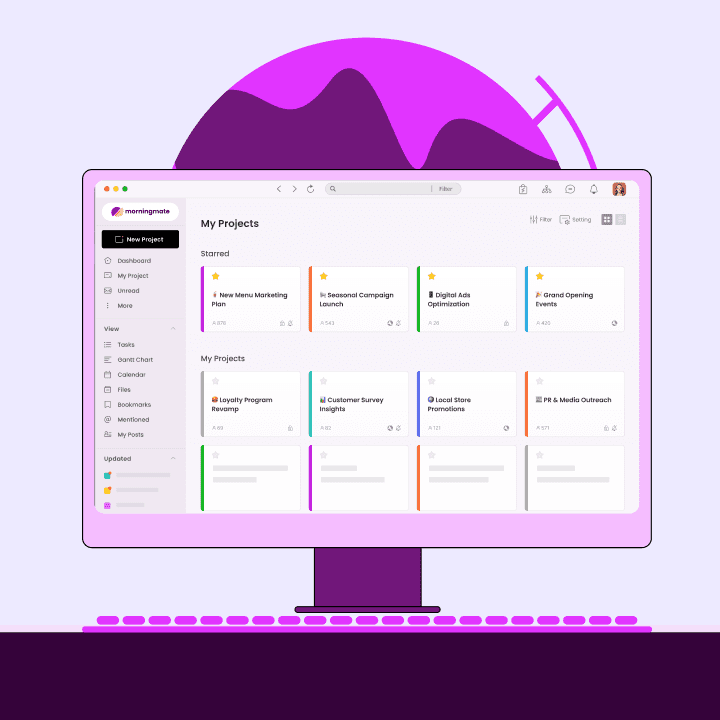
This is exactly where tools like Morningmate become relevant. Morningmate is a lightweight work management platform built around task management and team communication — designed to replace the scattered combination of email threads, WhatsApp groups, and personal to-do apps with one organized workspace. It is simple enough for non-technical teams to adopt immediately, which is often the barrier that stops growing companies from ever consolidating their tools in the first place.
What Good Task Ownership Actually Looks Like
Effective task coordination is built on four things: clarity, visibility, accountability, and a single source of truth. When all four are in place, ownership stops being a conversation and becomes a system.
Here is what that looks like in practice for a team that has gotten task management right:
Every task has one named owner. Not a team, not a vague "marketing department" — one person whose job it is to drive that task to completion.
Deadlines are visible to everyone relevant. Not buried in a personal calendar or a chat message from two weeks ago.
Progress is updated in the same place the task lives. No need to ask — anyone can check the current status without interrupting the person doing the work.
Dependencies are documented. If Task B cannot start until Task A is done, that relationship is recorded and visible.
Completed work stays accessible. Done does not mean disappeared. Past tasks and their outcomes serve as context for future decisions.
None of this requires a complex enterprise tool. What it requires is agreement across your team to use one system — and a system simple enough that everyone actually will. That last part is the part most teams underestimate. You can have the best task management tool in the world, but if half your team finds it too complicated and quietly reverts to their own workflow, you are back to square one.
Choosing a Unified Task Management System Your Whole Team Will Use
The biggest mistake teams make when trying to fix their task workflow is choosing a tool based on features alone. They pick something powerful enough for the most complex use case on the team — and end up with a system that 80% of the team finds intimidating and avoids.
The right question is not "does this tool do everything?" It is "will everyone on this team actually use this tool consistently?" Adoption is the metric that matters. A simpler tool used by everyone beats a powerful tool used by no one.
Morningmate was built with this exact problem in mind. Its task management interface is clean and intuitive — the Feed view feels like a social media timeline, so there is no learning curve for people who are not naturally tech-savvy. Tasks are created, assigned, and tracked alongside conversations in one place, which means context never gets separated from action. Over 550,000 teams worldwide use it to bring order to what was previously a scattered mess of emails and personal apps.
When evaluating a task coordination system for your team, check for these non-negotiables:
Can every team member — including non-technical staff — use it without training sessions?
Does it allow clear task assignment with named owners and due dates?
Can managers see the status of all tasks without needing to ask?
Does it keep communication and task tracking in the same place, so context is never lost?
Is it scalable as your team grows?
Criteria | Email + Chat Apps | Complex PM Tools (Jira/Asana) | Morningmate |
|---|---|---|---|
Ease of adoption | High (but wrong tool for tasks) | Low — steep learning curve | High — familiar interface |
Task ownership clarity | None built-in | Strong but complex to set up | Clear, lightweight assignment |
Communication integration | Separated from tasks | Partial, add-on | Built-in chat, same workspace |
Manager visibility | Zero without manual updates | Strong but overwhelming | Clean, real-time overview |
Suitable for non-tech teams | Yes, but chaotic | Rarely | Yes — built for this |
How to Transition Your Team to a Unified Task Management System
Switching systems mid-flight is always uncomfortable. But the discomfort of a transition is far smaller than the ongoing cost of fragmented task tracking. Here is a practical approach to making the shift without losing momentum.
Step 1: Audit Your Current Task Chaos
Before introducing anything new, spend one week documenting where tasks actually live across your team. You will likely find tasks in email, chat threads, personal apps, spreadsheets, and people's heads. Make this visible to the whole team — seeing the map of your own fragmentation is often the most persuasive argument for change.
Step 2: Define What Task Ownership Means for Your Team
Agree on a simple standard before you pick a tool. What does it mean to "own" a task? What information must every task have — an owner, a due date, a status? Defining this as a team creates buy-in before the tool conversation even starts. It also means you know exactly what you need a task management system to support.
Step 3: Pick One Tool and Commit as a Team
This is where most transitions fail. The tool gets introduced, but using it stays optional. Within weeks, people drift back to their own systems. Make the new tool the only official system for task tracking — not one option among many. Leadership has to model this behavior first.
Step 4: Start Simple — Do Not Migrate Everything at Once
Pick one project or one team as a pilot. Run all task coordination for that project through the new system for four weeks. Document what improved. Then expand. A gradual rollout beats a big-bang migration that overwhelms people and creates resistance.
Team Productivity Improvement After Adopting a Unified Task Workflow (Self-Reported, 12 Weeks Post-Adoption)
+27%
On-time delivery
+41%
Manager visibility
+55%
Ownership clarity
-38%
Status meetings
Fig 2: Reported outcomes after teams consolidated to a single task management system (illustrative, 2026 data)
Task Management Is Not a Tool Problem — It Is a Culture Problem That Tools Can Fix
Here is the honest truth: task coordination breaks down because of how teams talk about work, not just where they track it. When ownership is treated as informal, when updates are considered optional, when "I'll send a message" is seen as the same as "I've assigned this task" — the culture is working against you regardless of what tool you use.
But here is also the honest upside: the right tool reinforces the right habits. When task management is built into how your team communicates — not bolted on as a separate system people have to remember to check — it becomes part of the natural workflow. Ownership becomes visible by default. Updates happen in context. Managers stop needing to run status meetings just to find out what is happening.
The goal is not to add another tool to the pile. It is to replace the pile with one simple system that your whole team actually uses. That is when task tracking stops being a chore and starts being a genuine competitive advantage for your team. You can explore how combining team communication with task management creates that kind of environment in practice.
Task management works when ownership is clear, visibility is shared, and everyone is working from the same system. Until that is true for your team, every fragmented tool in the mix is quietly costing you more than you realize. The fix is simpler than most teams think — it just requires the decision to actually make it.