Project Management

Task management doesn't fall apart because your team lacks talent — it falls apart because no one owns the system. When there's no operations manager in the room, task tracking, task coordination, and day-to-day workflow visibility often become everyone's job, which quietly means they become no one's job. If you're a team lead, a business owner, or a manager holding things together with email threads and group chats, this article is for you.
The reality is that most growing teams skip the ops manager hire until something breaks — a deadline gets missed, a project falls through the cracks, or two people duplicate the same work for a week without realizing it. By that point, the damage is done. But here's the good news: a healthy task workflow doesn't require a dedicated ops hire. What it requires is structure, shared visibility, and the right habits baked into how your team works every single day.
This guide walks you through what that structure actually looks like — practically, not theoretically. From setting up task ownership to creating lightweight review rituals, you'll find a workflow model your team can adopt without adding headcount or complexity.
Why Teams Struggle With Task Management Without an Ops Manager
Most teams don't realize they have a task management problem — they think they have a communication problem. Someone missed a message. A file got lost. A deadline wasn't on anyone's radar. But these are symptoms, not causes. The root issue is usually the absence of a clear system for task tracking and task coordination that everyone actually follows.
According to Gallup's workplace research, unclear roles and responsibilities are among the top drivers of employee disengagement. When task ownership is fuzzy, people either wait for direction or step on each other's toes. Either way, work slows down and frustration builds.
Without an ops manager to catch these gaps, the warning signs tend to look like this:
Tasks are assigned verbally or in chat and never documented
Status updates only happen when someone asks for them
It's unclear who makes the final call on a decision
Work gets duplicated because visibility is low
New team members take weeks to understand how work actually flows
The table below shows how common these friction points are across different team sizes and how they typically escalate without structure in place.
Workflow Problem | Small Teams (under 15) | Growing Teams (15–100) |
|---|---|---|
No single source of truth for tasks | Manageable but messy | Critical breakdown point |
Unclear task ownership | Resolved informally | Causes regular delays |
Status updates via chat or email | Works with effort | Information gets lost regularly |
No review or retrospective habit | Low impact short-term | Compounds into culture issues |
The Hidden Cost of Unstructured Task Workflows
Poor task management isn't just inconvenient — it's expensive. McKinsey research found that employees spend nearly 20% of their workweek searching for internal information or tracking down colleagues to complete tasks. For a 20-person team, that's the equivalent of four full-time employees producing nothing but overhead.
When task coordination breaks down, the effects ripple out fast. Deadlines slip. Context gets lost between handoffs. Managers spend more time chasing updates than actually leading. And the team starts to feel like they're always reacting instead of executing.
% of Workweek Lost to Poor Task Coordination
32%
Email-based teams
27%
Chat-only tools
11%
Structured task workflows
Fig 1: Estimated workweek time lost to coordination overhead by workflow type (illustrative)
What a Healthy Task Management System Actually Looks Like
A healthy task workflow isn't about using the most powerful software or following the most elaborate project methodology. It's about creating predictability — so your team knows where to find work, who owns it, and what "done" looks like. Here are the core pillars your team needs, even without a dedicated ops manager.
1. One Central Place for All Tasks
Every task, no matter how small, needs to live somewhere that isn't someone's inbox or a chat thread that'll scroll out of view by tomorrow. This is the foundation of healthy task management. Pick one tool and commit to it as a team — the biggest mistake teams make is using three platforms simultaneously and then wondering why nothing is visible.
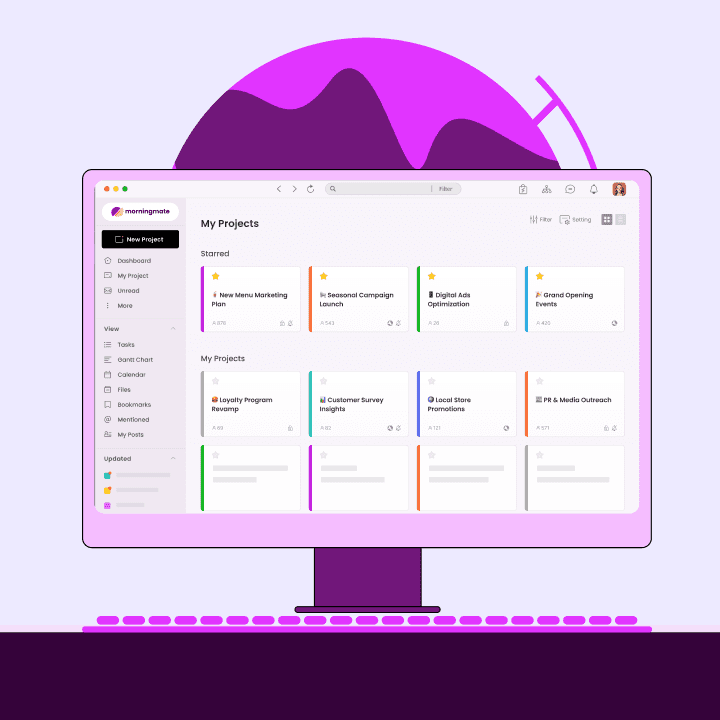
This is where a tool like Morningmate fits naturally. It's a lightweight work management platform used by over 550,000 teams worldwide that combines task management with built-in chat — so instead of bouncing between your project tool and your messenger, everything lives in one place. The Feed view works similarly to social media, making it easy for non-technical team members to post updates, tag tasks, and follow progress without a learning curve.
2. Clear Task Ownership — Always One Name Per Task
Shared ownership is a myth in task coordination. When two people are responsible, neither feels fully accountable. Every task needs exactly one owner — the person who will make sure it gets done, even if others contribute to it. This single habit eliminates the majority of "I thought you were handling it" moments.
That doesn't mean one person does everything alone. It means one person is the point of accountability. Others can be tagged as collaborators, but the task owner is the one who moves the status, raises blockers, and closes the loop.
3. Visible Status Without Requiring Meetings
If the only way your team knows the status of a task is by asking about it in a meeting, your task tracking system isn't working. Healthy teams build status visibility directly into how they work — not as an extra reporting step, but as a natural part of updating tasks.
This might mean using simple status labels like "In Progress," "Blocked," or "Done." It might mean a weekly async post summarizing what moved forward and what didn't. The key is that anyone on the team — including you as the manager — can get a clear picture of where things stand without interrupting someone's focus time.
4. A Lightweight Weekly Review Ritual
Even without an ops manager, someone needs to take a five-minute weekly scan of open tasks. Are any tasks overdue? Are any blocked and sitting untouched? Are priorities still aligned with what the team agreed to focus on? This doesn't need to be a meeting — it can be an async check-in posted to your team's main workspace.
The Harvard Business Review has noted that short, frequent async check-ins often outperform long synchronous meetings for keeping distributed teams aligned. Building this rhythm — even informally — acts as a natural substitute for what an ops manager would traditionally oversee.
Task Management Tools and Habits: A Side-by-Side Comparison
Not all approaches to task workflow deliver the same results. The table below compares three common setups teams fall into — and what each one actually produces in practice.
Workflow Setup | Visibility | Accountability | Scalability |
|---|---|---|---|
Email + WhatsApp | Very low | Unclear | Breaks after 10 people |
Spreadsheets + chat | Medium | Partial | High maintenance |
Dedicated task workflow tool | High | Built-in | Grows with the team |
Complex PM tools (Jira, Asana) | High | Strong | Steep learning curve, over-engineered for small teams |
The sweet spot for most teams without an ops manager is a dedicated task workflow tool that's simple enough for everyone to actually use. Morningmate is built exactly for this gap — it gives you structured task management without the complexity of enterprise-grade project execution platforms that require training and admin overhead to maintain. See how small teams choose the right task management tool.
Building the Habit Layer: Making Task Coordination Stick
Tools alone don't fix workflows. Habits do. The best task management system in the world fails if the team only uses it inconsistently. Here's a simple five-step habit layer you can implement this week — no ops manager required.
Create tasks before starting work, not after. Every piece of work your team takes on should exist as a task before anyone touches it. This sounds obvious but is rarely practiced consistently.
Assign an owner and a due date to every task. No exceptions. An unassigned task is a task that won't get done.
Update status when something changes — not just when it's done. If a task is blocked, mark it blocked. If it's pushed to next week, update the date. Status transparency is what replaces the need for constant check-in meetings.
Use one communication thread per task. Discussions about a specific task should happen in or directly connected to that task — not in a separate chat thread that loses context. Morningmate's built-in chat is designed for exactly this, letting your team comment and coordinate directly within their task workflow without switching apps.
Do a five-minute async review every Friday. Scan open tasks, flag anything overdue, and post a brief summary to the team. This single habit gives you the visibility that an ops manager would traditionally provide.
You can also learn more about async communication habits that keep remote teams aligned without piling on meetings.
What Teams Report After Fixing Their Task Management Workflow
The impact of structured task coordination shows up quickly. Teams that move from scattered email and chat-based task tracking to a dedicated task management system consistently report measurable improvements in clarity, speed, and team morale. The chart below illustrates the kind of gains teams typically experience after adopting a structured task workflow.
Team Improvement After Adopting Structured Task Management (%)
71%
Fewer missed deadlines
64%
Less time in status meetings
58%
Improved team accountability
Fig 2: Self-reported team improvements after adopting structured task workflow (illustrative, based on aggregated survey data)
Task Management Is the Ops Manager You Don't Have
Effective task management doesn't replace the judgment of a great operations manager, but it does replace the coordination function — which is often what teams actually need most. When task tracking is structured, visible, and consistently used, your team stops relying on one person to hold everything together. The system does that work instead.
If your team is still relying on email threads, WhatsApp groups, or scattered spreadsheets for task coordination, the upgrade doesn't need to be dramatic. Start small: one workspace, one task per work item, one owner per task. Build the five habits outlined in this article over the next 30 days. Most teams see a noticeable shift in clarity and momentum within the first two weeks.
The goal of strong task management isn't to add bureaucracy — it's to remove the invisible overhead that's quietly slowing your team down. With the right lightweight system and consistent habits, your team can run a clean, accountable workflow regardless of your headcount or your org structure. That's what healthy task coordination actually looks like when you build it right.