Project Management

Effective task management starts long before anyone opens a project board — it starts the moment your team decides which app to open first. If that sounds trivial, consider this: the average knowledge worker now switches between apps more than 1,100 times a day, and that constant context-switching carries a real cost that most small teams never stop to measure. Call it the collaboration tax — the invisible toll of fragmented tools, scattered messages, and duplicated effort that quietly drains your team's most valuable resource: focused time.
Small teams feel this tax the hardest. Without dedicated ops staff or IT support to enforce tool discipline, work ends up spread across email, WhatsApp, spreadsheets, sticky notes, and whatever app someone discovered last month. Every conversation that starts in one place and finishes in another is a gap where context gets lost. Every task that lives in a chat thread instead of a proper task tracking system is a risk — one scroll away from being forgotten entirely.
This article breaks down exactly how much time app-switching costs your team, where that time goes, and what a smarter approach to task coordination actually looks like in practice. The numbers will probably surprise you — and the fix is simpler than you think.
The Real Cost of Task Management Chaos
Let's put a number on the problem. According to Harvard Business Review, employees lose significant chunks of productive time not to meetings alone, but to the coordination overhead that surrounds work — status checks, tool-hopping, and re-explaining context. Separate research from McKinsey's Social Economy report found that workers spend nearly 20% of their workweek just searching for internal information and tracking down colleagues.
For a 10-person team, that's two full-time employees' worth of productivity spent on coordination friction every single week. Not on actual work — on finding the work, remembering what was decided, and figuring out where the latest file lives. That is the collaboration tax in its rawest form.
The problem compounds when you look at task workflow specifically. When tasks are assigned in a chat, updated in email, and tracked in a spreadsheet, no single person ever has the full picture. Managers end up running status-check meetings not because they want to, but because their task management setup gives them no other choice.
Activity | Fragmented Tools (avg. per person/day) | Unified Task Management System |
|---|---|---|
Finding task updates | 25–35 min | 2–5 min |
Locating shared files | 15–20 min | Under 1 min |
Re-explaining context to teammates | 20–30 min | 5–8 min |
Switching between apps | 40–60 min | 10–15 min |
Running unnecessary status meetings | 30–45 min | 0–10 min |
Where Task Tracking Time Actually Goes
Most teams underestimate their collaboration tax because the costs don't appear on any report. Nobody logs "30 minutes spent re-reading a WhatsApp thread looking for an approval." But those minutes are real, and they accumulate fast. Here are the four biggest drains on task coordination time for small teams.
1. The App-Switch Spiral
A typical task workflow might look like this: task assigned via Slack, update shared over email, file attached in Google Drive, final approval requested over WhatsApp. That's four apps for one task — and four places where context can go missing. Each switch costs a mental reset. Research in cognitive psychology calls this "attention residue," the lingering cognitive load that follows you from one app to the next.
2. Duplicated Communication
When there's no single home for task management, the same information gets repeated across channels. Someone posts an update in chat. Someone else didn't see it and emails asking for a status. A third person sends a voice note. By the time everyone's aligned, three conversations have happened about one task — and not a single line of actual work has been done.
3. Lost Files and Forgotten Decisions
Files shared in chat threads disappear the moment the conversation moves on. Decisions made in a meeting get lost if nobody documented them in the task tracking system. Teams then spend time rebuilding context — or worse, making the same decision twice because nobody can find the original one.
4. Status Meetings That Shouldn't Exist
When task coordination is fragmented, the only way to get a full picture is to call a meeting. These check-ins feel necessary, but they're really a symptom of a broken task management system — not a feature of good leadership. A well-structured task workflow makes most status meetings optional, because everyone can already see what's happening.
Daily Time Lost to Collaboration Friction by Tool Setup
2.4 hrs
Email + WhatsApp
1.8 hrs
Slack + Drive + PM Tool
0.6 hrs
Unified Workspace
Fig 1: Estimated average daily hours lost to coordination friction by tool setup (illustrative, based on industry benchmarks)
Why Overbuilt Tools Make Task Management Worse
The instinct when teams feel coordination pain is to reach for a more powerful tool. Enter Jira, Asana, or Monday — platforms with exhaustive features, complex permission systems, and steep learning curves. For a software development team with a dedicated project manager, those tools make sense. For a 15-person marketing agency or a growing retail operations team, they often make things worse.
When a task management tool is too complex to use comfortably, adoption collapses. Team members default back to WhatsApp and email — the apps they already know — and the expensive PM tool sits half-used, adding to the app-switching problem rather than solving it. Gartner research consistently shows that tool complexity is one of the top reasons workplace software goes underutilized.
The answer isn't a more powerful tool — it's a more usable one. Task coordination works best when the tool is intuitive enough that everyone actually uses it, from the operations lead to the newest hire who has never touched a project management platform before.
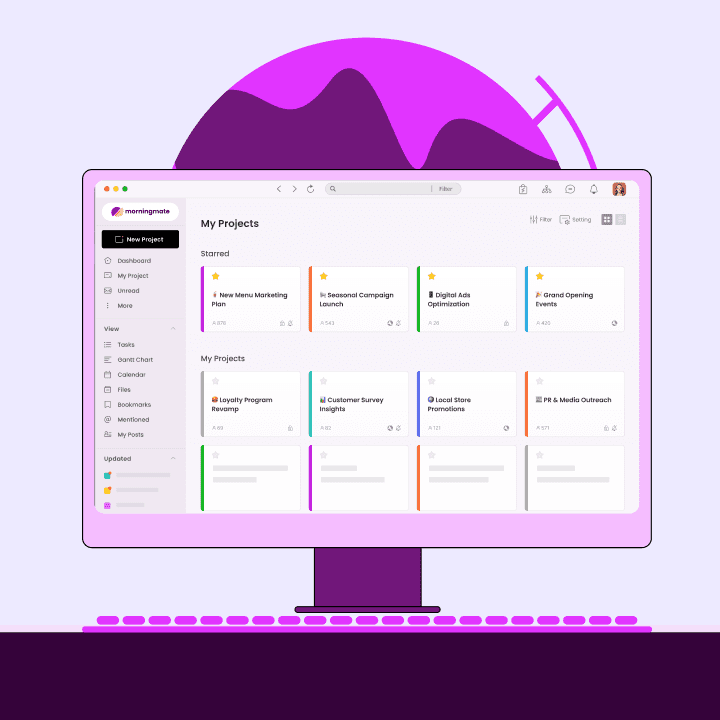
This is where tools like Morningmate take a different approach. Instead of replicating enterprise-grade complexity, Morningmate is built around a familiar social-media-style feed and a built-in chat interface that feels like WhatsApp — so non-technical teams pick it up immediately. Task management, file sharing, and team communication all live in one place, without the learning curve that kills adoption at smaller companies.
What Consolidated Task Management Actually Looks Like
Moving from fragmented tools to a unified task workflow doesn't have to be a major overhaul. The teams that make the switch successfully tend to follow a clear pattern. Here's a practical framework you can adapt for your own team.
Step 1 — Audit Your Current App Stack
List every tool your team currently uses for task tracking, communication, and file sharing. Count how many times a single task touches multiple tools from creation to completion. That number is your baseline collaboration tax.
Step 2 — Identify the Core Workflow Needs
Most small teams need three things: a way to assign and track tasks, a way to communicate about those tasks in context, and a way to store and access files related to the work. Anything beyond that is usually nice-to-have, not essential for day-to-day task coordination.
Step 3 — Choose One Home for Task Management
Pick a single platform where tasks are created, assigned, updated, and closed. Not two. Not "mostly one, but also Slack for quick things." One. This single decision eliminates more coordination friction than any other change you can make.
Step 4 — Migrate Communication Into the Same Space
The real magic happens when task tracking and team chat live together. When you can comment directly on a task, tag a teammate, and attach a file — all in the same thread — the collaboration tax drops sharply. No more "which app has the latest update?" because every update lives exactly where the task does.
Morningmate is built on this exact principle. Its task management features sit alongside a built-in chat and a feed-style home screen, so your team's communication and task workflow are never more than one click apart. Over 550,000 teams worldwide use it as their single coordination hub — replacing the mess of personal apps without introducing the complexity of enterprise software.
Step 5 — Set a "One Channel" Rule
Decide as a team that work-related updates happen in your chosen task management tool — not in personal WhatsApp groups, not in email chains. This isn't about being rigid; it's about making sure nothing important falls through the cracks because it ended up in the wrong place.
Scenario | Fragmented Approach | Unified Task Management |
|---|---|---|
New task assigned | Sent via WhatsApp or email; easily missed | Created in platform; assignee notified instantly |
Task status update | Buried in chat thread; manager must ask | Visible on task board; no follow-up needed |
File sharing | Scattered across Drive, email, Slack | Attached directly to the relevant task |
Team discussion on a task | Happens in a separate chat; context lost | Threaded inside the task; fully searchable |
Manager visibility | Requires status meeting to get full picture | Real-time overview on task dashboard |
The Productivity Gains from Better Task Coordination
Teams that consolidate their task management setup consistently report the same outcomes: fewer meetings, faster decisions, and less time spent on internal coordination. The Asana Anatomy of Work report found that teams with clearer workflows and centralized task tracking complete work significantly faster than those relying on fragmented communication channels.
The gains aren't just about speed. When task coordination is transparent and centralized, trust improves — team members know what everyone else is working on, which reduces the low-grade anxiety of wondering whether something is getting done. Managers spend less time chasing updates and more time doing the actual work of leadership: removing blockers, making decisions, and planning ahead.
Morningmate's task management features are built specifically for this outcome. You can create tasks, set due dates, assign owners, track progress, and communicate in context — all without needing three separate apps open at once. For teams that have been running on email and WhatsApp, the shift feels immediate.
Team Productivity Score Before vs. After Consolidating Task Management
42%
Email-first teams (before)
61%
Multi-app teams (partial fix)
89%
Unified task workflow (after)
Fig 2: Illustrative productivity scores reflecting team self-reported efficiency after tool consolidation (based on aggregated industry survey data)
Stop Paying the Collaboration Tax With Better Task Management
The collaboration tax is not an inevitable cost of running a team. It's a symptom of tool fragmentation — and it's entirely solvable. When task management, communication, and file coordination live in one place, the friction disappears. Your team stops spending its best hours on coordination overhead and starts spending them on work that actually moves the needle.
The goal isn't to add another app to your stack. It's to replace the chaos with one place where task tracking is clear, communication is contextual, and nothing important ever disappears into a WhatsApp thread again. That shift — from scattered to centralized task coordination — is where small teams reclaim their most valuable asset: time that actually belongs to the work.
If your team is still managing work across email and personal messenger apps, the cost is already accumulating. Better task management isn't a luxury — for growing teams, it's the foundation everything else is built on.