Project Management

Task management is the silent backbone of how your team actually gets work done — and yet, most teams treat it as an afterthought, burying action items in meeting notes that nobody reads twice. If your week is filled with status update calls, check-in syncs, and "quick" catch-ups that eat 45 minutes, there is a good chance your team is using meetings to do work that a shared task board could handle in seconds. The problem is not that meetings are inherently bad. The problem is that they are doing the wrong job.
According to a Harvard Business Review study, executives spend an average of 23 hours per week in meetings — up from less than 10 hours in the 1960s. A significant chunk of that time is spent on coordination work: who owns what, what is blocked, and what has been completed. That is exactly what task tracking systems exist to handle. When teams lack a clear task workflow, meetings become the default mechanism for visibility — and visibility should never cost you half your week.
This article breaks down why meetings keep replacing proper task coordination, what the real cost looks like, and how to shift your team toward a model where the task board speaks first and the calendar stays lighter. Whether you are managing a remote team or running operations across a hybrid office, the fix is simpler than you might think.
Why Teams Reach for a Meeting Instead of a Task Board
The reflex is understandable. When something feels urgent, scheduling a meeting feels like taking action. It signals seriousness. It gets people in the same (virtual) room. But more often than not, the urgency could have been addressed with a well-structured task workflow — one where everyone can see progress, blockers, and ownership without anyone having to ask.
There are a few common reasons teams fall into the meeting trap instead of leaning on task management systems:
No single source of truth: When tasks live in emails, WhatsApp threads, and sticky notes, there is no shared board to point to. Meetings fill that gap.
Lack of trust in async updates: If your team has no reliable system for logging progress, managers call meetings to verify status themselves.
Tool overload: Teams juggling five different apps for communication, files, and tasks default to meetings because it feels easier than navigating scattered platforms.
No visibility without asking: When task coordination is invisible to leadership, check-ins become mandatory rather than optional.
The pattern is consistent: weak task management creates an information vacuum, and meetings rush in to fill it. The solution is not fewer meetings for the sake of it — it is giving your team a task tracking system strong enough that most meetings become redundant.
Meeting Type | What It's Actually Doing | What Should Replace It |
|---|---|---|
Daily standup (30 min) | Checking who owns what and what is blocked | Shared task board with status labels |
Weekly status update | Reporting progress that should already be visible | Task management dashboard with real-time updates |
Ad-hoc check-in call | Hunting for information that was never recorded | Async task comments and file attachments |
Kickoff meeting | Assigning roles and explaining scope | Task board with assigned owners, due dates, and briefs |
The Real Cost of Meetings as Task Management
Meetings are not free. Every hour spent in a status update is an hour not spent on actual work. But the cost goes beyond time — it erodes focus, fragments deep work sessions, and creates a culture where people feel they cannot make decisions without a meeting first.
Microsoft's 2026 Work Trend Index found that meeting time has more than doubled since 2020 for the average knowledge worker, while time for focused, uninterrupted work has decreased. When task coordination happens verbally instead of through a structured task workflow, the entire team pays a focus tax every single day.
Weekly Hours Lost to Avoidable Meetings by Role
6 hrs
Individual Contributors
9 hrs
Team Managers
13 hrs
Operations Leads
Fig 1: Estimated weekly hours lost to meetings that could be replaced by task tracking (illustrative)
The numbers are particularly painful for operations leads and team managers — the exact people who most need unbroken thinking time to do strategic work. When they spend their mornings in status calls, they spend their afternoons catching up on the work they should have done in the morning. Task management done right breaks this cycle.
What a Shared Task Board Actually Gives Your Team
A well-structured task board does more than list to-dos. It creates a living, breathing record of who is working on what, where things stand, and what the next step is — without requiring anyone to ask. That visibility alone eliminates the most common reasons teams schedule unnecessary meetings.
Here is what effective task coordination looks like in practice:
Every task has a clear owner. No ambiguity about who is responsible. When someone needs an update, they check the board — not their inbox.
Statuses are visible at a glance. "In Progress," "Blocked," "Done" — the team can self-report without being prompted by a manager.
Deadlines are attached to tasks, not buried in meeting notes. Due dates live where the work lives.
Context travels with the task. Files, comments, and decisions are stored inside the task card, not scattered across email threads and chat messages.
Managers have real-time visibility. No more asking "how is that coming along?" — the answer is already on the board.
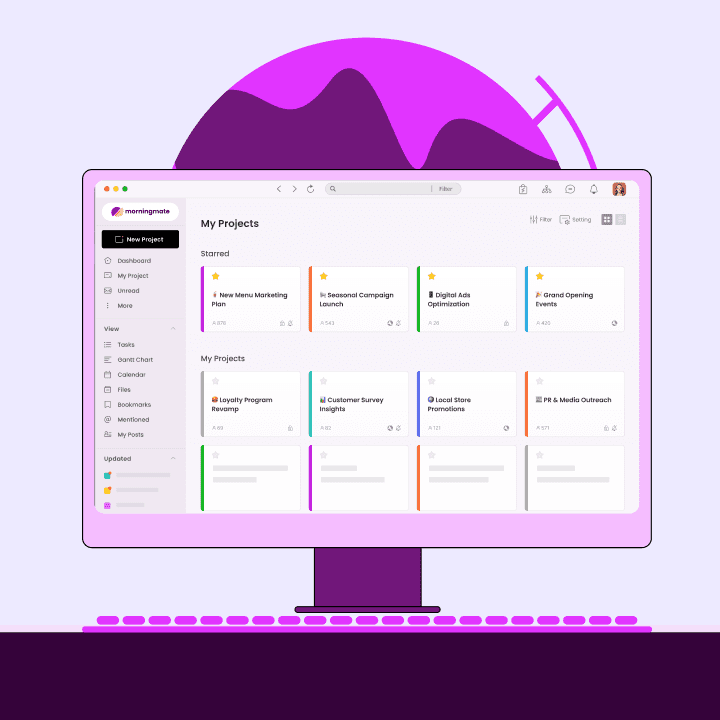
This is exactly the model that tools like Morningmate are built around. Morningmate is a lightweight work management platform that combines task management with built-in team chat — so your task board and your team communication live in the same place. No more switching between five apps to piece together project status. Everything your team needs to stay aligned is in one organized workspace.
How to Transition from Meeting-Heavy to Task Management-First
Shifting from a meeting-heavy culture to a task-first one is not about banning meetings — it is about being intentional about when a meeting is genuinely the right tool. Here is a practical framework for making that shift without disrupting your team.
Step 1: Audit Your Current Meetings
Before changing anything, map out every recurring meeting your team has. For each one, ask: what information is being exchanged, and could that information live on a task board instead? You will likely find that at least 40% of your weekly meetings are pure status reporting — the kind that task tracking handles automatically.
Step 2: Build a Task Board That Your Team Will Actually Use
The biggest reason task management systems fail is adoption. If the tool is too complex, people revert to WhatsApp and email within a week. Choose a task workflow platform that is simple enough for non-technical team members to use from day one. The best task management tools feel intuitive — not like another thing to learn.
Morningmate's Feed view is designed to feel like a familiar social media interface, which means even team members who have never used a project management tool before can get up to speed quickly. With 550,000 teams using it globally, the onboarding curve is intentionally minimal.
Step 3: Set Norms Around Async Task Updates
Ask every team member to update their tasks at the start and end of the day. When the board is live and current, managers have no reason to schedule a check-in call just to ask "where does this stand?" Build the habit team-wide and protect it actively in the first few weeks.
Step 4: Replace Status Meetings with a Board Review
Instead of a 30-minute weekly standup, try a 10-minute async board review. Each person leaves a short comment on their tasks. The manager reviews the board independently. Questions get answered in the task thread — not in a meeting room. This is async task coordination at its most effective, and it gives everyone their mornings back.
Task Management vs. Meeting-Driven Coordination: A Direct Comparison
If you are still weighing whether the shift is worth it, this comparison makes the case clearly. The difference between a team that relies on meetings for task coordination and one that uses a proper task workflow is not just efficiency — it is the entire working experience.
Work Scenario | Meeting-Driven Teams | Task Management-First Teams |
|---|---|---|
Checking project status | Schedule a call, wait for availability | Open the board, see status instantly |
Handling a blocker | Wait for next standup to raise it | Flag in task, notify owner immediately |
Onboarding a new team member | Multiple orientation meetings needed | Task board provides instant context |
Cross-team task coordination | Recurring sync meetings between teams | Shared boards visible across departments |
Decision tracking | Buried in meeting notes (if recorded) | Logged inside the task, always findable |
What Happens to Team Focus When Task Tracking Replaces Status Meetings
The productivity gains from reducing unnecessary meetings are well-documented. Gallup research consistently shows that employee engagement and output improve significantly when workers have longer stretches of uninterrupted time. When your task management system handles the coordination layer, your team gets those stretches back.
Teams that adopt a task-first communication model typically report:
Fewer context-switching moments during the day
Better documentation of decisions and work history
Faster onboarding for new team members
Less anxiety about "falling behind" because progress is always visible
More meaningful meetings — ones that actually require real-time discussion
Morningmate supports this working style directly. Its built-in chat is designed with the same familiar interface as WhatsApp, so team members can communicate contextually — inside a task, alongside a file, or in a dedicated project channel — without ever needing to jump to a separate messaging app. Task workflow and team chat share the same space, which means less friction and fewer dropped threads.
Reported Improvement in Team Focus After Switching to Task-First Coordination
22%
Email-Based Teams
47%
Dedicated PM Tool Users
71%
Integrated Task + Chat Tools
Fig 2: Self-reported focus improvement after adopting task-first coordination workflows (illustrative)
When Meetings Still Make Sense — and How Task Management Supports Them
To be clear: the goal is not to eliminate meetings. Some conversations genuinely need to happen in real time — brainstorming sessions, difficult feedback conversations, strategic planning, or moments when tone and nuance matter. The goal is to protect those meetings from being diluted by coordination noise.
When your task tracking system is doing its job, the meetings that remain are sharper, shorter, and more valuable. People arrive prepared because the board already told them where things stand. Decisions get made faster because the context is already documented. And follow-ups are easy because action items go straight into the task workflow — not into someone's email drafts folder.
Think of task management as the preparation layer that makes your meetings worth having. Async communication and task coordination do the heavy lifting of keeping everyone aligned day-to-day, so your real-time meetings can focus on the conversations that actually need them.
Putting Task Management at the Center of How Your Team Works
Effective task management is not just a productivity hack — it is a cultural decision about how your team communicates, builds trust, and holds itself accountable. When task coordination is visible, structured, and consistent, you stop relying on meetings to carry information that a board can carry for free.
Start small: pick one recurring meeting this week and ask whether a shared task board could replace it. Set up the task workflow, assign owners, add due dates, and let the team update it for one week instead of showing up to a call. You will likely find that the meeting was never necessary — the information just needed a better home.
Teams that invest in strong task management systems get more than time back. They build a culture where work is transparent, communication is intentional, and progress does not depend on who remembered to show up to the standup. That is the kind of team that scales — and the kind of work environment people actually want to be part of. If you are looking for a place to start, Morningmate gives your team a unified workspace for task management and communication, built to be simple enough that everyone uses it from day one. Because the best task tracking system is the one your whole team actually shows up to.