Project Management

Task management should move your projects forward — but for most teams, it quietly becomes a second job in itself. If you've ever spent a Friday afternoon sending follow-up messages just to find out where three different tasks stand, you already know what this feels like. The chase for project updates eats into real working hours, fragments your team's focus, and creates a cycle of interruptions that nobody planned for and nobody wants to maintain.
It starts innocently enough. Someone sends a quick message asking for a status update. Another person follows up on an email from two days ago. A manager pings three people in a group chat to figure out who owns a deliverable. None of these moments feel like a big deal on their own — but add them up across a week, and your team has collectively spent hours just trying to figure out what's happening, rather than actually making things happen.
According to Asana's Anatomy of Work report, workers spend 58% of their day on coordination work — things like chasing updates, attending status meetings, and managing communication — rather than the skilled work they were hired to do. That's not a productivity problem. That's a task coordination problem masquerading as a normal workday.
Why Update-Chasing Becomes a Habit Nobody Notices
The reason teams fall into this pattern is surprisingly structural. Most teams don't have a single place where task management lives. Instead, work gets scattered across email threads, personal chat apps, spreadsheets, and verbal check-ins. When there's no central system, asking people directly becomes the only reliable way to know what's going on.
This is especially common in hybrid teams where some people are in the office and others are remote. The people physically present get informal updates in hallways. Remote teammates get left out and compensate by sending more messages. Everyone ends up doing more communication work to compensate for a broken task workflow — and the problem compounds over time.
What makes this dangerous is that it feels productive. You're communicating, you're responsive, you're keeping things moving. But in reality, your team is running a shadow operation on top of actual work — an informal, exhausting layer of status management that could be eliminated entirely with the right task tracking system.
Update Method | Time Cost Per Day | Key Problem |
|---|---|---|
Email follow-ups | 45–60 min | Information gets buried, replies delayed |
Group chat messages | 30–45 min | Context lost, interrupts deep work |
Status meetings | 60–90 min | High time cost, information fades after |
Spreadsheet tracking | 20–30 min | Manual updates, quickly out of date |
The Real Cost of Poor Task Management
Let's put some real numbers to this. McKinsey research found that employees spend an average of 1.8 hours per day searching for information and chasing updates. Across a five-day work week, that's nine hours — more than an entire workday — lost purely to coordination friction. For a team of ten people, that's ninety person-hours per week that produce zero deliverables.
The financial toll is significant, but the human cost is just as serious. When people spend their energy managing information instead of doing their actual work, burnout follows. Task tracking chaos doesn't just hurt productivity — it erodes trust, creates anxiety around deadlines, and makes high performers feel like they're constantly playing catch-up.
There's also a compounding visibility problem. When managers can't see task status at a glance, they compensate by scheduling more check-in meetings. Those meetings generate more action items that need to be tracked. And the cycle of poor task management gets worse with every project.
Hours Per Week Lost to Chasing Project Updates (Per Team Member)
9 hrs
Email-only Teams
7 hrs
Chat App Users
4 hrs
Basic PM Tools
1.5 hrs
Integrated Systems
Fig 1: Estimated weekly hours lost to update-chasing by team communication setup (illustrative)
The Three Patterns That Create a Second Job
Most teams don't realize they've built a second job out of task coordination until someone points it out. Here are the three patterns that cause it.
1. No Single Source of Truth for Task Status
When task management is spread across emails, chat apps, and verbal conversations, nobody knows where to look for an authoritative update. So people ask. And then they ask again when the first answer gets buried. A centralized task tracking system eliminates this pattern by making status visible to everyone without anyone needing to ask.
2. Work Gets Assigned but Never Closed Out
Tasks that are created informally — over chat or in a meeting — rarely have a formal close. They live in someone's memory, not a system. This forces managers to chase completions manually, which is exactly the second job we're talking about. Proper task workflow means every task has an owner, a deadline, and a visible status that anyone can check without interrupting someone's focus.
3. Over-Reliance on Meetings to Sync on Work
When teams don't trust their task management system to keep everyone aligned, they replace that trust with meetings. Status meetings, check-ins, standups — many of these exist solely because there's no visible, shared view of what's happening. Harvard Business Review has reported that executives spend an average of 23 hours per week in meetings, many of which could be replaced with a simple shared task board.
How to Break the Update-Chasing Cycle with Better Task Management
The fix isn't about working harder or communicating more — it's about making task coordination automatic. Here's a practical framework for getting there.
Step 1: Consolidate Where Work Lives
Pick one place for task management and stick to it. This sounds obvious, but most teams fail here because they choose tools that are either too complex or too disconnected from where conversations happen. If your task tracker lives in one app and your conversations live in another, people will always default to chat — and task tracking will always lag behind.
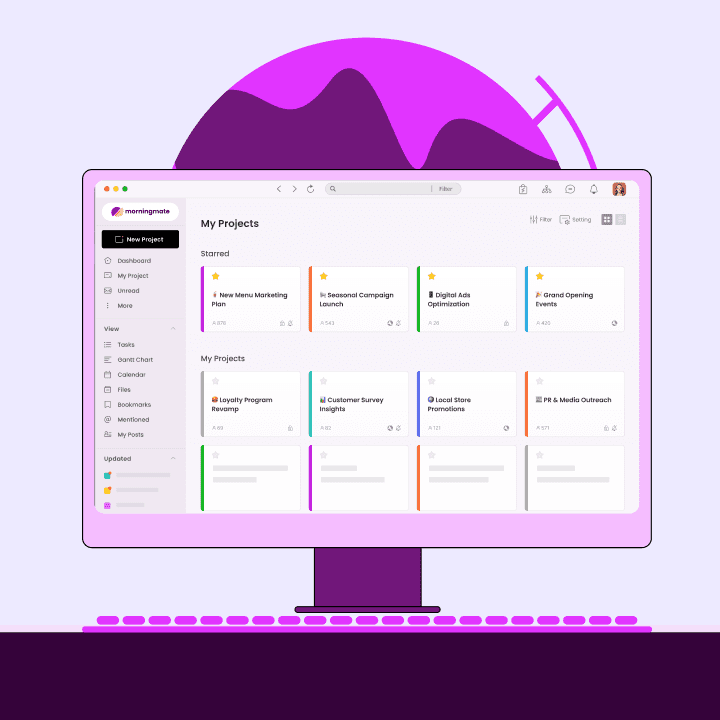
This is where Morningmate stands out. It's a work management platform used by over 550,000 teams that combines task management with built-in chat in a single, lightweight workspace. Teams can create tasks, assign owners, set deadlines, and discuss the work — all in one place, without switching between tools. The Feed view mirrors familiar social media layouts, so even non-technical team members get comfortable quickly.
Step 2: Make Task Status Visible by Default
Every task in your system should have a clear owner and a current status that's visible without asking anyone. This transforms task tracking from a push system — where managers ask for updates — to a pull system, where anyone can check status at any time. Progress becomes self-reporting.
Step 3: Replace Status Meetings with Async Updates
Once your task workflow is visible, you can eliminate most of your status meetings. Instead of gathering everyone to share what's happening, your team updates tasks directly in the system and anyone who needs to know can check at their own pace. This is especially valuable for remote and hybrid teams managing async communication.
Step 4: Connect Communication to Tasks, Not the Other Way Around
The key insight is that communication should serve task management — not replace it. When a conversation about a task happens inside the task itself (rather than in a separate chat or email thread), the context is preserved. Anyone who joins later can see the full history without needing to ask someone to recap everything.
Morningmate's built-in chat works directly alongside its task management features, so discussions stay attached to the work they're about. No more hunting through WhatsApp threads to find the decision someone made last Tuesday.
Choosing the Right Task Management Setup for Your Team
Not every tool fits every team. The right task tracking setup depends on your team's size, technical comfort level, and how complex your work coordination actually needs to be. Here's a quick comparison to help frame the decision.
Team Type | Common Problem | What to Look For |
|---|---|---|
Small hybrid team (10–30) | Updates scattered in chat and email | Simple task board + built-in messaging |
Growing company (30–100) | No visibility across teams or projects | Cross-team task workflow with role-based views |
Non-technical team | Complicated tools go unused | Familiar interface, low learning curve |
Remote-first team | Async communication breaks down | Task tracking with async-friendly updates |
For teams that feel overwhelmed by tools like Jira or Asana but have outgrown WhatsApp and email, Morningmate hits a practical middle ground. It offers robust task management and file management without the steep learning curve that causes adoption to fail. You can explore how this kind of setup helps growing teams in our guide to choosing the right work management tool as your team scales.
What Happens When Teams Fix Their Task Management
The results of cleaning up task coordination aren't just operational — they're cultural. When people stop spending energy chasing updates, they have more room to think, create, and do the work they're actually good at. Managers spend less time policing status and more time unblocking their teams. Decisions get made faster because context is always available.
Teams that move to centralized task tracking consistently report fewer missed deadlines, less duplicated work, and shorter, more focused meetings. The second job of chasing updates quietly disappears — not because people worked harder, but because the system started doing that work for them.
Team Improvements After Adopting Centralized Task Management (%)
62%
Fewer Status Meetings
71%
Faster Decision Making
55%
Reduced Missed Deadlines
68%
Improved Team Visibility
Fig 2: Self-reported team improvements after adopting centralized task management (illustrative)
Stop Chasing — Start Managing
The update-chasing problem is one of the most common and most fixable drains on team productivity. It's not about people being disorganized or uncommitted — it's about systems that force people to communicate in place of actual task management. When task tracking is visible, centralized, and tied to real conversations, the second job disappears on its own.
Good task management doesn't just save time. It changes how your team feels about work — less reactive, more in control, and free to focus on what they're actually there to do. Whether you're leading a ten-person hybrid team or managing cross-team work coordination across a growing company, fixing how your team tracks tasks is the highest-leverage change you can make this year.
If your team is ready to stop treating status updates as a full-time job, take a closer look at how stronger task management practices can transform the way work gets done — and consider tools built to make that shift as simple as possible from day one.