Project Management
You book a meeting. You assign a task. You send a follow-up message. And somehow, by end of day, nothing feels connected. That's the quiet frustration of using the wrong tools for the wrong jobs — specifically, when teams lean on scheduling apps to do the work that only a proper work management system can handle.
Scheduling apps and work management platforms are not the same thing, even though they often get lumped together in conversations about productivity tools. One tells your team when to do something. The other tells them what to do, how it connects to everything else, and who is responsible. That's a meaningful difference — and getting it wrong costs real time and real money.
If you're a team manager or operations lead trying to untangle your tools stack, this guide breaks down exactly what each type of tool does, where the lines blur, and how to build a setup that actually keeps work moving.
What Scheduling Apps Actually Do
Scheduling apps are built around one core function: coordinating time. Tools like Calendly, Google Calendar, and Doodle help individuals and teams find shared availability, book meetings, set reminders, and block focus time. They're genuinely useful for that narrow purpose.
Where they fall short is context. A calendar event tells you a meeting is happening at 10am on Thursday. It doesn't tell you what decisions came out of that meeting, what tasks were created as a result, or whether those tasks are actually getting done. That gap is where work falls through the cracks.
Common Scheduling App Features
Most scheduling tools share a similar feature set. Knowing what they cover helps you spot what they don't.
Meeting booking and calendar syncing
Availability detection across team members
Automated reminders and notifications
Time zone management for distributed teams
Integration with video conferencing tools like Zoom or Google Meet
Notice what's missing: task ownership, project timelines, file sharing, team communication, or any way to track progress on actual work. Scheduling apps are a slice of the productivity puzzle — not the whole picture.
What Work Management Tools Are Built For
Work management platforms sit at a different layer. They're designed to organize, assign, and track the actual work your team does — not just when they're meeting about it. According to McKinsey's research on team productivity, employees spend nearly 20% of their workweek searching for internal information or tracking down colleagues for updates. Work management tools exist to close that gap.
A solid work management platform gives your team a single place where tasks are created, assigned, discussed, and completed — with full visibility for everyone who needs it. That's the kind of operational clarity that scheduling apps simply aren't designed to provide.
Core Features of a Work Management Platform
The best work management tools go beyond basic to-do lists. Here's what they typically offer:
Task creation, assignment, and due dates
Project timelines and progress tracking
Team communication tied directly to tasks or projects
File storage and document management
Dashboards and reporting for managers
Workflows that reflect how your team actually operates
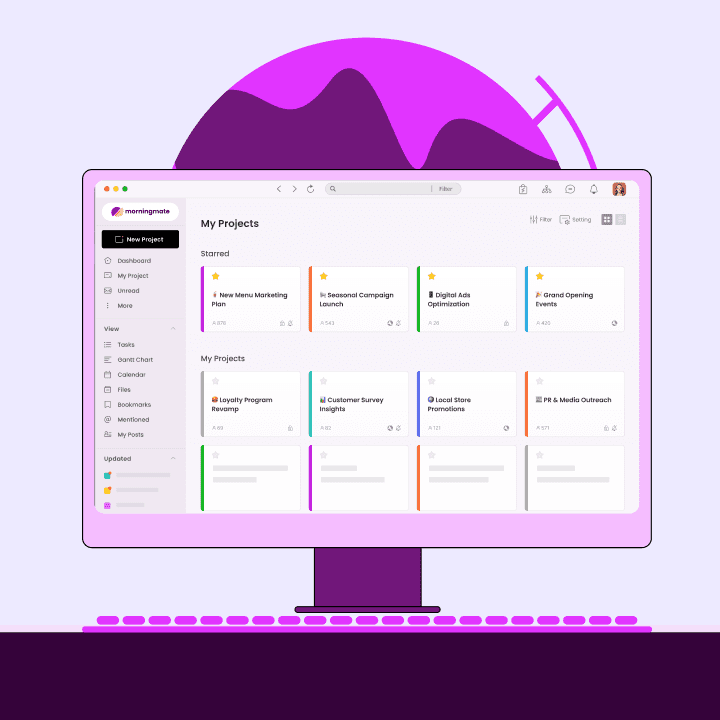
This is where tools like Morningmate come in. Morningmate is a lightweight work management platform designed for teams who need structure without complexity. Its Feed view — styled like a social media timeline — makes it easy for anyone on the team to post updates, share files, and assign tasks without a learning curve. For teams still running work through WhatsApp threads or email chains, it's a direct upgrade that doesn't require any technical expertise to adopt.
Scheduling Apps vs. Work Management: Where the Confusion Starts
Part of the reason these tools get confused is that many scheduling apps have started adding light task features, and many work management tools have added calendar views. That overlap creates real confusion when teams are trying to decide what to use.
But surface-level feature overlap doesn't mean functional equivalence. A calendar app with a task list is not a work management system. And a work management tool with a calendar view doesn't replace a dedicated scheduling tool for complex meeting coordination. Knowing the primary purpose of each tool is what keeps your stack lean and effective.
The Real Cost of Using the Wrong Tool
When teams rely on scheduling apps to manage work — or use work management tools to coordinate time — things break down fast. Here's what that looks like in practice:
Tasks get buried in meeting notes with no clear owner
Follow-ups happen over email or personal messengers, disconnected from the original context
Managers don't have visibility into what's actually getting done between meetings
Remote or hybrid team members fall out of sync because updates live in too many places
Harvard Business Review has noted that collaboration tool overload is a growing issue — teams that use more tools than necessary often communicate less effectively, not more. The goal isn't more tools. It's the right tools doing the right jobs.
How to Decide What Your Team Needs
Before adding any new tool to your stack, run through these questions honestly. The answers will tell you whether you need a scheduling app, a work management platform, or both — and how they should connect.
Questions to Ask Before Choosing a Tool
Where does work get lost? If it's in meeting follow-ups with no clear owner, you need work management. If it's in booking conflicts and time zone chaos, you need better scheduling.
Where do your team's conversations happen? If they're on WhatsApp, iMessage, or personal email, that's a red flag. Work conversations should live where the work lives.
Who needs visibility? Managers and executives who need to see project status across teams need a work management layer — calendars don't surface that information.
How technical is your team? If you manage a field team, a retail operation, or any non-tech workforce, the tool needs to be immediately intuitive. Complexity kills adoption.
What does your current tool stack already cover? Audit what you have before adding something new. Overlap creates confusion and extra cost.
Building a Stack That Works Together
The strongest setups use scheduling apps and work management platforms in complementary ways — each doing its specific job, with clear handoffs between them. Here's a simple framework that works well for most teams in the 10–100 person range.
A Practical Two-Layer Approach
Layer 1 — Scheduling: Use a dedicated scheduling tool (Google Calendar, Calendly, or similar) to handle meeting coordination, availability, and reminders. Keep this layer focused on time, nothing else.
Layer 2 — Work Management: Use a platform like Morningmate to manage tasks, projects, team communication, and files. Morningmate's built-in chat — which works like a familiar messaging app — means your team can discuss tasks and share updates in the same place where the work is tracked. That alone eliminates a major source of scattered information.
The key rule: decisions and action items from meetings should always move into your work management system within 24 hours. If a task only lives in a calendar event description, it's already at risk of being forgotten.
Integration Points to Watch For
Good tools connect cleanly. When evaluating a work management platform, check whether it integrates with the scheduling tools your team already uses. Native integrations between calendar apps and task platforms reduce friction and make it easier for teams to stay in sync without switching contexts constantly.
Also worth noting: Gallup's State of the Global Workplace report consistently highlights that employees who feel their work is well-organized and clearly communicated report significantly higher engagement. Tool choice is not just an operational decision — it affects how your team feels about their work every day.
Signs You've Outgrown Your Current Setup
Teams often stay with inadequate tools longer than they should because switching feels like a big lift. But there are clear signals that your current setup is holding you back.
You regularly send follow-up messages asking for status updates
Important decisions from meetings get lost or forgotten
New team members take weeks to understand how work gets communicated
You're managing work across three or more different apps with no clear hierarchy
Remote team members frequently feel out of the loop
If more than two of those sound familiar, it's time to look seriously at how your team manages work — not just schedules it. A lightweight work management tool is often the missing piece, especially for teams that haven't made the move away from email and personal messengers yet.
Morningmate was built specifically for this transition. It's used by over 550,000 teams globally — many of them non-technical operations teams, field crews, and growing businesses that needed structure without having to hire a project management specialist just to set things up. If your team is ready to stop losing work between apps, it's worth a look.
The right question isn't "scheduling app or work management tool?" It's "are we using each one for what it was actually built to do?" Get that right, and a lot of the daily friction your team experiences will start to disappear on its own.