Project Management

Task management is hard enough when your team shares an office — but when everyone is remote, even a plan that everyone agrees on can fall apart before the first deadline. You hold the kickoff call, everyone nods, someone drops a summary in the group chat, and then... nothing moves. Sound familiar? The problem is rarely motivation or talent. It is almost always a structural gap between agreement and execution.
Remote teams are particularly vulnerable to this gap because they rely heavily on asynchronous communication. Without the hallway check-in or the over-the-shoulder nudge, tasks drift. Ownership blurs. Updates get buried in long chat threads. And by the time a manager realizes something has stalled, valuable time has already been lost. Effective task management is what separates teams that consistently deliver from those that constantly scramble.
This article breaks down exactly why follow-through breaks down on remote teams — and what you can do to fix it, without adding complicated new processes or tools that your team will abandon after a week.
The Real Reason Task Management Breaks Down Remotely
Most managers assume the problem is accountability — that people just are not taking ownership. But research tells a different story. According to Harvard Business Review, one of the most common failure points in distributed teams is not lack of effort but lack of clarity — specifically around who owns what after the initial conversation ends.
When you are in a room together, context fills in the gaps. Someone hesitates, you notice. A task sits untouched, a colleague picks it up. Remotely, those invisible signals disappear. Task tracking becomes entirely dependent on explicit communication, and most teams are simply not set up to do that consistently.
There are a few specific breakdowns that happen most often:
Verbal agreement without written assignment: The meeting ends, but tasks were never formally assigned with a due date and owner.
Updates scattered across tools: Conversations happen in WhatsApp, email, Slack, and video calls — with no single thread pulling it all together.
No visibility between check-ins: Managers cannot see progress in real time and only find out tasks are blocked when they ask directly.
Async miscommunication: A message sent at 3 PM gets read at 9 AM the next day — without context, it leads to re-work or missed steps.
The result is that task coordination becomes reactive rather than proactive. Everyone agrees on the plan — but the plan lives in someone's head instead of in a shared, visible system.
Breakdown Point | What It Looks Like | Why It Happens Remotely |
|---|---|---|
No clear ownership | Tasks assigned to "the team" | No one is watching in real time |
Scattered updates | Status buried across 3–5 apps | No single source of truth |
Missed deadlines | Due dates slip without warning | No automated reminders or visibility |
Blocked tasks unnoticed | Someone is stuck but does not escalate | No easy way to flag blockers visibly |
How Big Is the Follow-Through Problem? The Numbers Are Telling
This is not a niche issue. Gallup's workplace research consistently shows that employees who lack clear role clarity and task visibility are significantly less engaged — and less productive. In remote settings, that clarity gap widens considerably because managers have fewer natural touchpoints to course-correct.
A 2026 report from the Project Management Institute found that organizations waste a significant portion of every dollar spent on projects due to poor task workflow and inadequate communication. For remote teams, that figure is even higher. The cost is not just financial — it erodes trust between team members and between managers and their reports.
Root Causes of Remote Task Follow-Through Failure
67%
Unclear ownership
58%
Scattered updates
44%
No async structure
Fig 1: Top reported causes of follow-through failure on remote teams (illustrative, based on industry patterns)
The Async Trap: When Good Communication Still Fails Task Tracking
Many remote teams believe they have solved the communication problem by using tools like Slack or WhatsApp. But communication volume is not the same as task coordination. Sending a message is not the same as assigning a task. And a chat thread is not a task tracker.
The core issue is that personal messaging apps were designed for conversations, not for work coordination. When you use them for task management, critical information gets lost in scroll. Someone might say "can you handle the client report by Friday?" in a chat — but without a formal task assignment, there is no due date, no status, and no way to track whether it happened.
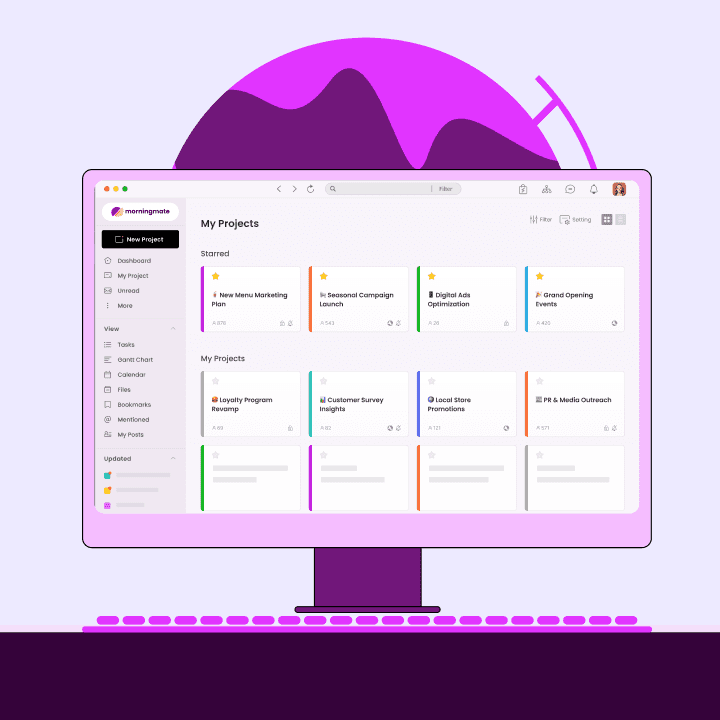
This is exactly the problem Morningmate was built to solve. It is a lightweight work management tool that combines task tracking with built-in chat — so conversations stay connected to the work they are about. Instead of switching between WhatsApp, email, and a separate project tool, your team works inside one organized space. The interface feels as familiar as a messaging app, but it behaves like a proper task workflow system.
The key is not eliminating async communication — it is structuring it so that task coordination does not fall through the cracks between messages.
Five Practical Fixes for Remote Task Management
The good news is that most remote follow-through failures are fixable with relatively small process changes. You do not need to overhaul your entire way of working. You need to close a few specific gaps in your task workflow.
1. Convert Every Agreement Into a Written Task
This sounds obvious, but most teams skip it. Every time a decision is made in a meeting or a chat, it should be converted into an explicit task with three things: an owner, a due date, and a description of what "done" looks like. Verbal agreements evaporate. Written task assignments do not.
2. Build a Single Source of Truth for Task Tracking
Your team cannot follow through on tasks they cannot see. Pick one place where all tasks live — not email, not a chat thread, not someone's personal to-do list. This is what makes choosing the right task management tool so important. When everyone can see what is assigned, what is in progress, and what is blocked, the team self-corrects faster without needing a manager to chase updates.
3. Use Status Updates That Do Not Require a Meeting
Async status updates should be a daily habit, not a weekly event. Short written updates — even a one-line note on a task card — keep everyone aligned without adding more calls to the calendar. Morningmate's Feed view makes this feel natural: it looks like a social media timeline, so team members can post quick updates on tasks and projects in a way that is easy to share and easy to scan.
4. Make Blockers Visible Immediately
On remote teams, blockers often stay hidden too long because people do not want to interrupt a colleague across time zones. Create a norm — and a system — where flagging a blocker is easy and expected. A simple status tag like "blocked" on a task card is enough to surface the issue without requiring a live conversation.
5. Review Task Workflow Weekly, Not Just at Milestones
A quick weekly review of your team's task board — not a full meeting, just a shared scan — catches drift early. If a task has not moved in three days and its deadline is in two, you know before it becomes a problem. This rhythm of consistent task tracking is what separates high-performing remote teams from those that are always firefighting.
Choosing the Right Task Management Approach for Your Team
Not all teams need the same approach. A five-person startup has different task coordination needs than a 100-person distributed company. The right solution depends on your team size, your existing tools, and how structured your work actually needs to be.
One mistake many teams make is reaching for the most feature-rich project management tool available — only to find that the complexity itself becomes a barrier. Asana's Anatomy of Work report has consistently highlighted that tool overload is a real productivity drain. If your team needs three training sessions just to use a task tracker, they will not use it consistently.
That is why the best task management systems for remote teams are ones that are adopted quickly and used daily — not ones that are technically powerful but practically ignored. The simpler the tool, the more likely your team will actually log in and update their tasks.
Team Profile | Common Task Coordination Challenge | Best Practice Fix |
|---|---|---|
Small remote team (5–20) | Everyone using personal messaging apps | Centralize tasks in one shared workspace |
Mid-size hybrid team (20–100) | In-office staff have more visibility than remote | Equal async task tracking for all members |
Growing company (100+) | Cross-team work invisible to leadership | Company-wide task management dashboard |
Non-tech teams | Overly complex tools abandoned quickly | Simple, familiar interface with low learning curve |
What Better Task Management Actually Looks Like in Practice
Teams that nail their task workflow share a few common behaviors. Tasks are created at the moment of agreement — not later, not "when someone has time." Ownership is specific: one person per task, not a whole team. Deadlines are visible to everyone, not just the assigned person. And progress is updated regularly, without needing a manager to ask.
Over 550,000 teams use Morningmate to build exactly this kind of structure. The tool's task management features let you assign work, set due dates, attach files, and comment directly on a task — keeping all the context in one place. Because it also includes built-in chat that mirrors a familiar messaging interface, teams do not have to choose between staying organized and staying connected. You can set up a remote team workflow that genuinely sticks.
The difference is measurable. Teams that shift from email and personal messenger apps to a structured task management system report fewer missed deadlines, less time spent chasing updates, and more confidence that the plan will actually be executed.
Team Follow-Through Rate Before vs. After Structured Task Tracking
41%
Email + Chat only
63%
Basic task tool
87%
Integrated task + chat
Fig 2: Estimated task follow-through rates by communication setup (illustrative, based on industry benchmarks)
Fix Your Task Management Before the Next Plan Falls Apart
Remote teams do not fail at follow-through because people are disengaged or incompetent. They fail because the systems between agreement and execution are broken. Task management — real task management, not just a shared to-do list — is the infrastructure that turns plans into results.
The fix is not complex. Write tasks down the moment they are agreed upon. Give every task one owner. Keep all task tracking visible in a single place. Build async update habits so progress is never invisible. And choose a tool your team will actually use — one that feels familiar rather than intimidating.
When your task workflow is clear, remote teams execute just as well as co-located ones — sometimes better, because the structure forces the kind of explicit communication that prevents misunderstandings before they happen. Start with one project, one team, and one week of disciplined task coordination. The difference will be immediate.