Project Management

If your team members stay quiet in meetings, avoid sharing ideas, or never push back on decisions — that silence is not harmony. It is a warning sign. What you are likely missing is psychological safety at work, and without it, even the most talented teams underperform.
Psychological safety is the shared belief that it is safe to speak up, take risks, and be honest without fear of embarrassment, punishment, or rejection. It sounds simple. But building it — and sustaining it — requires deliberate effort from every manager and leader in your organization.
This guide breaks down what psychological safety at work actually means, why it matters more than ever in 2026, and what you can do to build it across your team — remote, hybrid, or in-person.
What Is Psychological Safety at Work?
The term was popularized by Harvard Business School professor Amy Edmondson, who defines it as "a belief that one will not be punished or humiliated for speaking up with ideas, questions, concerns, or mistakes." Her landmark research on team effectiveness showed that psychological safety is the single strongest predictor of high-performing teams — more than individual talent, experience, or skill level.
In practical terms, psychological safety at work means your team members feel comfortable doing things like:
Admitting they made a mistake without fearing blame
Asking a "basic" question without worrying about looking incompetent
Challenging a decision made by someone more senior
Sharing a half-formed idea before it is fully polished
Raising a concern about a project direction or team dynamic
It does not mean there is no accountability, no performance expectations, or no conflict. High psychological safety teams still disagree — they just disagree openly and productively.
Why Psychological Safety Matters More Than Ever
In 2026, the conversation around psychological safety has moved well beyond a HR buzzword. Gallup research consistently links employee engagement to safety and trust at the team level, with disengaged teams costing organizations measurably in productivity, turnover, and quality of output.
Three trends are making this even more urgent right now:
Remote and hybrid work has weakened informal trust signals. When people do not share physical space, the small daily moments that build rapport — a hallway chat, a shared lunch — disappear. Trust has to be built more deliberately.
AI adoption is creating fear and ambiguity. Teams are navigating significant changes to how work gets done. Employees who do not feel safe raising concerns about these changes stay silent, which leads to poor adoption and hidden friction.
Younger workers are leaving teams where they feel unheard. Retaining talent increasingly depends on culture, not just compensation. Teams that lack psychological safety see higher voluntary turnover, especially among high performers who have options.
The Four Stages of Psychological Safety
Researcher Timothy Clark developed a widely used framework called the 4 Stages of Psychological Safety, which describes how safety develops progressively within a team or organization.
Stage 1: Inclusion Safety
This is the baseline. Team members feel accepted and valued as part of the group. They do not feel excluded based on background, role, or identity. Without inclusion safety, everything else collapses.
Stage 2: Learner Safety
At this stage, people feel safe to ask questions, experiment, and make mistakes. Learning requires vulnerability, and vulnerability requires trust. If your team is afraid to admit what they do not know, their growth stalls — and so does yours.
Stage 3: Contributor Safety
Here, team members feel safe to contribute their ideas and do meaningful work. They believe their input is valued and that they have real autonomy. This is where innovation starts to emerge.
Stage 4: Challenger Safety
The highest level. Team members feel safe enough to challenge the status quo — to question decisions, flag bad ideas, and push back on leadership without fear of retaliation. This is rare, and it is where truly high-performing teams operate.
As a manager, your goal is to move your team progressively through these stages. Most teams stall at Stage 2 or 3 and never reach the level of candor that drives real innovation.
Signs Your Team Lacks Psychological Safety
Before you can fix the problem, you need to recognize it. Here are common warning signs that psychological safety at work is low on your team:
Meetings where only one or two voices dominate and everyone else is quiet
People agree in meetings but complain privately afterward
Mistakes get hidden until they become bigger problems
Nobody challenges decisions — even obviously bad ones
New team members stay silent for weeks and never fully integrate
Questions are answered with impatience or condescension
There is a noticeable gap between what people say in one-on-ones versus group settings
If several of these sound familiar, you are not alone. According to McKinsey research on psychological safety and leadership, a significant proportion of employees report that they do not feel comfortable speaking up at work — and that the primary barrier is their direct manager's behavior, not company-wide policy.
How to Build Psychological Safety on Your Team
The good news is that psychological safety is buildable. It requires consistent behavior from leaders, the right systems, and a culture that rewards honesty. Here is where to start.
1. Model Vulnerability as a Leader
The tone comes from the top. If you want your team to admit mistakes and ask questions, you need to do it first. Share something you got wrong recently. Ask for feedback on a decision you made. Say "I am not sure — what do you think?" in group settings. These small moments of openness give your team permission to do the same.
2. Respond Constructively to Bad News
The fastest way to destroy psychological safety is to react badly when someone brings you a problem. If a team member admits a mistake and gets punished, embarrassed, or ignored — every other person on the team is watching. They will draw their own conclusions about whether honesty is safe.
Practice separating the person from the problem. When something goes wrong, lead with curiosity: "Walk me through what happened" rather than "Why did you do that?" The goal is to understand, not assign blame.
3. Create Structured Opportunities to Speak Up
Not everyone feels comfortable raising their hand in a large meeting. If you only create one channel for input — the open group discussion — you will only ever hear from the most extroverted or senior voices. Instead, build multiple touchpoints:
Regular one-on-one check-ins where quieter team members can share concerns privately
Anonymous feedback channels for sensitive topics
A standing agenda item in team meetings for "concerns or blockers"
Written updates that allow async input before a live discussion
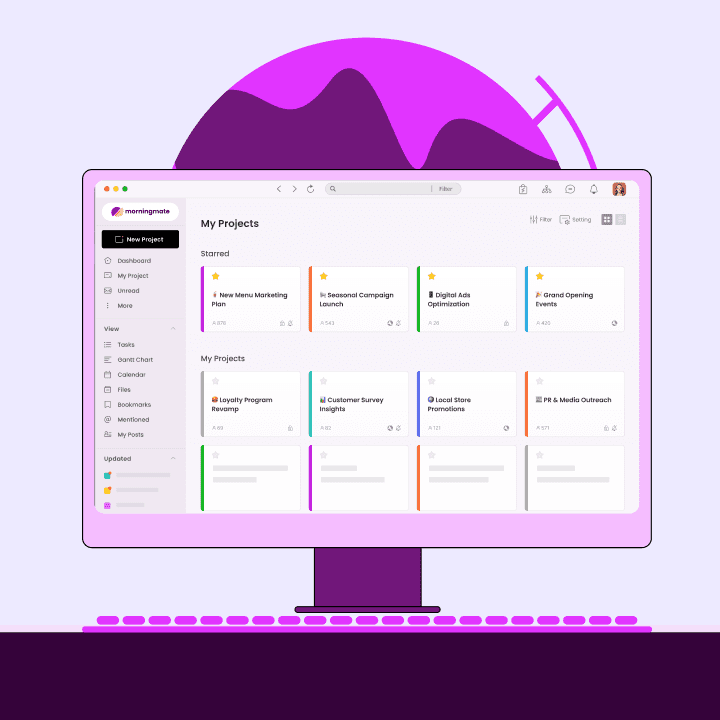
This last point is where your team's collaboration tools make a real difference. Morningmate, a lightweight work management tool used by over 550,000 teams, has a Feed view that works like a social media timeline — team members can post updates, ask questions, or flag issues in a low-pressure, familiar format. Because it looks and feels like something people already use in their personal lives, even non-tech team members contribute more readily than they would in a formal email chain.
4. Make Work Visible and Fair
Psychological safety erodes when people feel like decisions are made behind closed doors, credit is distributed unfairly, or certain voices are always prioritized. Transparency is a foundation for trust. When your team can see what projects are in progress, who is responsible, and how decisions are being made, they are more likely to feel included and respected.
Morningmate's task management features let managers assign tasks, set priorities, and track progress in one shared workspace — so everyone has visibility into what is happening across the team, without needing to chase updates through emails or personal messenger apps.
5. Address Behavior That Undermines Safety Directly
If someone on your team regularly interrupts others, dismisses ideas publicly, or responds to questions with sarcasm — you have to address it. Tolerating that behavior sends a message to your whole team about what is actually acceptable. Private, direct feedback to the individual is far more effective than ignoring it and hoping it stops.
Psychological Safety in Remote and Hybrid Teams
Building psychological safety is already challenging face-to-face. In remote or hybrid environments, it requires even more intentional effort, because the informal cues that build trust — body language, shared physical presence, spontaneous conversations — are reduced or absent entirely.
A few practices that work well for remote team communication and safety:
Start meetings with a brief personal check-in. Even two minutes of non-work conversation helps team members feel like humans first.
Use async-first communication thoughtfully. Encourage team members to share ideas in writing before live discussions so no one is put on the spot unprepared.
Create explicit norms around response times and availability. Ambiguity around expectations creates anxiety. Clarity creates safety.
Acknowledge contributions publicly. In remote settings, recognition is easy to skip. Make it a habit to call out good work in a shared space.
Morningmate's built-in chat works like a familiar messaging app — similar to WhatsApp — so remote team members can have casual, human conversations alongside structured work updates. That combination of informal connection and organized work in one place helps distributed teams maintain the kind of ongoing communication that builds trust over time. It also replaces the fragmented mess of personal messenger apps that many teams still rely on for work conversations.
Measuring Psychological Safety on Your Team
You cannot improve what you do not measure. Here are a few practical ways to gauge where your team currently stands:
Run a short anonymous survey. Ask three to five questions like "I feel comfortable sharing concerns with my manager" or "I feel safe to take risks on this team." Use a simple rating scale and track it over time.
Observe meeting dynamics. Count who speaks and who stays silent. Note whether disagreement is expressed or suppressed. What you observe in meetings tells you a lot about what your team actually feels.
Track whether problems surface early or late. If issues are consistently discovered at crisis point rather than early on, that is a safety problem. People knew — they just did not feel safe saying so.
Ask directly in one-on-ones. "Is there anything you have been holding back from sharing with the team or with me?" That question alone, asked sincerely, can open important conversations.
A Quick Checklist for Managers
Use this as a starting point to evaluate your own behavior and team culture:
Do you admit mistakes openly in front of your team?
Do you respond to bad news with curiosity rather than blame?
Do you actively invite input from quieter team members?
Do you follow up when someone raises a concern — even if you cannot fix it immediately?
Do you give credit clearly and publicly?
Do you address behavior that shuts others down?
Have you made it easy for people to share updates, ask questions, and flag issues without everything requiring a formal meeting?
That last point matters more than it might seem. When work communication happens in scattered email threads and WhatsApp groups, people self-censor because they are not sure where to post, who will see it, or how it will be received. Giving your team a single, organized workspace — where posting an update or flagging a concern is as easy as posting on social media — removes a practical barrier to speaking up. Morningmate was built around exactly that idea: making it easier for teams to communicate openly without the friction of complex project management tools.
Psychological Safety Is a Leadership Responsibility
It is tempting to think about psychological safety as something your HR team handles, or something that fixes itself with the right culture statement. It does not. Research and practice both point to the same conclusion: the primary driver of psychological safety on any given team is the direct manager's behavior, day in and day out.
That means how you respond in your next team meeting matters. How you react when someone brings you a problem today will shape whether anyone brings you a problem next month. The small, repeated moments of openness, fairness, and curiosity you demonstrate are what build — or erode — your team's sense of safety.
Psychological safety at work is not a soft initiative. It is the infrastructure on which everything else — performance, innovation, retention, and honest communication — is built. Start with your own behavior, create the right systems, and give your team the tools and space to speak up. The results will follow.