Project Management

Managing employee performance is one of the trickiest balancing acts in leadership. Push too hard and you become the boss everyone dreads. Pull back too much and work slips through the cracks. The sweet spot — giving your team room to do their best work while still staying informed — is something most managers actively struggle to find.
The good news is that managing performance without micromanaging is absolutely a learnable skill. It comes down to building the right systems, setting clear expectations, and creating visibility into work without hovering over every detail. When you get this right, your team moves faster, stays more motivated, and actually delivers better results.
Whether you're leading a fully remote team, managing a hybrid setup, or trying to get off email threads once and for all, this guide breaks down practical ways to track performance, give meaningful feedback, and build accountability — without becoming the manager no one wants to work for.
Why Micromanagement Backfires (Even When You Mean Well)
Most managers who micromanage aren't doing it out of malice — they're doing it out of anxiety. They worry about missed deadlines, unclear ownership, or being blindsided by problems. That anxiety is understandable. But the response of checking in constantly, asking for updates every few hours, or rewriting work your team has already done creates a different set of problems.
Research from Harvard Business Review consistently shows that employees who feel micromanaged report lower engagement, less creative output, and higher intention to leave. When people don't feel trusted to do their jobs, they stop bringing initiative to work — they just wait to be told what to do next.
The goal isn't to stop caring about performance. It's to shift from control-based oversight to systems-based oversight — where you know what's happening because your team has good habits and the right tools, not because you're watching every move.
Start With Clarity: Define What Good Performance Actually Looks Like
A lot of performance problems aren't really performance problems — they're expectation problems. When team members don't know what "done" looks like, or how their work connects to bigger goals, they fill in the gaps themselves. Sometimes they fill them in wrong.
Set Outcome-Based Goals, Not Activity-Based Ones
Instead of measuring how many hours someone works or how many emails they send, focus on outcomes. What does a successful week, month, or quarter actually look like for this person in their role? Define it clearly, and make sure they understand it too.
A useful framework here is OKRs (Objectives and Key Results) — setting a clear objective and then attaching 2–3 measurable results that tell you whether you got there. Even if you don't use formal OKRs, the principle holds: tie performance to output, not effort.
Document Expectations Where Everyone Can See Them
Verbal agreements get forgotten. Expectations buried in email chains never get revisited. The fix is simple: write expectations down somewhere central and accessible.
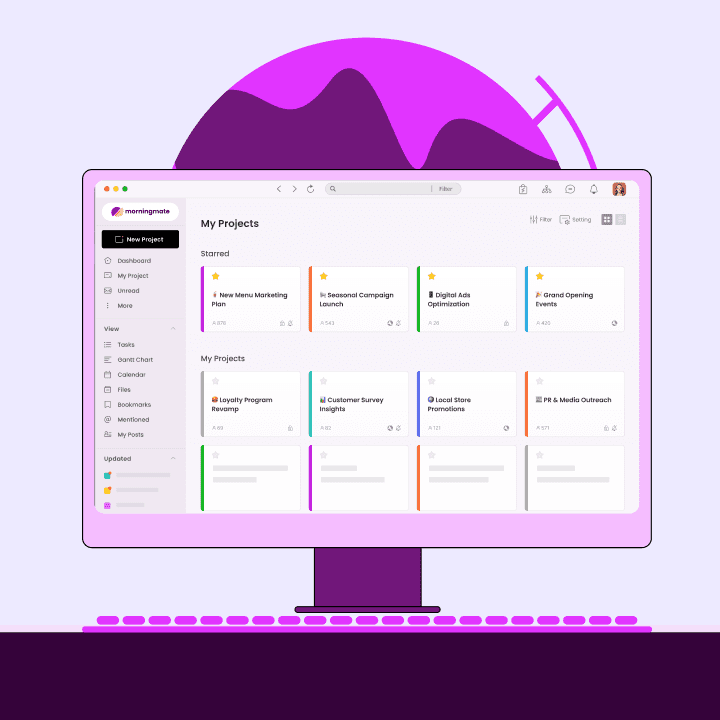
This is where tools like Morningmate come in handy. Morningmate is a lightweight work management tool that combines task management, team chat, and file sharing in one place. You can create a task or post for each team member with their goals and responsibilities, so nothing lives only in someone's inbox. When expectations are visible and documented, you don't need to chase — you can just check in on the task.
Build a Rhythm of Check-Ins That Don't Feel Like Surveillance
Regular one-on-ones and team check-ins are one of the most effective tools for managing performance without hovering. The key word is "regular" — predictable touchpoints replace the need for constant ad-hoc interruptions.
Weekly One-on-Ones
A short weekly one-on-one — even 20–30 minutes — gives you a structured window to hear about blockers, celebrate progress, and course-correct before small issues become big ones. This format works best when it's a two-way conversation, not a status report to the manager.
Come prepared with a few questions: What did you make progress on this week? What's blocking you? What do you need from me? These questions shift the dynamic from reporting to problem-solving.
Async Updates for Distributed Teams
If your team is remote or spread across time zones, live check-ins aren't always possible. Async updates are a practical alternative — a brief end-of-day or end-of-week note that covers what was done, what's next, and any blockers.
Gallup research on remote work highlights that one of the top challenges for distributed teams is feeling disconnected from team progress and priorities. A simple async update habit solves this without requiring anyone to join a call. Morningmate's feed-style interface — which works a lot like a social media feed — makes these updates easy to post and easy to scan, so managers stay informed and team members don't feel like they're filing reports.
Create Visibility Without Creating Overhead
One of the biggest reasons managers micromanage is that they genuinely can't see what's happening. When work lives in inboxes, WhatsApp threads, and scattered documents, the only way to get visibility is to ask — which starts to feel like surveillance pretty fast.
The solution isn't more check-ins. It's better systems for surfacing work naturally.
Use a Shared Task Board
A shared task board lets you see the status of work at a glance — without having to ask anyone. You can see what's in progress, what's stuck, and what's been completed. This is one of the core features Morningmate is built around: every task has an owner, a due date, and a status, so work is always visible to the people who need to see it.
This kind of setup is especially valuable for operations leads or business owners managing multiple teams. Instead of pinging five people for updates on Friday afternoon, you open the board and the picture is already there.
Centralize Communication Around Work
When chat and task management are separated, context gets lost. Decisions made in Slack or WhatsApp don't make it back to the task. Comments on a task don't reach the person who needs to act on them. Keeping communication tied to the actual work — not in a separate app — solves this.
Morningmate's built-in chat is designed to work alongside tasks, not separately from them. Conversations stay connected to the work they're about, which means less chasing, less context-switching, and fewer moments where you feel like you need to intervene just to understand what's happening.
Give Feedback That Actually Changes Behavior
Performance management without micromanaging still requires honest, timely feedback. The difference is in how and when you give it.
Make Feedback Specific and Timely
Vague feedback — "great work" or "this could be better" — doesn't help anyone improve. Specific feedback tied to observable behavior does. "The way you structured that client proposal made the next steps very clear — that made a real difference" is something a person can repeat. "Nice job on that proposal" is not.
Timing matters too. Feedback given weeks after the fact lands differently than feedback given close to the event. Build the habit of sharing feedback in the moment — or at your next one-on-one — rather than saving it for a formal review.
Separate Performance Conversations From Compensation Conversations
McKinsey research on performance management has found that mixing feedback conversations with compensation discussions often shuts down the learning. When someone is worried about whether their pay is changing, they're not really absorbing the developmental feedback. Keep these two conversations separate — feedback throughout the year, compensation as its own dedicated discussion.
Build a Culture of Accountability (Not Blame)
Accountability and micromanagement are not the same thing. Accountability means people own their commitments and follow through. Micromanagement means you don't trust them to do it without supervision. You can have the first without the second.
Make Ownership Explicit
Every task or project should have a single named owner — someone who is responsible for seeing it through to completion. When ownership is shared or unclear, accountability evaporates. "We were all responsible" is the same as "nobody was responsible."
This is a small structural habit with a big impact. When you assign work, assign it to a person — not a group. Make the deadline visible. And make it easy for that person to flag blockers early rather than silently struggling until the deadline arrives.
Treat Missed Deadlines as Data, Not Offenses
When something slips, the first question shouldn't be "why didn't you finish this?" It should be "what got in the way?" The answer tells you something useful — whether it's a resourcing problem, an unclear requirement, a personal blocker, or a pattern worth addressing over time.
Teams where missed deadlines trigger blame quickly become teams where people hide problems until it's too late. Teams where missed deadlines trigger honest conversations become teams that get better at delivering. The difference starts with how you respond as a manager.
A Quick Checklist: Are You Managing or Micromanaging?
If you're not sure where you fall on the spectrum, here's a simple self-check. Honest answers only.
Do you ask for status updates more than once a day on the same task?
Do you rewrite or redo work your team has submitted without explaining why?
Do you find it hard to delegate because you worry the work won't be done right?
Do your team members come to you for permission on decisions they should own?
Do you find out about problems after they've already grown — because people didn't feel safe telling you earlier?
If you said yes to more than two of these, there's likely a trust or systems gap worth addressing — not a performance gap on your team's side.
The Manager's Role Is to Remove Obstacles, Not Add Them
The best managers see their job as clearing the path, not walking it for their team. That means giving clear direction upfront, making sure work is visible and organized, and showing up with helpful feedback instead of constant oversight.
If you're still managing work through email threads and group chats, a lot of the chaos you're trying to control is actually being created by the tools — or lack of them. Switching to a centralized work management tool like Morningmate can reduce the need to chase updates because work is already organized and visible. Less chasing means less micromanaging — and more time doing the parts of your job that actually require your judgment.
Managing employee performance without micromanaging isn't about letting things slide. It's about building systems smart enough that you don't have to be the system. When your team has clear goals, visible work, and a safe space to raise problems early, performance takes care of itself more often than you'd expect.