Project Management

Running a law firm means juggling dozens of active matters at once — client deadlines, court filings, billing cycles, internal reviews, and a constant stream of emails that somehow never seem to slow down. Without a structured system holding everything together, things slip. Deadlines get missed. Clients feel neglected. And your team spends more time searching for information than actually doing legal work.
That is exactly why more firms are turning to law firm project management software. Not because they want to overcomplicate their operations, but because they need a single, organized place where work is tracked, communication is centralized, and nothing falls through the cracks. The shift is already well underway — and the firms that adopt the right tools early are gaining a real competitive edge.
Whether you manage a boutique practice with ten attorneys or a mid-sized firm scaling across multiple offices, choosing the right project management approach can transform how your team works. This guide breaks down what to look for, how to evaluate your options, and which features actually matter in a legal environment.
Why Law Firms Need Dedicated Project Management
Legal work is inherently project-based. Every client matter has a defined scope, a set of tasks, responsible parties, and a deadline. Yet many firms still rely on email chains, sticky notes, and shared drives that nobody organizes consistently. The result is predictable: wasted time, duplicated effort, and the occasional catastrophic oversight.
According to McKinsey's research on legal operations, legal professionals spend a significant portion of their day on administrative coordination rather than high-value legal work. Project management software directly addresses this drain by automating routine tracking and making task ownership explicit.
The firms pulling ahead right now are the ones treating matter management the same way a product team treats a product launch — with clear owners, visible progress, and structured handoffs. That mindset shift, backed by the right tool, is what separates reactive firms from proactive ones.
What to Look for in Law Firm Project Management Software
Not all project management tools are built with legal teams in mind. A tool designed for software developers or marketing agencies might technically work, but it will create more friction than it solves. Here are the features that matter most for law firms specifically.
Matter and Task Organization
Each client matter should have its own workspace where tasks, documents, and conversations live together. This keeps context intact and makes it easy for any team member to pick up where someone left off. Look for tools that let you create task lists, assign owners, set due dates, and track status at a glance.
Subtasks are particularly important in legal work, where a single deliverable — say, a contract review — might have five or six sequential steps that different people handle. Your software should make that hierarchy visible without requiring a project management degree to set up.
Centralized Communication
Email is one of the biggest productivity killers in law firms. Important updates get buried, replies go to the wrong thread, and junior associates have to dig through a hundred messages to find a single attachment. A platform with built-in team communication eliminates that chaos.
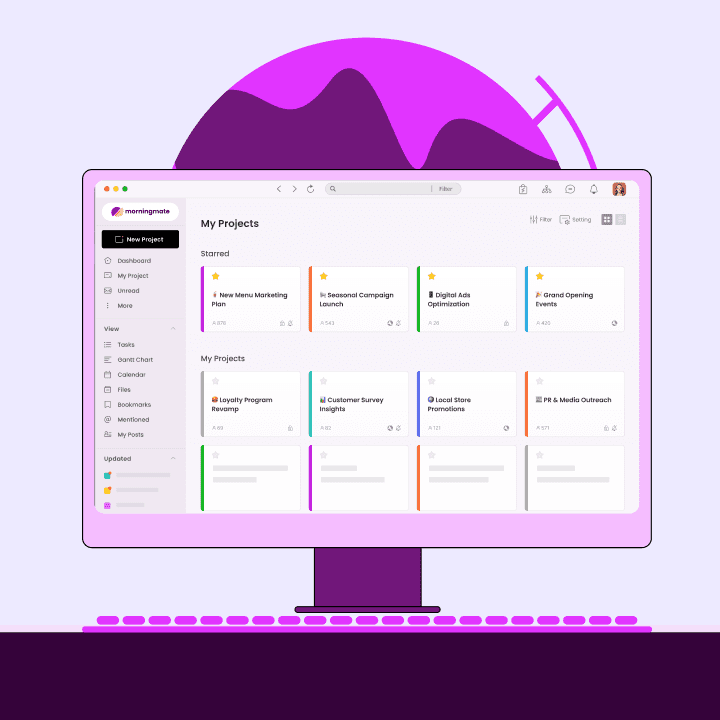
This is one area where Morningmate stands out among collaboration tools. It combines task management with a built-in chat that feels familiar — similar to WhatsApp in its interface — so your team can communicate directly within the context of their work. No switching between five different apps just to ask a quick question about a filing deadline.
Document and File Management
Law firms generate enormous volumes of documents. Contracts, briefs, correspondence, research memos — all of it needs to be findable, versioned, and accessible to the right people at the right time. Your project management software should support file uploads and organization at the task or matter level, not just in a generic shared folder.
When files live alongside the tasks they relate to, your team stops asking "where is that document?" and starts spending that time on actual legal analysis.
Visibility for Leadership
Managing partners and operations leads need to see across the entire firm — which matters are active, what is at risk of missing a deadline, and where capacity is stretched thin. The best law firm project management software gives leadership a real-time view without requiring everyone to manually update a spreadsheet.
Tools like Morningmate — a lightweight work management platform used by over 550,000 teams globally — offer a feed-style view that surfaces activity across all ongoing projects. It is the kind of visibility that lets a managing partner stay informed without micromanaging every matter.
Common Challenges Law Firms Face Without Project Management Tools
If your firm has not yet adopted dedicated project management software, you are likely experiencing at least a few of these pain points regularly.
Missed deadlines: Without a shared system tracking due dates, reminders live in individual calendars — and handoffs between team members often drop critical context.
Duplicated work: When two attorneys work on the same document without knowing it, or when research is done twice because nobody could find the original memo.
Client communication gaps: Updates fall through because there is no clear owner for keeping the client informed at each stage.
Onboarding friction: New staff have no structured way to understand ongoing matters, so they spend weeks piecing together context from scattered emails.
No audit trail: When something goes wrong, reconstructing who decided what and when becomes a painful forensic exercise.
Each of these problems has a direct cost — in billable hours lost, in client satisfaction, and in staff morale. A good project management tool does not just organize work; it removes the cognitive load that comes from trying to hold everything together manually.
How to Set Up Project Management for a Law Firm: A Practical Framework
Choosing the right software is only half the battle. Implementation matters just as much. Here is a step-by-step approach that works for firms of most sizes.
Step 1 — Map Your Matter Types
Start by identifying the two or three most common types of matters your firm handles — corporate transactions, litigation, real estate closings, or whatever fits your practice area. For each matter type, list the standard tasks, milestones, and handoffs involved. This becomes your template.
Having reusable templates means you are not rebuilding the same task structure from scratch for every new client. It also ensures consistency across your team, regardless of who opens the matter.
Step 2 — Assign Clear Ownership
Every task in your system needs a single owner. Not "the litigation team" — a specific person. This is the most important cultural shift that comes with adopting project management software, and it is worth enforcing firmly at the start. Shared ownership is no ownership.
Step 3 — Replace Email with In-Tool Communication
The fastest way to kill adoption is to keep using email for everything while also trying to use a new tool. Commit to moving matter-related conversations into your project management platform. This is where a tool with built-in messaging — like Morningmate's chat feature, which keeps conversations linked to specific tasks and projects — makes adoption significantly easier. The interface already feels familiar, so the learning curve is low even for non-technical staff.
Step 4 — Run a Pilot with One Practice Group
Do not roll out a new system to the entire firm at once. Pick one practice group, ideally one with a team leader who is enthusiastic about the change, and run the new process for 30 to 60 days. Gather feedback, fix friction points, then expand. This approach reduces resistance and gives you proof of concept to show skeptics.
Step 5 — Review and Optimize Monthly
Project management is not a set-and-forget system. Schedule a monthly review — even a 20-minute team check-in — to ask whether the current setup is actually helping. Are tasks being completed on time? Are templates being used consistently? Is communication happening inside the tool or drifting back to email? Adjust based on what you find.
Evaluating Law Firm Project Management Software: Key Questions to Ask
When you are comparing options, it helps to have a consistent set of criteria. Use these questions to evaluate any tool you are considering.
Is the interface simple enough that non-tech-savvy staff will actually use it? Complexity kills adoption. If paralegals and administrative staff find the tool confusing, the whole system breaks down.
Can we organize work by client matter, not just by department? Matter-centric organization is essential for legal work.
Does it include built-in communication, or does it require integration with another messaging tool? Fewer apps means less switching and less lost context.
How does it handle file management? Documents should be attached to the relevant task or matter, not dumped into a general folder.
What does the leadership view look like? Managing partners need a dashboard that shows firm-wide status without requiring them to dig into each individual matter.
What is the pricing structure? Some tools charge per user per month in ways that become expensive quickly as firms grow. Understand the total cost before committing.
Is there a free trial or low-commitment entry point? You should be able to test the tool with a real matter before buying.
The Trend Toward Simpler, More Integrated Tools
One of the clearest trends in legal operations right now is the move away from complex, enterprise-level software toward simpler, more integrated tools that people actually want to use. Forbes has noted that law firms are increasingly prioritizing usability and adoption rates over feature volume when selecting technology — because a powerful tool nobody uses is worse than a simple tool everyone embraces.
This is where smaller, more focused platforms have an advantage over legacy legal software. Tools that combine task management, communication, and file sharing in one clean interface — without requiring weeks of training — are winning over legal teams that previously relied on email and shared drives alone.
The American Bar Association's annual technology survey consistently shows that adoption of cloud-based collaboration tools in law firms continues to rise year over year, with smaller firms catching up rapidly to their larger counterparts. The direction is clear — the question is how quickly your firm moves.
Making the Right Choice for Your Firm
There is no single piece of law firm project management software that works perfectly for every practice. A ten-person immigration firm has different needs than a 60-person corporate boutique. What matters is finding a tool that your team will actually use consistently — one that is simple enough to adopt without a six-month implementation project, but robust enough to handle real legal work.
If your firm is currently managing work through a mix of email, WhatsApp groups, and spreadsheets, even a lightweight upgrade can produce dramatic results. Platforms like Morningmate are designed precisely for this transition — replacing the scattered communication of personal messenger apps with a structured, organized workspace that feels intuitive from day one. You can learn more about how teams use it for centralized team communication and structured task management.
Start with one matter type. Get your team aligned on one tool. Build the habit before expanding the scope. That is how successful implementations happen — not with a big-bang rollout, but with small, consistent steps that add up to a fundamentally better way of working.