Project Management

Most teams don't realize how bloated their tool stack has become until someone asks a simple question — "Wait, which app are we supposed to use for this?" If your team is toggling between five different platforms just to finish a single project, that's not productivity. That's digital clutter wearing a productivity costume.
A productivity tool audit is exactly what it sounds like: a structured review of every tool your team currently uses, why you're using it, and whether it's actually helping or quietly draining time, money, and focus. It's one of the highest-leverage things a manager or business owner can do — and most people put it off until the situation becomes painful.
This guide walks you through how to run a proper audit, what to look for, and how to make smarter decisions about the tools your team lives in every day.
Why Tool Sprawl Is a Real Problem
The average knowledge worker switches between apps dozens of times a day. According to research highlighted by Harvard Business Review, constant task-switching and app-toggling costs employees significant focus time — time that compounds across your entire team every single week.
Tool sprawl usually doesn't happen on purpose. A team adopts Slack for chat. Then someone adds Trello for tasks. Then a project manager brings in Asana. Then leadership wants updates in spreadsheets. Before long, nobody knows where the source of truth lives, and important information is scattered across half a dozen platforms.
The cost isn't just confusion. Redundant SaaS subscriptions add up fast, and NPI has found that organizations waste a significant portion of their software spend on underused or duplicated tools. A productivity tool audit is how you stop that leak.
Step-by-Step: How to Run a Productivity Tool Audit
Running an audit doesn't require a consultant or a week-long offsite. You can do this in a focused afternoon with the right structure. Here's how.
Step 1 — Take a Complete Inventory
Before you can evaluate anything, you need a full list of every tool your team uses — paid or free, official or unofficial. Include the apps people are using on their own, even if IT didn't approve them. Shadow tools are often where the most duplication hides.
Create a simple spreadsheet with these columns:
Tool name
Primary purpose (communication, task management, file storage, etc.)
Who uses it and how often
Monthly or annual cost
Owner or admin responsible for it
Don't filter yet — just capture everything. You'll be surprised how long the list gets.
Step 2 — Categorize by Function
Once you have the full inventory, group tools by what they're supposed to do. Common categories include communication, project and task management, file sharing, video calls, and reporting. This step often reveals obvious overlap — like having three tools that all technically handle team messaging.
Flag any category where you have more than one tool doing essentially the same job. That's your first sign of inefficiency. Also flag any tool that doesn't fit cleanly into a category — those are often legacy tools nobody has thought to question.
Step 3 — Evaluate Each Tool Against Clear Criteria
Now comes the honest part. For each tool, ask your team to rate it against the following questions:
Adoption: Is the whole team actually using this, or just a few people?
Clarity: Does everyone know what this tool is for and when to use it?
Overlap: Does another tool on your list do this job too?
Value: If you removed this tomorrow, would it hurt your workflow?
Cost vs. use: Is what you're paying proportional to how much value you get?
Gather input directly from the people using these tools daily, not just from managers. Front-line team members will tell you things that never make it into leadership conversations.
Step 4 — Identify the Gaps
A good productivity tool audit isn't only about cutting — it's also about spotting what's missing. Are people falling back on WhatsApp or personal email because there's no good place for quick team communication at work? Are tasks getting lost because there's no central place to track them?
This is where teams often realize they have too many specialized tools and no single hub. They have a chat app, a task app, a file app, and a meeting app — all disconnected. The gap is integration and simplicity, not more software.
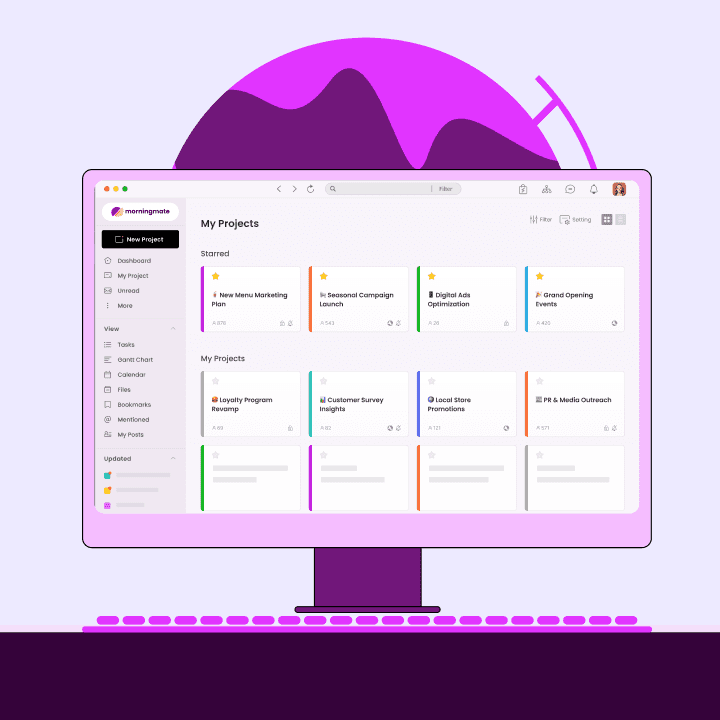
For many teams, a tool like Morningmate — a lightweight work management platform that combines task management, team chat, and file sharing in one place — becomes a natural answer to that gap. When everything lives in one organized workspace, you stop losing context every time you switch apps.
Step 5 — Make the Cut and Consolidate
With your evaluation done, you're ready to make decisions. Sort your tools into three buckets:
Keep: High adoption, clear purpose, no significant overlap
Replace or consolidate: Overlapping function, low adoption, or there's a better single tool that covers multiple needs
Cut: Low usage, no clear owner, and nobody would miss it
Be honest in this step. It's easy to keep a tool "just in case." But a tool that nobody uses is still costing you — in subscription fees, in onboarding new team members to it, and in cognitive overhead.
What to Look for When Choosing Replacement Tools
If your audit reveals that you need to replace or consolidate tools, resist the urge to just pick the most popular option. The best tool for your team is the one your team will actually use — consistently and correctly.
McKinsey research on workplace collaboration has shown that how well teams use their tools matters far more than which tools they choose. Adoption and consistency beat feature richness every time.
When evaluating replacement tools, prioritize these factors:
Ease of adoption: Can someone on a non-technical team figure it out without a training session?
Consolidation potential: Does it replace multiple tools, or add another layer?
Visibility: Can managers and team leads see work progress without chasing updates?
Communication built in: Does it keep conversations close to the work, or send people to yet another app?
Morningmate was built with exactly these criteria in mind. Its Feed view — designed to look and feel like a social media timeline — makes it intuitive from day one, even for teams who've never used a work management tool before. The built-in chat mirrors the interface of familiar messaging apps, so there's almost no learning curve. Teams across retail, logistics, construction, and other non-tech industries use it because it doesn't require a tech background to get value from it.
Getting Your Team on Board With Changes
The audit is the easy part. Getting people to actually change their habits is where most tool transitions fail. If you've ever tried to move a team off email or WhatsApp, you know how sticky those habits are.
Here's what actually works:
Explain the Why, Not Just the What
People resist change when they don't understand the reason behind it. Share what your audit found — the duplication, the cost, the confusion — and frame the change as a solution to a problem your team already feels. When people recognize the pain themselves, buy-in comes naturally.
Start With a Pilot Team
Rather than rolling out a new tool to everyone at once, start with one team or department. Let them work out the rough edges, develop norms, and become internal champions. A peer recommending a tool is far more persuasive than a top-down mandate.
Set Clear Protocols
One of the biggest reasons tool adoption fails is that teams never establish clear rules for how to use the new tool. Which types of updates go where? What's the expected response time for chat messages versus task comments? Without answers to these questions, people default back to old habits.
Take time to write down a simple communication protocol for your team. It doesn't need to be long — even a one-page document that answers "what goes where" is enough to prevent a lot of confusion.
How Often Should You Run a Tool Audit?
A productivity tool audit isn't a one-time event. Your team's needs change, new tools get added, and old ones quietly become obsolete. Building a regular audit into your operations calendar keeps things from getting out of hand again.
A good rhythm for most teams:
Quarterly: A light check — review any tools added in the past 90 days and confirm they're actually being used
Annually: A full audit using the steps above — evaluate every tool, review costs, and assess whether your stack still fits how your team works
At key milestones: Whenever your team grows significantly, restructures, or shifts to a new working model (hybrid, remote, in-person)
Morningmate's task management features make it easy to assign the audit itself as a recurring task, set deadlines, and track who's responsible for each part — so the review doesn't just get added to someone's mental to-do list and forgotten.
A Quick Audit Checklist to Get You Started
Use this checklist the next time you sit down for a productivity tool audit. It's not exhaustive, but it covers the essentials:
List every tool your team uses, including unofficial ones
Assign a primary function to each tool
Identify categories with more than one tool
Check adoption rates — who's actually using each tool?
Calculate the total monthly and annual cost of your stack
Ask front-line team members what's working and what isn't
Identify any workflow gaps not covered by existing tools
Create a keep / replace / cut list
Choose replacements based on adoption ease and consolidation potential
Write a simple protocol for any new tools before rollout
Schedule the next audit before you close this one
Running a thorough productivity tool audit is one of the clearest ways to reclaim focus, reduce spend, and give your team a working environment that actually makes sense. The goal isn't to have the fewest tools — it's to have the right tools, used the right way, by everyone. That's what makes a team genuinely productive, not just busy.