Project Management

Starting a new job is nerve-wracking enough when you can walk into an office, shake hands, and grab coffee with your new teammates. Do it remotely, and the stakes get even higher. Without the casual hallway conversations and spontaneous introductions, new hires can feel isolated within their first week — and that feeling sticks. How you onboard new employees remotely shapes not just their first impression, but their long-term engagement and retention.
The numbers back this up. According to Gallup, only 12% of employees strongly agree that their company does a great job onboarding new employees. That gap between expectation and reality is even wider in remote settings, where there is no physical environment to fill in the blanks. A structured, intentional remote onboarding process is not a nice-to-have — it is a business necessity.
This guide walks you through exactly how to onboard new employees remotely in a way that is organized, human, and actually works — even if your team is spread across time zones.
Why Remote Onboarding Fails (And What to Do Instead)
Most remote onboarding fails for one of three reasons: information is scattered across too many tools, there is no clear owner for the process, or new hires are left to figure things out on their own after the first day. The result is a new employee who feels confused and undervalued before they have even had a chance to contribute.
Harvard Business Review found that employees who go through a structured onboarding program are 58% more likely to still be with the company after three years. Structure does not mean rigid — it means predictable, clear, and supportive. Your new hire should always know what to expect next.
The Most Common Remote Onboarding Mistakes
Before building your process, it helps to know what to avoid. These are the patterns that consistently derail remote onboarding:
Sending a flood of documents on day one with no context or order
Relying on email threads to deliver onboarding information (things get buried fast)
Scheduling back-to-back video calls that leave no room for self-paced learning
Forgetting to introduce the new hire to people outside their immediate team
Treating onboarding as a one-week event rather than a 30-to-90-day journey
Before Day One: Lay the Groundwork
The remote onboarding experience actually starts before your new hire logs in for the first time. Pre-boarding — the period between offer acceptance and the first day — is where you set the tone. Use this window to remove friction, not add to it.
Send a Pre-Boarding Welcome Package
A welcome message from their direct manager, a simple first-week schedule, and login credentials sent in advance go a long way. Do not make your new hire show up on day one and spend three hours trying to access tools. Get all the technical setup sorted before they arrive.
You can also share a short "about the team" document — nothing formal, just names, roles, and a fun fact or two. It gives the new employee something to reference when they start meeting people and removes the anxiety of not knowing who is who.
Set Up Their Digital Workspace
One of the biggest pain points in remote onboarding is the chaos of scattered information. Teams often rely on email chains, WhatsApp groups, and random shared folders to communicate — none of which are built for onboarding. This is where a dedicated work management tool makes a real difference.
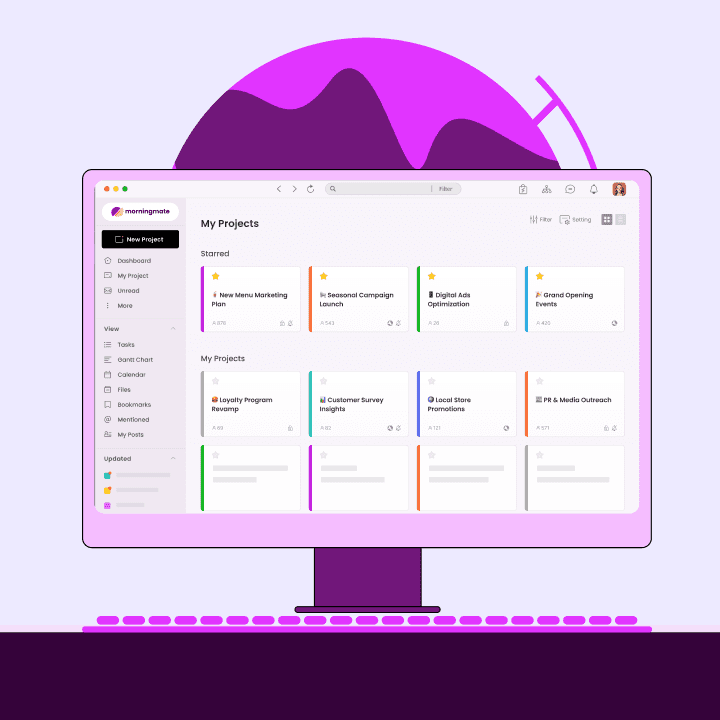
Morningmate, a lightweight team collaboration tool used by over 550,000 teams worldwide, lets you create a dedicated onboarding space where all tasks, documents, announcements, and conversations live in one place. Instead of forwarding emails or adding someone to five different group chats, you simply add the new hire to the relevant workspace and everything they need is already there.
The First Week: Structure Without Overload
Day one is not about productivity. It is about belonging. Your goal in the first week is to help the new employee understand the culture, meet key people, and get a clear picture of what success looks like in their role.
A Simple First-Week Framework
Rather than overwhelming your new hire with information, spread it out intentionally across the week:
Day 1 — Welcome and orientation: Introductions, tool walkthrough, and a relaxed video call with the direct manager. Keep it light. Ask about them, not just their role.
Day 2 — Team culture and context: Share the company's mission, values, and how the team operates day-to-day. Walk through communication norms — when to use chat vs. email, how decisions get made.
Day 3 — Role deep-dive: Go over responsibilities, current projects, and short-term goals. Assign a small, low-stakes task so they can get a feel for the workflow.
Day 4 — Cross-team introductions: Set up 15-minute virtual coffee chats with two or three people from other teams or departments.
Day 5 — Reflection and Q&A: Check in informally. What questions do they have? What felt unclear? Adjust the plan for week two based on their feedback.
Assign a Dedicated Buddy
One of the most effective things you can do for a remote new hire is pair them with an onboarding buddy — someone who is not their manager and whose job is simply to be approachable. The buddy answers the questions new hires feel embarrassed to ask their boss: where to find things, how things actually work, what the team culture is really like.
Microsoft's research on onboarding buddies found that new hires with a buddy were 23% more satisfied with their onboarding experience and reached productivity milestones faster. It is a low-effort, high-impact practice that most remote teams overlook.
The First 30–90 Days: Building Momentum
Onboarding does not end after week one. The real integration happens over the first 30 to 90 days, and this is where most companies drop the ball. Once the formal onboarding ends, many new employees are left to sink or swim without consistent check-ins or clear milestones.
Use a 30-60-90 Day Plan
A 30-60-90 day plan gives your new hire a clear roadmap and gives you a framework for measuring progress without micromanaging. Here is how to think about each phase:
First 30 days: Learn. Focus on understanding the team, the tools, and the workflows. No pressure to deliver big results yet.
Days 31–60: Contribute. Take ownership of a small project or recurring responsibility. Start making decisions within a defined scope.
Days 61–90: Drive. Propose improvements, take initiative, and operate with greater autonomy. Begin setting goals for the next quarter.
Document this plan somewhere visible and accessible to both the manager and the new hire. If your team uses work management software, build the 30-60-90 plan directly into the task system so milestones are trackable and nothing gets forgotten.
Keep Communication Consistent and Transparent
Remote employees rely on consistent communication to feel informed and included. Without the ambient awareness of an office — seeing what colleagues are working on, overhearing team updates — they can quickly feel out of the loop.
Morningmate's Feed view is particularly helpful here. It works similarly to a social media feed, showing team updates, task progress, and announcements in one scrollable stream. New hires can catch up on what the team has been working on without needing to ask — reducing that anxious feeling of not knowing what is happening around them. It is the kind of passive visibility that an office provides naturally, replicated in a remote setting.
Building Connection Across a Remote Team
Task completion and tool access are only half of what makes remote onboarding successful. The other half is human connection. New employees who feel like they belong are more engaged, more productive, and far less likely to leave within the first six months.
Make Space for Informal Interaction
In an office, informal connection happens automatically. Remotely, you have to design it. Schedule optional virtual team lunches or coffee chats. Create a non-work channel in your team's messaging tool where people share what they are watching, reading, or cooking. Small moments of levity build the kind of team culture that makes people want to stay.
If your team communicates through a mix of WhatsApp groups, email, and separate project tools, things get fragmented fast — especially for someone brand new. Morningmate's built-in chat, which has a familiar interface similar to WhatsApp, keeps all team conversations in the same platform as your work. New hires do not have to juggle multiple apps just to say good morning and submit a task update.
Celebrate Early Wins Publicly
Recognition matters — especially early. When a new hire completes their first project or gets positive feedback from a client, call it out in a team channel. It signals that their contributions are seen and valued, which builds confidence and belonging faster than almost anything else.
A Remote Onboarding Checklist You Can Use Right Away
Here is a quick reference checklist to help you structure your remote onboarding process from start to finish:
Before Day One
Send a welcome email with the first-week schedule and logistics
Provide tool access and login credentials in advance
Share a "meet the team" document
Assign an onboarding buddy
Set up their workspace in your team collaboration tool
Week One
Hold a relaxed welcome call with the direct manager
Walk through tools, communication norms, and workflows
Introduce to key team members and cross-functional partners
Assign a small first task with clear instructions
Schedule an end-of-week check-in to gather feedback
First 90 Days
Share a documented 30-60-90 day plan
Hold weekly one-on-ones with the direct manager
Conduct a 30-day and 60-day informal review
Celebrate early wins and contributions publicly
Gather structured feedback on the onboarding experience at the 90-day mark
The Real Measure of Successful Remote Onboarding
You will know your remote onboarding is working when new hires stop asking "who do I talk to about this?" and start saying "I know exactly what to do." That confidence does not come from a single great first day — it comes from a consistent, well-designed experience across the first three months.
If your team is still managing onboarding through email chains and scattered messages, it is worth looking at how a tool like Morningmate can centralize the process. With tasks, chat, and team updates all in one place, you can give every new hire the organized, welcoming experience they deserve — without adding complexity for your existing team. You can explore more on building better remote team communication habits to complement your onboarding process.
Remote onboarding done well is one of the highest-leverage investments you can make in your team. Get it right, and you are not just helping someone start a job — you are setting them up to do their best work.