Project Management

There's a moment every growing team hits — usually somewhere between 15 and 40 people — where things that used to happen naturally start to break down. Decisions take longer. New hires feel like outsiders. Inside jokes stop landing because half the team wasn't there when they started. What used to feel like a tight crew starts to feel like a company, and not always in a good way.
Managing a growing team without losing culture isn't about preserving some nostalgic version of how things used to be. It's about being intentional — building systems, habits, and rituals that carry your values forward even as your headcount doubles. The teams that do this well don't leave it to chance. They treat culture the same way they treat operations: with real structure and real accountability.
The good news is that you don't need a massive HR department or a culture consultant to make this work. You need clarity, consistency, and the right tools to keep everyone connected to what actually matters.
Why Culture Breaks Down as Teams Grow
Culture doesn't erode because people stop caring. It erodes because informal systems stop scaling. When your team was five people, culture was transmitted through proximity — you shared an office, a lunch table, a Slack channel. Everyone absorbed values by osmosis.
Once you cross a certain size, that osmosis stops working. New people join faster than they can absorb unwritten norms. Managers start making decisions in isolation. And without a shared system for how work gets communicated and coordinated, subcultures form — sometimes at odds with each other.
Research published in Harvard Business Review found that culture is one of the most powerful levers for organizational performance — but also one of the most fragile during periods of rapid growth. The companies that maintain strong cultures through scaling are the ones that make culture explicit, not implicit.
Define What Your Culture Actually Is
You can't protect something you haven't defined. Before you can manage a growing team without losing culture, you need to get specific about what your culture actually looks like in practice — not just in a mission statement.
Move Beyond Values Posters
Most companies list values like "transparency" or "ownership" on their website. But values only become culture when they're tied to behaviors — specific, observable things people do or don't do at work.
Try this exercise with your leadership team: for each value you claim to hold, write down three behaviors that demonstrate it and three behaviors that violate it. This turns abstract ideals into something new hires can actually learn and existing team members can model.
Document Your Norms
Every team has unwritten rules. How quickly do you respond to messages? What does a good meeting look like? How do people share feedback? When you're small, these get learned through observation. When you're growing, they need to be written down.
Create a lightweight "how we work" document — sometimes called a team charter or operating manual — and make it part of your onboarding. It doesn't need to be long. It just needs to be real and honest about how your team actually operates.
Build Systems That Carry Culture Forward
Culture lives in your day-to-day systems more than in your annual retreats. The way your team communicates, coordinates work, and shares information is culture made visible. If those systems are chaotic, your culture will feel chaotic — regardless of what your values doc says.
Centralize Communication Without Losing the Human Touch
One of the fastest ways culture breaks down in growing teams is when communication fragments across too many channels — emails, WhatsApp groups, three different project tools, and a shared drive no one fully trusts. People stop seeing the same information, and the team stops feeling like a team.
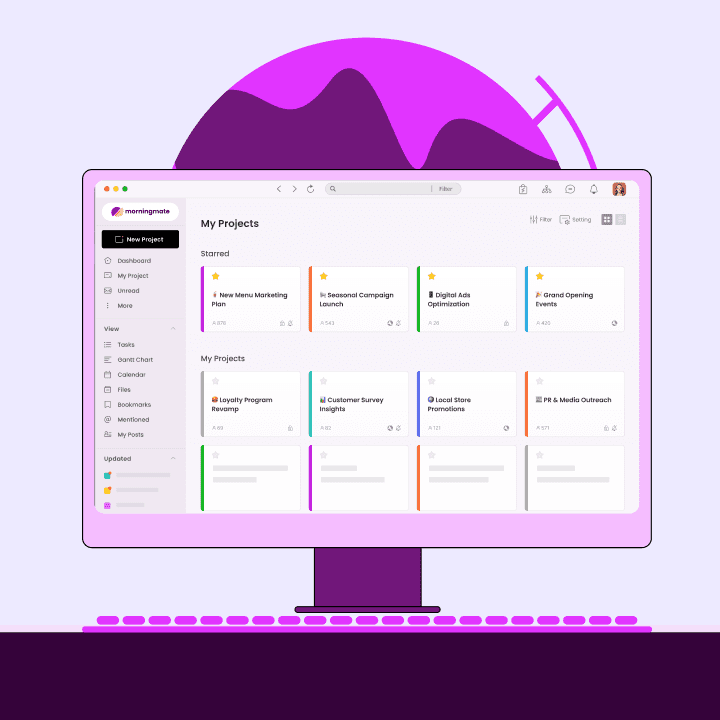
This is where a tool like Morningmate helps. It's a lightweight work management platform that brings task coordination and team communication into one place — replacing the scattered mess of email threads and personal messenger apps. Its Feed view works like a social timeline, so updates feel natural and visible to everyone, not buried in a inbox. Teams that consolidate communication this way tend to maintain better shared awareness — and shared awareness is foundational to shared culture.
Create Rituals That Scale
Rituals are the heartbeat of culture. They don't have to be elaborate — a weekly async update, a Friday wins post, a monthly all-hands where leadership actually listens. What matters is that they're consistent and that they reinforce the behaviors you care about.
As you grow, audit your existing rituals. Ask: does this still work at our current size? Can a new hire on their second week participate meaningfully? Some rituals need to evolve. Others need to be replaced with something that achieves the same purpose at a larger scale.
Make Work Visible Across the Team
One underrated contributor to culture is visibility — people knowing what their colleagues are working on and feeling like their own work is seen. When work happens in silos, people feel isolated, and the team stops functioning like a unit.
Morningmate's task management and Feed features give teams a shared view of ongoing work — not just a project manager's dashboard, but something every team member can check. For operations leads or managers overseeing multiple workstreams, this kind of transparency reduces the need for status meetings and keeps everyone oriented to the same priorities. See how this connects to building strong async communication habits on your team.
Hire and Onboard With Culture in Mind
Every new hire either reinforces or dilutes your culture. That's not a reason to hire people who are exactly like your existing team — diversity of background and perspective strengthens teams. But it is a reason to be intentional about what you're looking for beyond skills.
Culture-Conscious Hiring
Gallup research consistently shows that employees who feel connected to their organization's mission and culture are significantly more engaged and more likely to stay. That connection starts at the hiring stage — with how you describe your culture honestly, and how you probe for genuine alignment during interviews.
Stop asking "are you a team player?" Start asking questions that reveal how a candidate actually behaves: "Tell me about a time you disagreed with a decision and what you did." or "How do you prefer to communicate with your team when you're stuck?" Their answers tell you far more than rehearsed culture-fit responses.
Onboarding as a Culture Transfer
The first 30 days are when culture either gets transmitted or gets missed. A strong onboarding program does more than explain the product and introduce the tools — it immerses new hires in how the team thinks and communicates.
Pair every new hire with a cultural buddy (separate from their direct manager). Share your "how we work" document on day one. Use your team's actual communication channels — not a separate onboarding portal — so new hires see real work happening in real time from the start.
Keep Leadership Visible and Accountable
As companies grow, leaders often become less visible — more meetings, more strategy, less time on the floor. This is one of the most damaging things that can happen to a team's culture, because culture flows from the top whether you intend it to or not.
McKinsey research on organizational culture points to leadership behavior as the single biggest driver of whether cultural values actually take hold across an organization. It's not what leaders say — it's what they do, how they communicate, and what they visibly prioritize.
Leaders in growing teams need to show up in the same spaces their teams use. If your team shares weekly updates in a common feed, leadership should too. If your team uses a shared task board, leadership's work should be visible there as well. Morningmate's Feed, for example, makes it easy for managers and executives to post updates, share context, and stay visible without requiring additional meetings — which matters a lot when your team is spread across time zones or working hybrid schedules.
Measure Culture Before It Slips
You can't manage what you don't measure — and that applies to culture just as much as revenue. The challenge is that culture is harder to quantify. But that doesn't mean you should fly blind.
Regular Pulse Checks
Run short, anonymous surveys every quarter — not the 50-question annual engagement survey, but a focused 5–8 question pulse check. Ask about belonging, clarity of priorities, quality of communication, and whether people feel their work is valued. Track the trends over time, and act visibly on the results.
Watch the Behavioral Signals
Some of the most telling culture signals aren't in surveys — they're in behavior. Are people participating in team rituals or quietly opting out? Are new hires asking questions or staying silent? Is feedback flowing in both directions, or only top-down? Build a habit of noticing these things, not just at review time but consistently.
For operations leads and team managers, visibility into how teams collaborate day-to-day is part of this. Tools like Morningmate that centralize work and communication in one place give you a natural window into team health — without needing to schedule a check-in for every question. Explore how this connects to improving team visibility and accountability as your organization scales.
A Quick Checklist for Managing a Growing Team Without Losing Culture
Use this as a starting point for an honest audit of where your team stands right now:
Your values are tied to specific, observable behaviors — not just abstract words
You have a "how we work" document that new hires receive on day one
Team communication is centralized in one tool — not scattered across email, WhatsApp, and five other apps
You have at least 2–3 consistent team rituals that work at your current size
New hires are paired with a cultural buddy during onboarding
Leadership is visible in the same channels and tools the rest of the team uses
You run regular pulse surveys and share results with the team
Work is visible across teams — not siloed in individual inboxes
Managing a growing team without losing culture is hard — not because it requires any single dramatic intervention, but because it requires consistent small actions across hiring, communication, leadership, and systems. The teams that get it right treat culture as a living thing: something that needs tending, not just declaring. Start with one item on that checklist, get it right, and build from there.