Project Management

Giving feedback to employees is one of the most important — and most mishandled — responsibilities of any manager. When done well, it builds trust, accelerates growth, and keeps your team moving in the right direction. When done poorly, it creates confusion, resentment, and disengagement that quietly erodes performance over time.
The challenge is that most managers were never formally taught how to give feedback effectively. They either avoid hard conversations altogether or deliver feedback in ways that feel more like criticism than guidance. The result? Employees leave the conversation unsure of what to do differently — or worse, feeling demotivated.
If you lead a team — whether in-person, remote, or hybrid — this guide will help you build a feedback approach that actually works. One that your employees can act on, and that strengthens your working relationships rather than straining them.
Why Most Employee Feedback Falls Flat
Before getting into how to give feedback to employees effectively, it helps to understand why most feedback fails. Research published in Harvard Business Review found that feedback focused on pointing out mistakes can actually interfere with learning, because it activates a threat response in the brain that shuts down openness and reflection.
Most feedback also tends to be too vague, too delayed, or too infrequent. Telling someone they "need to communicate better" weeks after a project ends gives them nothing concrete to work with. Effective feedback is specific, timely, and tied to observable behavior — not personality traits.
The Business Case for Getting Feedback Right
This is not just about being a better manager. There is a measurable business impact. Gallup research shows that employees who receive meaningful feedback are nearly four times more likely to be engaged at work. Engaged employees are more productive, stay longer, and contribute more to team performance.
On the flip side, poor feedback — or a total absence of it — is one of the top drivers of voluntary turnover. If your team members do not know how they are doing or where they stand, they will look elsewhere for clarity and recognition.
How to Give Feedback to Employees Effectively: A Practical Framework
There is no single perfect method, but there are principles that consistently lead to better outcomes. The following framework gives you a structure you can adapt to different people, situations, and team cultures.
1. Make Feedback Specific and Behavior-Based
Vague feedback is useless feedback. Instead of saying "your presentations could be better," say "in yesterday's client call, the agenda was not shared beforehand, which meant the first ten minutes were spent getting everyone aligned." The second version is something your employee can actually act on.
Focus on observable actions and their impact — not assumptions about attitude or intent. This keeps the conversation grounded in fact rather than perception, which makes it easier for the employee to receive and apply.
2. Choose the Right Timing
Feedback is most effective when it is delivered close to the event it references. Waiting until a quarterly review to address something that happened in week two means the employee has continued the same behavior for months without guidance.
For positive feedback, share it publicly or promptly — it reinforces the behavior you want to see more of. For corrective feedback, have a private, timely conversation rather than letting issues accumulate. Addressing things in the moment (or close to it) signals that you are paying attention and that you care about your team's development.
3. Use a Clear Structure
Having a structure helps you stay focused and ensures your message lands clearly. One widely used approach is the Situation-Behavior-Impact (SBI) model:
Situation: Describe the specific context. ("During last Thursday's team standup...").
Behavior: State what you observed. ("...you interrupted two colleagues before they finished sharing their updates...").
Impact: Explain the effect it had. ("...which made it harder for the team to feel heard and slowed the meeting down.").
This model removes the emotional charge from feedback by keeping it anchored to facts. It also makes it easier for the employee to understand exactly what needs to change — and why it matters.
4. Make It a Two-Way Conversation
Effective feedback is not a monologue. After sharing your observations, invite the employee to respond. Ask what they were thinking in that moment, or what obstacles they are running into. You might learn context that changes your understanding of the situation.
This also shifts the dynamic from evaluation to collaboration. When employees feel heard during a feedback conversation, they are far more likely to act on what was discussed. Close with a clear next step — something specific and agreed upon by both of you.
5. Separate Feedback from Performance Reviews
One of the most common mistakes managers make is treating annual or quarterly reviews as the primary vehicle for feedback. Reviews are high-stakes events that often trigger anxiety — not the ideal environment for open, growth-oriented conversation.
Feedback should be ongoing, woven into the rhythm of weekly check-ins and day-to-day work. Reviews then become a summary of what has already been discussed — no surprises, no sudden revelations. This approach leads to more honest conversations and better outcomes on both sides.
Creating a Culture Where Feedback Flows Naturally
Individual feedback skills matter, but so does the environment you create around them. If your team culture does not feel psychologically safe — where people fear judgment or repercussion — no feedback framework will save you. McKinsey research on psychological safety consistently shows it is one of the strongest predictors of high-performing teams.
Building that culture starts with modeling the behavior yourself. Ask your team for feedback on your own management. Be transparent about your own mistakes. When you normalize feedback as something that flows in all directions — not just top-down — it stops feeling like a judgment and starts feeling like a resource.
Normalize Feedback in Your Team's Workflow
Feedback should not require a formal meeting or a calendar invite. Some of the most impactful feedback happens in brief, informal moments — a comment on a deliverable, a quick message after a call, a note on a shared document. The goal is to make feedback a natural part of how your team works together, not a special event people dread.
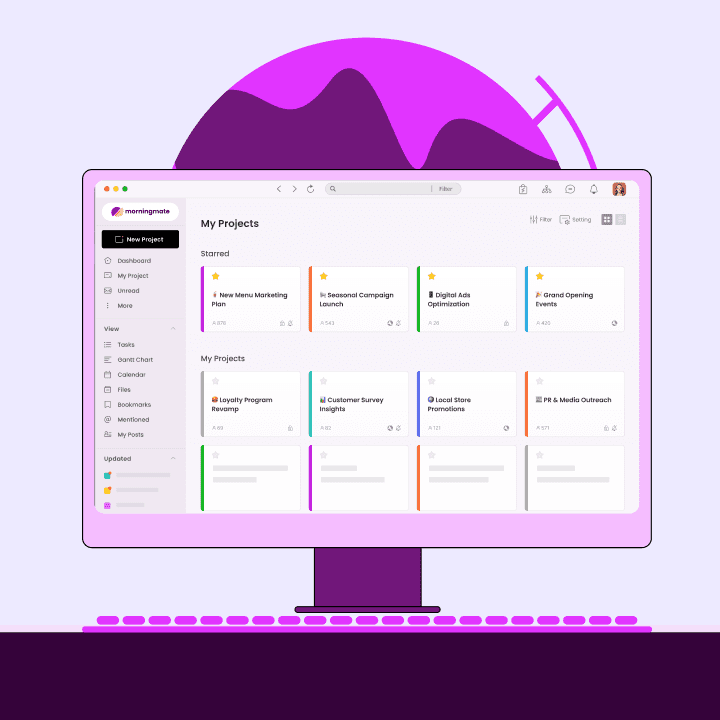
This is where having the right tools helps. Many teams still rely on email or personal messaging apps for work communication, which means feedback and updates get buried in scattered threads with no clear context. Morningmate — a lightweight work management tool used by over 550,000 teams — helps solve this by centralizing communication and task updates in one organized workspace. Its Feed view lets managers leave comments directly on tasks and posts, so feedback is tied to specific work items rather than lost in a chat inbox.
Use One-on-Ones as Your Feedback Engine
Regular one-on-ones are one of the most underutilized tools a manager has. A weekly or biweekly thirty-minute check-in gives you a dedicated space to share observations, ask how someone is feeling about their work, and address small issues before they become big ones.
Come to these meetings with specific notes rather than vague intentions. If you manage a distributed or hybrid team, keeping a running record of feedback topics helps ensure nothing gets forgotten between sessions. Tools like Morningmate make this easier by letting you create ongoing task threads or pinned posts for each team member, so you always have context before walking into the conversation. You can also explore how to run effective one-on-one meetings to make the most of this time.
Common Feedback Mistakes to Avoid
Even well-intentioned managers fall into patterns that undermine the feedback they give. Watch out for these:
The feedback sandwich: Wrapping criticism between two compliments sounds kind, but it dilutes your message and confuses the employee about what actually needs to change.
Saving it all for reviews: Delayed feedback is weak feedback. Address things when they are still relevant and actionable.
Focusing on personality: Saying someone is "too negative" or "not a team player" attacks identity rather than behavior. Stick to what you can observe.
Giving feedback without listening: If you are doing all the talking, you are missing half the information you need.
Inconsistency: Giving detailed feedback to some team members and barely any to others creates inequity and erodes trust.
Adapting Your Feedback Style to Different People
Not everyone receives feedback the same way. Some employees want direct, straightforward delivery. Others need more context and reassurance before they can absorb what you are telling them. Learning how each person on your team processes feedback is part of your job as a manager.
You do not have to guess — just ask. In a one-on-one, try: "How do you prefer to receive feedback? Is there a way that works better for you?" Most employees appreciate the question and will give you useful guidance. Adapting your approach shows respect and makes your feedback land more effectively.
For remote or async teams, this matters even more. Without the benefit of body language and tone, written feedback can easily be misread. If you manage remote employees, consider whether a voice note, a video message, or a quick call might be more effective than a text-based comment for sensitive feedback. Morningmate's built-in chat — which works with an interface similar to what most people already use in personal messaging apps — makes it easy to send quick audio or video messages alongside task updates, keeping feedback human even across time zones. This is especially useful for teams following async communication best practices.
A Quick Checklist: Before You Give Feedback
Use this before any feedback conversation to make sure you are set up for a productive exchange:
Am I clear on exactly what behavior I want to address?
Can I describe the specific situation and its impact?
Am I giving this feedback close enough to the event for it to be useful?
Have I chosen a private setting (for corrective feedback) or a visible one (for positive feedback)?
Am I approaching this as a conversation, not a verdict?
Do I have a clear next step or action in mind to propose?
Have I considered how this particular employee tends to receive feedback?
Running through this list takes less than two minutes, but it can significantly change the quality of the conversation you are about to have.
Turning Feedback Into a Team Strength
The managers who give feedback most effectively are not necessarily the most experienced or the most technically skilled. They are the ones who have made feedback a habit — not a once-a-year obligation. They check in regularly, they tie observations to real work, they listen as much as they speak, and they follow up to see if anything has changed.
When feedback becomes part of how your team operates day to day, it stops being uncomfortable and starts being valuable. Your team members know where they stand, they feel seen, and they have what they need to keep growing. That is when you stop managing performance and start building it. If you are looking for ways to structure your team's day-to-day communication to support this kind of culture, explore team communication tools that support remote and hybrid teams to find the right fit.