Project Management

Running a hotel means managing a dozen moving parts at once — front desk handovers, housekeeping schedules, maintenance requests, food and beverage coordination, and a guest experience that can unravel with a single dropped communication. Hotel operations team management is genuinely one of the most complex challenges in hospitality, not because the work itself is mysterious, but because it involves so many departments, shift rotations, and real-time decisions happening simultaneously.
Most hotel teams are not failing because their staff lacks skill. They are failing because the systems connecting those staff members are broken. Updates get lost in WhatsApp groups. Shift handovers happen verbally and get forgotten. A maintenance issue reported at 9am still hasn't been actioned by 3pm because nobody owns it. Sound familiar?
If you manage a hotel operations team — whether you oversee one property or several — this guide walks through practical strategies to bring structure, visibility, and accountability to your daily workflow without drowning your team in complexity.
Why Hotel Operations Teams Struggle with Coordination
Hotels operate across multiple departments that each have their own rhythms, priorities, and communication habits. Housekeeping thinks in room turnovers. Maintenance thinks in work orders. Front desk thinks in guest timelines. When these departments do not share a single source of operational truth, gaps appear fast.
McKinsey research on operations management consistently shows that cross-functional visibility is one of the most underdeveloped areas in service-sector businesses. Hotels are a prime example — most operational breakdowns are not technical failures, they are communication failures dressed up as process failures.
Three specific pain points show up again and again in hotel operations management:
Shift handover gaps: Critical information does not transfer cleanly between shifts, leaving incoming teams to piece together what happened.
Task ownership ambiguity: When a guest complaint or maintenance request comes in, it is unclear who is responsible for resolving it and by when.
Scattered communication channels: Managers rely on a mix of phone calls, personal WhatsApp messages, printed checklists, and verbal instructions — none of which create a reliable record.
Building a Structured Approach to Hotel Operations Team Management
Structure does not mean bureaucracy. For hotel teams, structure means every person on every shift knows what they are responsible for, who they report issues to, and where to find the information they need. Here is how to build that foundation.
1. Standardize Your Shift Handover Process
The handover between shifts is one of the highest-risk moments in hotel operations. A structured handover template — covering open tasks, guest issues, maintenance flags, and any pending follow-ups — makes sure nothing slips through the cracks when one team clocks out and another clocks in.
Rather than relying on memory or a quick verbal debrief, create a written handover log that lives in a shared digital workspace. This gives the incoming shift a clear, searchable record of exactly where things stand. It also creates accountability — if something was not logged at handover, that is a process gap worth addressing.
2. Assign Clear Task Ownership Across Departments
Every task in a hotel — whether it is a room service request, a broken AC unit, or a VIP arrival setup — needs a named owner and a deadline. Without those two elements, tasks drift. They get done late, done wrong, or not at all.
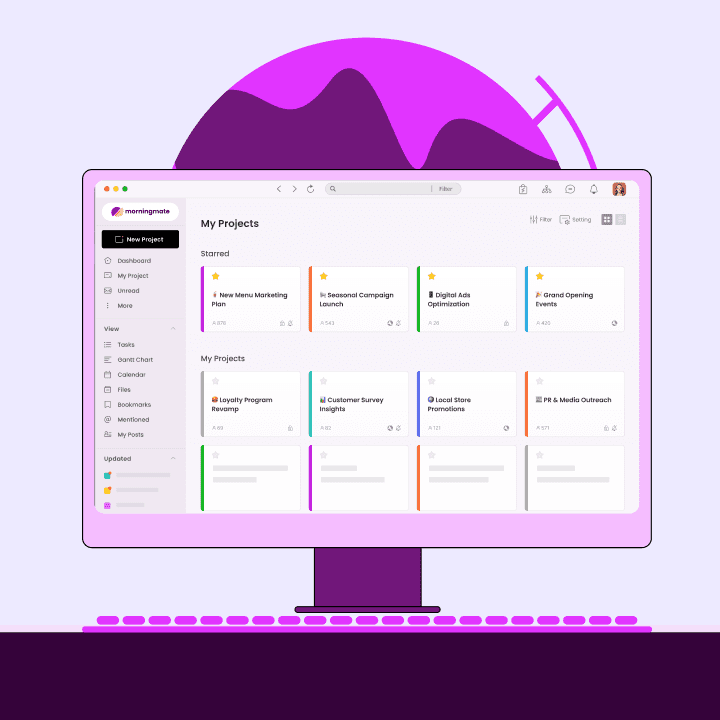
A simple task management system, accessible from any device, lets managers assign work clearly and lets team members update progress in real time. This is where tools like lightweight work management platforms genuinely earn their place in hotel operations. Morningmate, for example, is a work management tool that lets you create tasks, assign them to specific team members, set due dates, and track progress — all in one shared feed that every department can access. Unlike complex project management software built for tech teams, it is simple enough that housekeeping supervisors and front desk leads can actually use it without training sessions.
3. Replace Scattered Messaging with Organized Channels
Personal messaging apps like WhatsApp create chaos in professional settings. Messages get buried, context disappears, and there is no way to search back through decisions or instructions made three days ago. For hotel operations teams, this is especially dangerous during high-occupancy periods when the volume of communication spikes.
Organizing communication by department or topic — housekeeping, maintenance, front desk, F&B — gives every conversation a home. When a manager needs to find out what was discussed about a guest complaint from last Tuesday, they can find it in seconds instead of scrolling through a chaotic group chat.
Morningmate's built-in chat feature works similarly to WhatsApp in its interface — so it feels immediately familiar to your team — but it sits within a structured workspace where conversations connect directly to tasks and updates. This means your team does not need to learn a new communication style, just a better environment for it.
Managing People Across Shifts and Departments
Hotel operations management is not just about systems — it is about people. And managing people who work different shifts, in different physical spaces, with different responsibilities requires a different kind of leadership than a standard 9-to-5 office team.
Give Your Team Visibility, Not Just Instructions
Gallup's research on employee engagement shows that workers who clearly understand their role's impact on broader team goals are significantly more engaged. In hotel operations, this means your housekeeping team should understand how their turnaround speed directly affects check-in satisfaction scores. Your maintenance team should see how unresolved work orders connect to guest complaints.
When you create visibility into how each department's work connects to overall guest experience, people take more ownership. This is not motivational poster territory — it is practical management. Share daily operational summaries. Make metrics visible. Let teams see how their work feeds into the bigger picture.
Build a Feedback Loop Between Shifts
High-performing hotel operations teams treat each shift as a learning opportunity. A short end-of-shift note — what went well, what was delayed, what needs follow-up — creates a feedback loop that lets you spot patterns over time. Is maintenance always backed up on Thursday evenings? Are guest complaints spiking during a specific shift? You cannot see these patterns if the data only lives in people's heads.
A shared digital workspace where these notes accumulate creates institutional knowledge that survives staff turnover — one of the biggest operational risks in hospitality.
Empower Department Supervisors, Not Just Managers
One of the most common bottlenecks in hotel operations is over-centralized decision-making. When every minor issue needs to escalate to the hotel manager before anyone can act, response times slow down and guest experience suffers. Equip your housekeeping supervisors, front desk leads, and maintenance coordinators with the authority — and the tools — to resolve issues at their level.
This means clear decision-making boundaries. Define what a supervisor can resolve independently and what requires escalation. Put those guidelines somewhere accessible — not in a printed handbook filed in a drawer, but in a shared digital workspace your team actually checks every day.
A Practical Daily Operations Checklist for Hotel Teams
Structure your day around these core operational touchpoints to keep your hotel team aligned and responsive.
Morning Shift Start
Review overnight handover log for open issues or guest escalations
Confirm room status and housekeeping priorities for the day
Check maintenance work orders: outstanding, in-progress, completed
Brief department supervisors on arrivals, VIPs, and any special requests
Confirm all task assignments for the shift are clear and owned
Midday Check-In
Review task completion progress across departments
Flag any blocked or overdue tasks and reassign if needed
Check guest feedback channels for emerging issues
Confirm F&B and housekeeping are on schedule for afternoon check-ins
End-of-Shift Handover
Log all open tasks with current status and next action
Note any guest issues still in progress
Flag maintenance items that were not resolved and why
Confirm the incoming shift lead has reviewed the handover log before signing off
Using Technology Without Overcomplicating Things
One trap hotel operations managers fall into is adopting technology that is more complex than the problem it solves. Enterprise-level hospitality management systems have their place for reservations and billing, but for day-to-day team coordination — task assignments, shift communication, file sharing — you do not need something that requires a week of onboarding.
Harvard Business Review has noted that teams adopt collaboration tools most successfully when the interface matches how people already communicate — meaning tools that mirror familiar patterns see faster adoption and more consistent use. This is particularly relevant for hotel operations teams where staff may not be digitally native and resistance to new tools is a real barrier.
Morningmate was designed with exactly this in mind. Its feed view looks like a social media timeline — so your team can scroll through updates, tasks, and announcements the same way they would scroll through their phone. There is no steep learning curve, no certification required. For operations teams where non-technical staff need to collaborate across departments, that simplicity is not a nice-to-have — it is the whole point.
What Good Hotel Operations Management Actually Looks Like
A well-managed hotel operations team is one where any manager can walk in at any point in the day and immediately understand what is happening — which tasks are open, who owns them, what issues are active, and what was resolved. That kind of clarity does not come from micromanagement. It comes from systems that make information visible by default.
It also looks like a team that communicates issues early rather than hiding them. When your supervisors know there is a clear, blame-free process for flagging problems — and that flagging a problem means it gets routed to the right person quickly — they stop sitting on issues that could escalate into guest-facing disasters.
Start with the basics: standardize your handovers, assign clear task ownership, and bring your team's communication into one organized space. Those three changes alone will do more for your hotel's operational performance than any new PMS feature or retraining program. Build the habits first. The rest follows.