Project Management

If you run a small team, you've probably cobbled together a stack of free tools to keep things moving — a payroll app here, a leave tracker there, maybe a shared spreadsheet for onboarding. Free HR apps have made a lot of that admin work genuinely manageable without the cost of enterprise software. But there's a gap that most business owners discover too late: HR tools handle your people data, not your work.
That distinction matters more than it sounds. Knowing that someone is on leave, or that a new hire completed their paperwork, is not the same as knowing whether the project they were responsible for is still moving forward, who picked it up, and whether anyone on the team has visibility into the gap. HR apps and work management tools solve fundamentally different problems — and small teams often learn this the hard way.
This guide breaks down what the most popular free HR apps actually cover, where their coverage ends, and why pairing them with a lightweight work management tool closes the loop on how your team actually operates day to day.
What Free HR Apps Are Actually Built to Do
Free HR tools exist to handle the administrative side of employment. They're built around compliance, records, and people data — not around how work gets done. Before evaluating any tool, it helps to understand which HR functions fall into the "free tier" category and which ones require an upgrade.
Core Features Most Free HR Apps Cover
Across platforms like Zoho People, BambooHR's free trial, Factorial, and Connecteam's basic plan, the overlapping free features tend to cluster around a few core areas:
Employee records and profiles — storing contact info, job titles, departments, and documents in one place
Leave and time-off tracking — letting employees submit requests and managers approve or deny them
Onboarding checklists — basic task lists for new hires to complete before their first day or in their first week
Attendance tracking — clock-in and clock-out functionality, often with a mobile app
Basic reporting — headcount summaries, leave balances, and simple org charts
Some platforms, like Homebase or Factorial, extend their free plans to include shift scheduling for hourly teams. A few include e-signature support for contracts. But these are table stakes — the functionality that keeps HR paperwork organized and legally traceable.
What Gets Paywalled Quickly
The moment your HR needs get slightly more complex, free plans start showing their limits. Performance review workflows, advanced reporting, payroll integration, custom approval chains, and training management almost always sit behind a paid tier. The Society for Human Resource Management notes that small businesses often underestimate the administrative burden of HR processes until they're already behind — and that's exactly when the free plan ceiling becomes visible.
Popular Free HR Apps for Small Teams: A Practical Breakdown
Rather than ranking tools, here's an honest look at what each commonly-used free HR option actually delivers — so you can match it to your team's real situation.
Zoho People — Free for Up to 5 Users
Zoho People's free plan covers employee self-service, leave management, and basic attendance. It integrates with the broader Zoho ecosystem, which is useful if you already use Zoho CRM or Zoho Projects. The five-user cap makes it genuinely useful only for the smallest teams — think a founding team or a micro-agency.
Factorial — Generous Free Tier for Core HR
Factorial offers a reasonably wide free plan that includes time off, employee records, and an org chart. It's a solid choice for teams between 10 and 30 people who need structured HR records without paying for a full HRIS. Factorial's interface is clean and non-technical, which makes adoption easier for teams that aren't HR-native.
Connecteam — Built for Deskless and Frontline Teams
Connecteam's free plan (for up to 10 users) is notably strong for teams with hourly workers or field staff. It includes scheduling, time tracking, and a built-in chat. For a retail team, a cleaning company, or a small logistics operation, this covers a lot of ground. But the chat and scheduling are operational — they don't replace a system for tracking tasks, priorities, or project progress.
Homebase — Best Free Option for Shift-Based Teams
Homebase gives small teams free scheduling, time clocking, and team messaging for one location. It's purpose-built for restaurants, retail, and service businesses. Outside of that scheduling context, it has limited utility as a broader team management solution.
The Gap That HR Apps Don't Fill
Here's the real issue. HR apps answer questions like: Is this person employed? Are they on leave? Did they sign their contract? What's their job title? Those are important questions — but they're not the questions a manager asks at 9am on a Monday.
A manager's actual questions look more like: What's the status of the client proposal? Who's handling the onboarding campaign now that Sarah is out? Did anyone follow up on last week's feedback? These questions live in a completely different system — or more commonly, in a scattered mess of WhatsApp messages, email threads, and verbal updates that nobody can find later.
Research published in Harvard Business Review has repeatedly shown that poor visibility into work status is one of the leading drivers of managerial frustration and team inefficiency — not a lack of HR data, but a lack of clarity on who is doing what and whether it's on track.
What Work Management Fills In
A work management tool gives your team a shared, organized place to run actual work — assign tasks, set deadlines, communicate in context, share files, and track progress. It answers the operational questions your HR app never will.
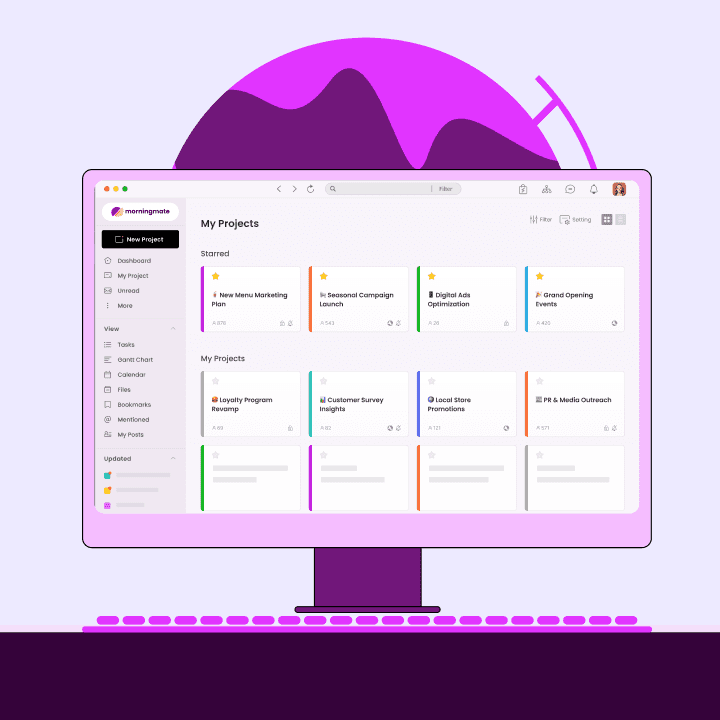
This is exactly where a tool like Morningmate fits in. Morningmate is a lightweight work management tool designed for teams that want structure without complexity. It combines task management, a social-media-style Feed for updates and announcements, and a built-in chat that works like WhatsApp — so your team doesn't have to learn a new way of communicating, they just have to use one place instead of five.
The Communication Problem Is Bigger Than You Think
Gallup's workplace research consistently finds that unclear communication and lack of role clarity are among the biggest contributors to employee disengagement — particularly in small and growing companies where formal systems haven't caught up with team size. When your only communication channels are personal WhatsApp groups and email, important context gets lost, decisions don't get documented, and new team members can never catch up.
An HR app won't solve that. It tracks that someone was hired — it doesn't help them understand what's happening on the team, what projects they're joining, or where to find past decisions.
How to Use Both Together: A Practical Setup for Small Teams
The good news is that you don't have to choose. HR apps and work management tools don't overlap — they complement each other. Here's a simple way to think about splitting responsibilities across your stack.
Let Your HR App Handle
Employee records, contracts, and document storage
Leave requests and approvals
Attendance and time tracking
Onboarding paperwork and compliance checklists
Payroll data (if supported)
Let Your Work Management Tool Handle
Task assignment and deadline tracking
Project status updates and team visibility
Day-to-day team communication and file sharing
Cross-team coordination and priorities
Knowledge sharing and team announcements
When a team member goes on leave, your HR app records it — but your work management tool is where you reassign their tasks, notify the team, and make sure nothing falls through. Both layers need to exist. One without the other leaves you with either great records and messy execution, or organized work and no people data.
A Simple Onboarding Example
Say you're onboarding a new operations hire. Your HR app handles the paperwork — contract signing, policy acknowledgment, adding them to payroll. But on day one, that person still needs to know: what are their actual responsibilities this week? Who do they talk to? Where do they find past decisions and project context?
That's where having a central workspace in a tool like Morningmate makes a difference. New team members can scroll the Feed to catch up on recent updates, get assigned their first tasks with clear context, and message teammates directly — all without needing to be added to five different WhatsApp groups and forwarded a month of email chains. For teams used to managing remote team communication, this kind of structured onboarding experience is a real differentiator.
Signs Your Team Has Outgrown "Just HR Apps"
If you're not sure whether you need a work management layer yet, here are some honest signals that you've crossed that threshold:
You can't quickly tell who's working on what without asking in a group chat
Important updates get buried in WhatsApp or email within hours
New hires take more than a week to understand what's happening across the team
Projects stall when one person is out because nobody else has context
You've had a "wait, I thought you were handling that" moment more than once this month
Decisions get made verbally or in DMs and then can't be found later
Any one of these is a signal. More than two means you've already been paying the cost of a missing work management layer — in time, in frustration, and in things that fall through the cracks.
Choosing the Right Work Management Tool to Pair With Your HR App
Not every work management tool is the right fit for a small team. Tools like Jira or Asana are powerful, but they come with setup overhead and a learning curve that non-technical teams often struggle with. If adoption is low, the tool doesn't work — no matter how many features it has.
The criteria that matter most for small teams are simplicity, visibility, and communication. You need something your whole team will actually open every day — not a complex system that only managers understand how to navigate.
Morningmate is built with exactly this in mind. Trusted by over 550,000 people globally, it's designed for teams that need real structure without the complexity of enterprise tools. The Feed view gives everyone a shared view of what's happening — similar to a social media timeline — so updates don't get buried. Tasks live alongside conversations, and the built-in chat means teams aren't splitting their communication across three different apps. For an operations lead or a business owner trying to get visibility across a growing team, that kind of unified view is worth more than a dozen separate integrations. You can explore how teams use it for work management for small teams to get a clearer picture of the day-to-day difference it makes.
Quick Reference: Free HR Apps vs. Work Management Tools
Here's a side-by-side summary to clarify what each type of tool is actually solving:
The table makes it plain: these tools aren't competing. They're covering different ground entirely. A small team that only has one of them is leaving real operational gaps open — and usually filling those gaps with group chats and email, which creates its own problems.
The right move isn't to find one tool that does everything. It's to be clear-eyed about what each category of tool actually solves, pick the best free option for each, and make sure the two work alongside each other without creating duplicate work. When you get that right, your team has both the people data and the work structure to operate without constant firefighting — and that's a better foundation for growth than any single app can give you.
Function | Free HR App | Work Management Tool |
|---|---|---|
Employee records | ✓ | ✗ |
Leave tracking | ✓ | ✗ |
Task assignment | ✗ | ✓ |
Project visibility | ✗ | ✓ |
Team communication | Limited | ✓ |
File sharing in context | ✗ | ✓ |
Onboarding paperwork | ✓ | ✗ |
Work status updates | ✗ | ✓ |
Knowledge management | ✗ | ✓ |