Project Management

Construction teams run on coordination. A missed update about a material delivery, a foreman who didn't get the revised blueprint, a subcontractor waiting on an approval that's buried in someone's inbox — any one of these can stall a job site for hours or days. And yet, most construction teams without enterprise software are still trying to hold all of this together with WhatsApp group chats, email threads, and spreadsheets.
It's a surprisingly common situation. Enterprise platforms like Procore or Oracle Primavera are powerful, but they're also expensive, complex to implement, and frankly overkill for small to mid-sized construction outfits. So teams end up stuck in the middle — too large to wing it informally, too small to justify a six-figure software investment.
The good news is that the gap between "chaos" and "enterprise software" is much smaller than most people think. With the right approach and the right lightweight tools, construction teams can get serious about coordination without serious overhead. Here's what that actually looks like in practice.
Why Construction Teams Struggle Without a Central System
Construction work is inherently multi-party. You've got project managers, site foremen, subcontractors, suppliers, and clients all needing different pieces of information at different times. When there's no central system, each of those parties ends up creating their own informal one — usually a WhatsApp group or an email chain — and those systems don't talk to each other.
According to McKinsey's research on construction productivity, the construction industry has seen some of the weakest productivity gains of any sector over the past two decades. A major contributing factor is poor information flow between project stakeholders. Work gets duplicated. Decisions get made without full context. And when something goes wrong, nobody can trace where the breakdown happened.
For teams without enterprise software, the default response to this problem is to add more messages — more check-ins, more status updates, more follow-ups. But volume isn't the same as clarity. More messages in a WhatsApp thread doesn't make information easier to find; it makes it harder.
The Real Cost of Scattered Communication on a Job Site
Think about what a typical workday looks like for a site manager running a project without a proper system. They start the morning checking three different WhatsApp groups, their personal email, and maybe a shared Google Drive folder. By 8am, they've already got twelve unread messages across four platforms, and they haven't even left the site office yet.
This kind of fragmented communication doesn't just waste time — it creates risk. Gallup has consistently found that unclear expectations and poor communication are among the top drivers of employee disengagement and error rates. In construction, where physical safety and project timelines are on the line, those errors carry real consequences.
Common problems that show up when construction teams lack centralized communication include:
Revised drawings shared in one chat that not everyone is part of
Task ownership that's verbally agreed on but never formally tracked
Approval requests that get buried under unrelated messages
Subcontractors working from outdated instructions because the update never reached them
No clear record of what was decided, when, and by whom
Each of these isn't just an inconvenience — it's a potential day of lost productivity, a rework cost, or a client dispute waiting to happen.
What Construction Teams Actually Need (That Isn't Enterprise Software)
Before jumping to solutions, it helps to be clear about what the actual requirements are. Most construction teams without enterprise software don't need advanced scheduling algorithms or BIM integration. What they actually need is much simpler:
One place where tasks are assigned and tracked
A shared space for updates that the whole team can see
A reliable way to share and store files like drawings and permits
A communication channel that separates work conversations from personal ones
Enough visibility for managers to see what's happening without micromanaging
That's a manageable list. And it's well within reach for teams that are willing to adopt a lightweight work management tool rather than waiting until they can afford enterprise software.
Task Management That Field Teams Will Actually Use
The biggest failure mode for construction teams adopting new tools is choosing something too complicated. If the foreman needs a training session to log a task update, adoption will collapse within two weeks. Whatever system you use needs to be intuitive enough that someone who isn't tech-savvy can pick it up on their first day.
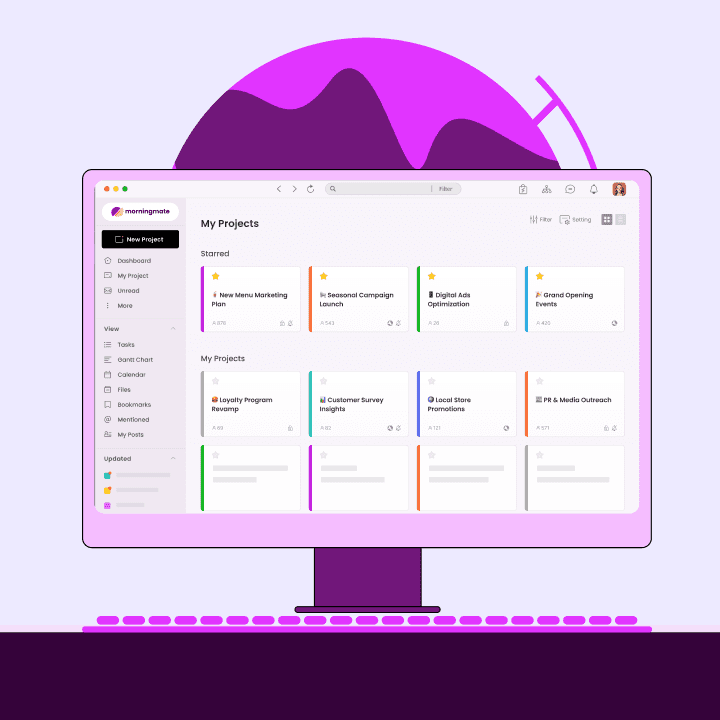
This is where tools like Morningmate offer a practical middle ground. Morningmate is a lightweight work management tool built around a familiar social-media-style feed, which means most people understand how to use it immediately — without documentation or onboarding sessions. Tasks can be created, assigned, and tracked in the same place where updates are posted, so nothing gets siloed.
For a construction team, this might look like a project manager posting a daily site update in the team feed, attaching the day's delivery schedule as a file, and assigning follow-up tasks directly from that same post. Everyone sees it. Everyone knows what they're responsible for. No separate email required.
Communication That Stays Separate From Personal Messaging
One of the persistent problems with using WhatsApp for construction project coordination is that work conversations bleed into personal life — and personal life bleeds into work. There's no clean separation, which means important updates get missed because they arrived at 10pm, or context gets lost because the chat moved on by morning.
A dedicated work communication channel solves this not by adding complexity, but by creating a boundary. Morningmate includes a built-in chat feature with an interface that feels similar to WhatsApp, which means your team doesn't have to learn a new way to communicate — they just do it in a space that's organized around work. Conversations stay searchable, files stay attached to the right threads, and nothing important disappears into a personal inbox.
File and Document Management Without the Mess
Construction projects generate a significant volume of documents — site plans, permit applications, inspection reports, supplier invoices, safety briefings. When these live in scattered email attachments and personal Google Drive folders, finding the right version of the right document at the right moment becomes its own project.
A centralized file management system, even a simple one, changes this completely. When files are attached to tasks or project updates, they're immediately contextual — you know why that document exists, who shared it, and what action it's connected to. That's a level of organization that email and personal cloud storage simply can't replicate.
A Practical Setup for Construction Teams Without Enterprise Software
If your team is ready to move away from WhatsApp-and-email chaos but isn't ready for enterprise software, here's a straightforward structure that works well for construction project coordination.
Create one workspace per project. Keep each job site or contract in its own space so updates, tasks, and files don't bleed across projects.
Set up a daily update habit. Ask whoever runs the site to post a brief morning update each day — what's happening, what's needed, any blockers. This becomes the team's shared starting point instead of a flurry of individual messages.
Assign tasks with due dates and owners. Every action item that comes out of a meeting or a site visit gets logged as a task. No verbal agreements that live only in someone's memory.
Attach files to the relevant post or task. Instead of sending blueprints by email, attach them to the post or task they're related to. Anyone who needs that drawing knows exactly where to find it.
Use chat for quick questions, the feed for updates. Separate the channel for real-time back-and-forth from the channel for structured updates. This prevents important information from getting buried in chat history.
This kind of structure requires almost no technical setup and very little training. It's the operational foundation that most construction teams without enterprise software are missing — and it's achievable in a day.
Getting Your Team to Actually Adopt a New System
The hardest part of any tool rollout isn't the software — it's the habits. People default to what they know, and for most construction teams, that means WhatsApp. The way you handle the first two weeks of adoption will largely determine whether the new system sticks.
A few principles that help:
Start with the people who will benefit most. Site managers and project coordinators feel the pain of scattered information most acutely. Get them using the tool first, and let the value become visible to the rest of the team.
Don't run two systems in parallel for long. If some updates are still going to WhatsApp and some are going to the new tool, the new tool will lose. Pick a date and make the switch clean.
Lead by example from management. If the project manager posts updates in the tool and references it in meetings, the team will follow. If the manager keeps using email, nothing will change.
Keep it simple at first. Don't try to build out every workflow on day one. Get the daily update habit and basic task assignment working before you add anything else.
Tools like Morningmate are specifically designed to make this transition easier. Because the interface is familiar — the feed looks like social media, the chat looks like WhatsApp — the learning curve is minimal. For non-tech construction teams, that familiarity matters more than any feature list.
When You Might Actually Need Enterprise Software
It's worth being honest: there are scenarios where enterprise construction software genuinely makes sense. If you're managing multiple large-scale commercial projects simultaneously, running a team of hundreds across different regions, or operating in a compliance-heavy environment that requires detailed audit trails and integrations with accounting systems, then a purpose-built platform may be worth the investment and the complexity.
But for the majority of construction teams — small to mid-sized firms managing one to five active projects, field crews that work in shifting configurations, or contractors who collaborate with a rotating set of subcontractors — enterprise software is not the answer to scattered communication. A simpler, more flexible system that your team will actually use is.
The goal isn't to have the most sophisticated tool. The goal is to have fewer things falling through the cracks, more visibility across your projects, and a team that spends less time chasing information and more time doing the work. That's achievable without enterprise software — and often more sustainable without it.