Project Management

Most advice about async-first communication reads like it was written for a distributed engineering team with Slack bots, automated standups, and a dedicated DevOps person to manage it all. If your team sells, services, coordinates logistics, or does anything that does not involve writing code — that advice probably feels like it was meant for someone else entirely.
But here is the truth: async-first communication is not a tech thing. It is a clarity thing. It is about making sure your team does not have to interrupt each other constantly just to stay aligned — and that the right information is findable when someone needs it, not buried in a WhatsApp thread from three weeks ago.
If you manage a small non-technical team — a retail operation, a marketing agency, a property firm, a logistics crew, a school admin office — this is what async-first communication actually looks like in practice. Not the theory. The day-to-day.
Why async matters more than ever for small teams
There is a common assumption that async communication is only necessary for remote or globally distributed teams. But even teams that work in the same office are dealing with fragmented attention, back-to-back schedules, and information scattered across email inboxes, personal phones, and group chats.
Research published in Harvard Business Review found that unnecessary meetings and interruptions cost organizations significant time and energy — and that reclaiming even a few hours per week of focused work dramatically improves both output quality and employee satisfaction. For a small team where every person counts, those hours matter enormously.
Meanwhile, Gallup's ongoing workplace research consistently shows that unclear expectations and poor communication are among the top drivers of disengagement. Async-first communication directly addresses both — when done right, it makes expectations explicit and documentation the norm rather than the exception.
What "async-first" actually means (and what it does not)
Async-first does not mean "never talk to each other." It means that your default is to communicate in a way that does not require the other person to be available right now. You document decisions. You share updates in a shared space. You give context so people can catch up on their own time.
Real-time conversations still happen — for brainstorming, for difficult conversations, for moments that genuinely need back-and-forth. But they are the exception, not the default. The goal is to stop making synchronous communication the load-bearing wall of your entire operation.
For a non-technical team, this shift often requires changing just a few habits. You do not need new technology or a complete overhaul. You need a consistent place for updates, a shared understanding of what belongs where, and the discipline to write things down.
The four pillars of async-first communication for non-tech teams
1. One place for project updates — not a group chat
Group chats are great for quick questions and social banter. They are terrible for project updates. A status shared in a WhatsApp group is gone by tomorrow, buried under reactions and tangential conversations. Nobody can search for it reliably, and anyone who was offline when it was sent has probably missed it.
Async-first teams have a dedicated space for project communication — somewhere updates live permanently, are easy to find, and are organized by context rather than by time. This is the foundation. Without it, everything else falls apart.
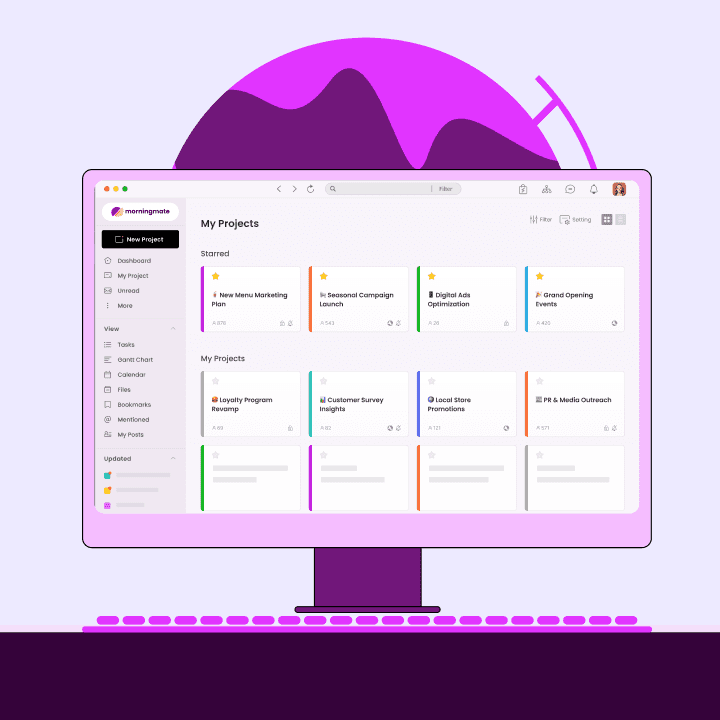
This is exactly where a tool like Morningmate fills a real gap. Morningmate is a lightweight work management platform built around a social-media-style Feed view — team members post updates, share files, and ask questions in dedicated project spaces, and everything stays organized and searchable. It feels familiar to anyone who uses social media, which means even non-technical team members pick it up quickly without a training program.
2. Written norms that everyone actually understands
Async communication only works if people know what is expected of them. That means defining a few simple norms — and writing them down somewhere visible.
Here are examples that work well for small non-technical teams:
Response time expectations: Routine messages get a response within 4 hours during work hours. Urgent matters have a separate escalation path (a direct call or a flagged message).
Where to post what: Project updates go in the project workspace. Quick questions can go in chat. Decisions get documented in the relevant project thread, not left in a DM.
Meeting-free windows: Block certain hours where no one is expected to be available for calls. This protects deep work time and reduces anxiety around response speed.
End-of-day wrap-ups: Team members post a short update at the end of their shift — what they completed, what is blocked, what is next. Takes two minutes and replaces a daily standup for many teams.
You do not need to write a policy document. A shared note or a pinned post in your team workspace is enough to start.
3. Task visibility that does not rely on asking someone
One of the most common pain points for managers of small non-technical teams is not knowing what is actually happening without having to ask. That asking — "Hey, where are we on X?" — is itself a form of interruption. Multiply it across five team members and five projects, and you have burned most of your morning.
Async-first teams make task status visible by default. Every task has an owner, a due date, and a current status. Nobody has to ask — anyone with access can see what is in progress, what is blocked, and what has been completed.
Morningmate's task management features are built with this in mind. Tasks can be assigned, given deadlines, and tracked in a shared view — so managers get the visibility they need without turning every progress update into a separate conversation. It is a practical replacement for the "any updates on this?" messages that clutter most team chats.
4. Files and decisions in context, not scattered across emails
Ask anyone on a non-technical team where the final version of a document is, and you will usually get a hesitant answer. It might be in someone's email. It might be in a folder nobody remembers. It might have been shared in a group chat six weeks ago.
Async-first communication means files and decisions live with the work they belong to. When you finalize the Q3 marketing plan, it gets attached to the relevant project space — not sent as an email attachment that lives only in the inbox of whoever was CC'd.
This is especially important for onboarding new team members and for knowledge management across growing teams. When context is embedded in the workflow, new people can get up to speed without needing a one-hour orientation call for every project.
A practical week-one transition plan for non-technical teams
You do not need a long rollout. Here is a simple first week for a team that is ready to shift toward async-first communication.
Day 1 — Audit your current communication channels. List every place your team currently shares information: email, WhatsApp, Messenger, verbal updates, etc. Identify which channels create the most confusion or information loss.
Day 2 — Choose one shared workspace for project updates. Pick a tool and set up spaces for your active projects. The tool matters less than the consistency. Commit to posting updates there instead of in a group chat.
Day 3 — Write three simple norms. Response time expectations, where to post what, and how to flag urgent matters. Share them with the team.
Day 4 — Assign owners and due dates to active tasks. Go through current work and make sure every open task has a named owner and a date. This alone will surface a surprising number of ambiguities.
Day 5 — Run your first async end-of-week update. Instead of a Friday meeting, ask each person to post a short wrap-up in the shared workspace. Read them, respond with any questions, and notice how much ground you covered without a single scheduled call.
Common mistakes non-technical teams make when going async-first
The biggest mistake is keeping the old channels running in parallel. If people can still get answers instantly via WhatsApp, they will never develop the habit of checking the shared workspace. You do not have to delete anything — but you do need to redirect clearly and consistently.
The second mistake is treating every update like a formal report. Async updates do not need to be polished. A two-sentence note — "Finished the supplier call, they confirmed delivery for Thursday. Waiting on the revised quote before we move forward." — is completely sufficient. The goal is information sharing, not performance.
Finally, watch out for async overload. If every small decision requires a written thread with multiple replies, people will revert to calling each other. Keep the bar for async low, and reserve longer threads for decisions that genuinely benefit from a paper trail.
What changes when your team goes async-first
McKinsey's research on organizational communication highlights that teams with clearer information flows and fewer unnecessary interruptions consistently outperform those relying on ad hoc, real-time-only communication — across industries, not just in tech.
For a small non-technical team, the change often shows up as something quieter: less stress at the start of the day, fewer "sorry, what did I miss?" moments, managers who can actually see what is happening without micromanaging, and team members who feel clearer on their priorities.
It also makes part-time workers, shift workers, and anyone who is not always online feel genuinely included — because the information is there when they arrive, not locked inside someone else's head or a conversation they missed.
Morningmate was built with exactly this kind of team in mind — the operations staff, the project coordinators, the small business owners who need a central place to manage work without adopting a tool that requires IT support to configure. The built-in chat sits alongside task management and file sharing in one interface, so teams can move away from personal messenger apps without losing the conversational feel they are used to.
Going async-first is not about doing less talking. It is about making every conversation count — and making sure the work speaks for itself, even when you are not in the room.