Project Management

If you've ever searched for a project management tool, you've almost certainly landed on ProofHub, Teamwork, or Nifty. They show up in every comparison article, every "best tools for teams" roundup, and every Reddit thread about getting work organized. They're well-built products — and for the right team, they do exactly what they promise.
But here's the thing: they were built with a very specific kind of team in mind. Creative agencies, client-facing studios, and project-based businesses with billable hours, client portals, and retainer tracking baked into their workflows. If that's not you, you're probably paying for a lot of features you'll never use — while still struggling to get your team on the same page.
This article breaks down exactly why agency-focused project management tools don't translate well to other types of teams, what actually goes wrong when you try to force-fit them, and what to look for instead. If your team is growing, hybrid, or simply tired of juggling email threads and WhatsApp groups, this one's for you.
The Agency DNA Problem
ProofHub, Teamwork, and Nifty weren't built in a vacuum. They evolved out of a real pain point — agencies managing multiple clients, deadlines, and deliverables at once. That origin story shapes everything: the interface, the feature set, the pricing model, even the onboarding experience.
Teamwork, for example, is heavily oriented around client billing, time tracking, and project profitability. ProofHub leans into proofing and approval workflows — useful when you're sending creative assets to a client for sign-off, less useful when you're running internal operations. Nifty positions itself around milestones and roadmaps, which works beautifully for a product agency but feels overly structured for a 20-person logistics company just trying to keep track of who's doing what.
The result is that non-agency teams — operations leads, business owners, HR teams, retail managers — end up either overwhelmed by complexity or stuck ignoring most of the tool and reverting to email anyway.
What "Complexity Tax" Actually Costs Your Team
There's a real cost to using software that's more complicated than your work actually needs. McKinsey research has consistently found that employees spend a significant portion of their workweek just navigating communication and coordination — searching for information, following up on updates, and switching between tools. When your project management software adds friction instead of removing it, that number gets worse, not better.
Think about what happens when you roll out a tool like Teamwork to a non-technical team. You build the workspace, set up the projects, explain the difference between tasks and subtasks and milestones. Then a week later, half the team is still updating each other on WhatsApp because the tool felt too unfamiliar. That's not a training problem — it's a design problem.
Harvard Business Review has noted that collaboration overload — too many tools, too many channels, too many places to look — is one of the biggest drains on employee productivity. Adding a powerful but confusing tool to the mix doesn't fix the overload. It deepens it.
The Adoption Cliff
Most project management tools fail not at the demo stage, but at the adoption stage. A tool that looks great in a sales presentation can become a ghost town two months after launch if people don't find it intuitive enough to make part of their daily routine.
Agency-focused tools are particularly prone to this with non-agency teams because the interface assumes a certain level of familiarity with project management concepts. Gantt charts, burndown rates, sprint planning — these are second nature in a software agency. They're foreign territory to a property management firm or a small manufacturing operation.
Where These Tools Fall Short for Non-Agency Teams
Let's get specific. If your team isn't a client-facing agency, here are the friction points you're most likely to run into with tools like ProofHub, Teamwork, or Nifty.
Overly Structured Workflows
Agency tools are built around project phases, client deliverables, and approval chains. For internal operations teams, this structure becomes a straitjacket. Not every update needs to live inside a formal project. Not every task has a client attached to it. When your tool forces you to create a project before you can assign anything, simple work gets complicated fast.
Communication Lives Outside the Tool
One of the biggest gaps in agency-oriented platforms is that they treat task management and team communication as separate worlds. You manage work in the tool, but you still message your team on Slack or WhatsApp. That separation means context gets split across platforms — a decision made in a chat that never makes it into the project record, or a file shared in email that no one can find six weeks later.
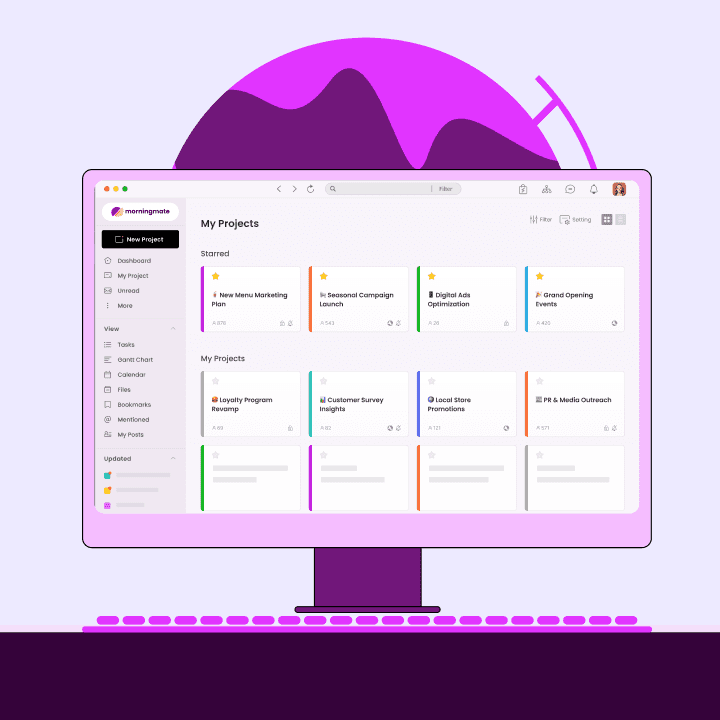
This is exactly the problem that tools like built-in team communication platforms are designed to solve. Morningmate, for instance, is a work management tool that combines task management with a built-in chat that works like a familiar messaging app — so your team's conversations and their work happen in the same place, not across three different tabs. For non-technical teams especially, that familiarity lowers the adoption barrier significantly.
Pricing Models That Don't Scale Sensibly
Teamwork and ProofHub both have pricing structures that make sense if you're billing clients and tracking project profitability. For internal teams, you're paying for billing features, client portals, and reporting dashboards you'll never open. As your team grows, you scale into pricing tiers designed for agency complexity — even if your actual needs are much simpler.
Built for Output Tracking, Not Team Visibility
Operations leads and business owners don't just need to know if a deliverable is done. They need to see what their team is working on right now, where things are getting stuck, and how workload is distributed. Agency tools optimize for client-facing output tracking. They're less useful for the kind of internal visibility that a growing company's leadership team actually needs day to day.
What Non-Agency Teams Actually Need
The good news is that the requirements for non-agency teams are actually pretty clear once you strip away the agency-specific noise. Here's what actually matters.
Simple task assignment and tracking — anyone on the team should be able to create a task, assign it, set a due date, and follow up. No training course required.
Team communication in context — messages, files, and decisions should live alongside the work they relate to. Not in a separate app.
Visibility across teams — managers and executives need a way to see what's in progress across departments without having to chase updates or schedule status meetings.
Low learning curve — the interface should feel familiar, not like a new system that requires an onboarding program to roll out.
Centralized files and knowledge — no more hunting through email attachments or trying to remember which WhatsApp group had the right document.
Notice what's not on that list: client portals, time-billing, Gantt chart exports, or sprint velocity reports. Those are agency requirements. Most teams don't need them — and paying for them while lacking the basics is a bad trade.
The Real Alternative: Simpler, Not Weaker
There's a common misconception that simpler tools are less powerful. In practice, the opposite is often true for non-agency teams. A tool your whole team actually uses every day will always outperform a feature-heavy platform that half your team ignores.
Gallup's workplace research has repeatedly shown that clarity, communication, and accountability are the core drivers of team performance — not the sophistication of the software you're running. The best tool is the one that makes those three things easier, not the one with the most tabs in the sidebar.
This is where Morningmate was built for a different kind of team. Its Feed view presents work updates in a format that looks and feels like a social media feed — something every team member already knows how to navigate, whether they're in the office, remote, or on a job site. Tasks, updates, and shared files surface naturally without requiring anyone to dig through project hierarchies or figure out which module holds what.
How to Choose the Right Tool for Your Team
Before signing up for any project management tool — agency-focused or otherwise — run through this quick checklist with your team's real situation in mind.
Who will actually use this daily? If your team includes people who aren't project managers by role, the tool needs to be intuitive enough for them without training.
Do you have external clients who need access? If yes, a client portal feature matters. If no, you're paying for something you won't use.
Where does your team currently communicate? If the answer is WhatsApp or email, you need a tool that can replace that — not just sit alongside it.
What's your visibility need? Do managers need a quick overview of team workload, or detailed project reporting? Match the tool to the actual question you're trying to answer.
How fast do you need this live? A tool that takes two months to configure and roll out will lose to a simpler tool that's running in a week.
If you answer these questions honestly and find that you don't need client portals, billing reports, or complex sprint planning, then agency-focused tools aren't just overkill — they're likely to hurt your adoption rate and create more fragmentation, not less.
The Bottom Line on Agency Tools vs. Everyone Else
ProofHub, Teamwork, and Nifty are good tools. But good tools built for agencies don't automatically become good tools for operations teams, growing SMBs, hybrid companies, or any team whose work doesn't look like a client retainer. The complexity that makes them powerful for agencies makes them difficult for everyone else.
The shift worth making isn't from one complex tool to another. It's from a tool that was designed for a different kind of work to one that was built around how your team actually operates. That means fewer features you'll never touch, a faster path to adoption, and a workspace your whole team — not just your project managers — will actually open every morning.
Morningmate is trusted by over 550,000 teams worldwide precisely because it doesn't try to do everything. It does the right things — task management, team chat, file sharing, and work visibility — in a package that feels familiar from day one. For teams that have been burned by tools built for someone else's workflow, that simplicity isn't a limitation. It's the whole point.